Case Record
The following record has been compiled from the available account associated with this case.
The Case
On the night of August 31, 1977, a frightened mother in North London went to investigate a disturbance in her children's bedroom.
What happened next would become one of the most famous alleged hauntings ever investigated.
Peggy Hodgson lived with her children in a council house at 284 Green Street in Enfield.
The family did not live in an isolated mansion.
There was no ancient castle.
No ruined monastery stood nearby.
No elaborate Gothic history was required.
The house was an ordinary semi-detached home on an ordinary London street.
Then the children began complaining that their beds were shaking.
Strange knocking sounds followed.
Furniture appeared to move.
Objects were reportedly thrown across rooms.
Neighbors became involved.
Police officers entered the house.
Newspaper reporters arrived.
Photographers waited for something to happen.
Paranormal investigators began spending enormous amounts of time with the family.
And eventually, one of the children—eleven-year-old Janet Hodgson—began producing a deep, rasping voice that seemed completely unlike her own.
The disturbances continued, with varying intensity, for roughly eighteen months.
By the time they subsided, the Enfield case had accumulated photographs, audio recordings, eyewitness testimony, press coverage, investigator notes and claims of extraordinary physical phenomena.
It had also accumulated something equally important:
Evidence of trickery.
The children were caught attempting to fake some events.
That fact divided investigators then and continues to divide people examining the case today.
For believers, Enfield presents an unusual possibility: a genuine paranormal disturbance complicated by children who occasionally cheated when expected to produce phenomena on demand.
For skeptics, the cheating provides the key to the entire case.
The supernatural explanation is unnecessary.
Nearly fifty years later, the central question remains:
What actually happened inside 284 Green Street?
284 Green Street
The house at the center of the case was located in Enfield, North London.
It was a modest council home occupied by Peggy Hodgson and her children.
Peggy was raising the family after separating from her husband.
The household included daughters Margaret and Janet and sons Johnny and Billy.
Janet, who was eleven when the disturbances began, would eventually become the person most closely associated with the case.
Nothing about the house itself initially suggested that it would become internationally famous.
The family was not operating a paranormal attraction.
The property was not widely known as haunted.
The events did not begin with professional ghost hunters already present.
According to the family's account, they began in a children's bedroom.
August 31, 1977
The traditional starting date of the Enfield Poltergeist is August 31, 1977.
Peggy Hodgson's children were preparing for bed.
Janet and her brother complained that their beds were moving.
Peggy initially had little reason to interpret the complaints as paranormal.
Children make noise.
Children play tricks.
Beds creak.
Houses produce sounds.
But the disturbances continued.
A chest of drawers or similar piece of furniture reportedly moved.
Peggy attempted to push it back.
According to the family's account, it seemed to move again.
Then came knocking.
The sounds appeared to come from walls or other parts of the house.
Peggy became concerned enough to seek help.
The Neighbors
The Hodgsons turned to neighbors.
This is significant because the case quickly expanded beyond the testimony of a single family.
Vic Nottingham, a neighbor, reportedly entered the house and heard unusual noises.
Attempts were made to locate an ordinary source.
Could the knocking come from pipes?
Neighbors?
The walls?
Someone outside?
No immediately obvious explanation satisfied the people present.
Eventually, the police were called.
The Police Arrive
The involvement of police became one of the most frequently cited pieces of evidence supporting the Enfield case.
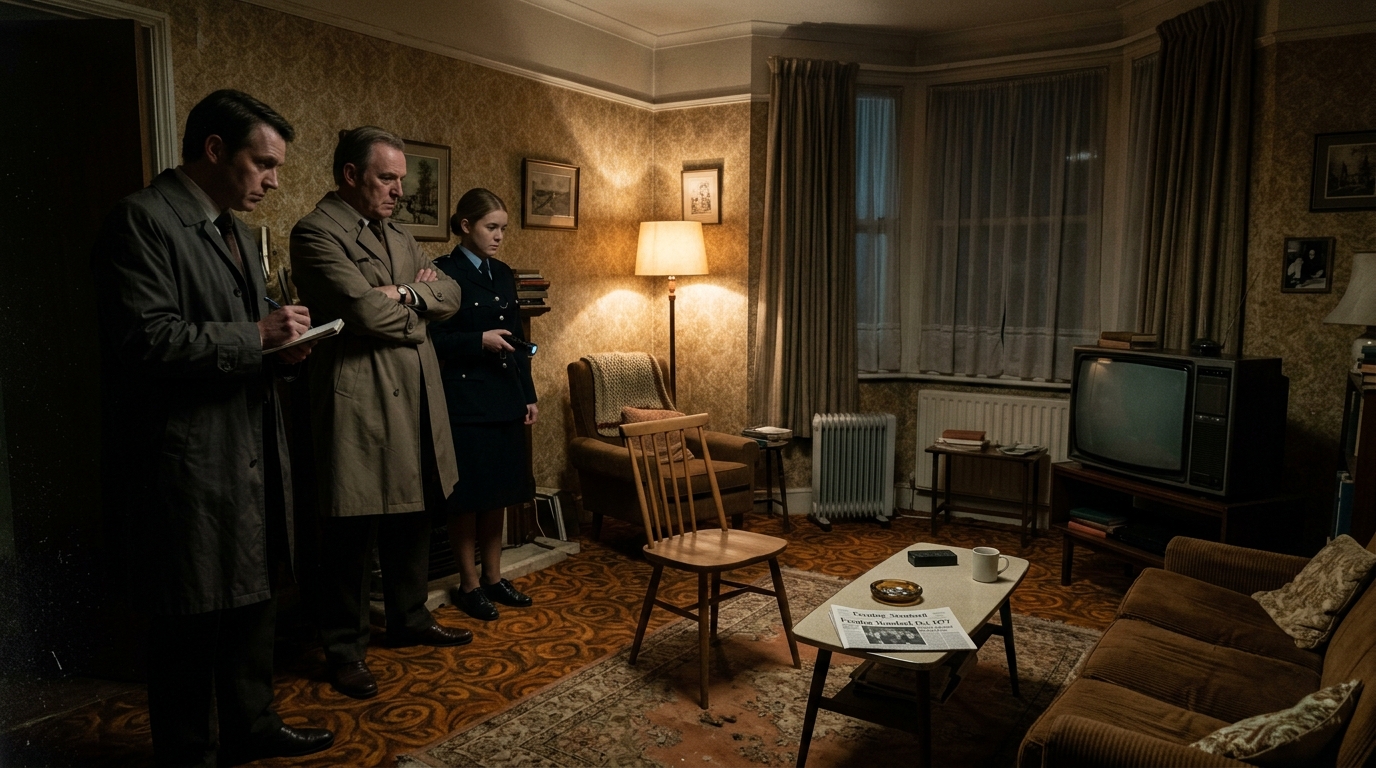
Two officers responded to the house.
They were not paranormal investigators.
They had no professional reason to establish the existence of ghosts.
Their task was considerably more ordinary: determine whether someone was causing trouble or whether there was some other problem requiring police attention.
One of those officers, Woman Police Constable Carolyn Heeps, later gave an account of something unusual.
She reported seeing a chair move.
The Moving Chair
According to the officer's statement, a chair appeared to move across the floor without anyone visibly touching it.
The movement was not proof of a ghost.
The officer did not claim to have seen a spirit push the chair.
She observed movement for which she could not identify an immediate cause.
That distinction matters.
A police officer witnessing an unexplained event is stronger evidence than a later rumor that "the police saw a ghost."
But it remains eyewitness testimony.
The chair was not under controlled laboratory observation.
Hidden physical causes were not conclusively excluded.
No instrument recorded an invisible force.
The police did not open a paranormal investigation.
Still, the presence of an apparently independent witness so early in the case helped give Enfield credibility that many haunting stories lack.
The Story Reaches the Press
The disturbances soon attracted media attention.
The Daily Mirror became involved.
Reporter Douglas Bence and photographer Graham Morris visited the house.
Newspaper involvement transformed the situation.
The Hodgsons were no longer simply a frightened family describing strange noises to neighbors.
The house became a news story.
Photographers attempted to capture the reported phenomena.
Journalists observed the family.
The possibility of publicity introduced another layer of uncertainty.
Attention can document events.
It can also change them.
Children behave differently when adults are watching.
Witnesses become more expectant.
Ambiguous events acquire significance.
And once a haunting becomes newsworthy, everyone involved knows that something extraordinary is expected to happen.
The Society for Psychical Research
The Daily Mirror contacted the Society for Psychical Research, commonly known as the SPR.
Founded in 1882, the organization had a long history of investigating claims involving apparitions, telepathy, mediums and other alleged paranormal phenomena.
The SPR was not a church or an exorcism organization.
Its members historically included both believers and skeptics.
The goal, at least in principle, was investigation.
The Enfield case soon attracted one investigator who would devote an extraordinary amount of time to it.
His name was Maurice Grosse.
Maurice Grosse
Maurice Grosse was an inventor and investigator associated with the Society for Psychical Research.
He arrived at Green Street shortly after the disturbances began.
Grosse would become one of the central figures in the entire case.
He spent extensive periods inside the house.
He interviewed family members.
He recorded events.
He listened to knocks.
He observed Janet.
He attempted experiments.
And he became convinced that at least some of the reported phenomena could not be explained by ordinary trickery.
Grosse was not a detached observer who visited once and left.
He became deeply involved with the family and investigation.
That gave him enormous firsthand exposure to the case.
It also created a potential problem.
The longer an investigator becomes emotionally and intellectually invested in a case, the harder complete objectivity may become.
Grosse's Personal Background
There was another element of Maurice Grosse's life that critics later considered relevant.
Before the Enfield investigation, Grosse had suffered the death of his daughter Janet in a motorcycle accident.
The coincidence of names—his deceased daughter and Janet Hodgson—has sometimes been emphasized in discussions of his involvement.
It would be unfair to claim that grief automatically invalidated his observations.
Personal loss does not make someone incapable of investigating evidence.
But Grosse's interest in survival after death was not purely academic.
He had personal reasons to care deeply about the possibility that consciousness might continue after death.
Skeptics argue that this could have influenced his interpretation of ambiguous events.
Supporters argue that it merely explains why he was willing to devote so much time to investigating them.
Guy Lyon Playfair
Another SPR investigator, Guy Lyon Playfair, later joined the case.
Playfair spent substantial time at Green Street and eventually became one of Enfield's best-known chroniclers.
He later wrote This House Is Haunted, a detailed account of the investigation.
Grosse and Playfair reported numerous events that they believed were difficult to explain through fraud or ordinary physical causes.
Their work forms much of the foundation for the pro-paranormal interpretation of Enfield.
But their conclusions were never universally accepted, including within the wider psychical research community.
What Is a Poltergeist?
The word "poltergeist" comes from German terms often translated roughly as "noisy spirit."
Unlike the traditional image of a ghost appearing as a visible dead person, poltergeist cases usually center on physical disturbances.
Knocking.
Banging.
Objects moving.
Furniture shifting.
Doors opening.
Items being thrown.
Lights or electrical devices behaving strangely.
In many historical cases, the activity appears to center around a particular person, often an adolescent.
Paranormal researchers sometimes call that person the "focus."
At Enfield, the focus increasingly appeared to be Janet Hodgson.
Janet Hodgson
Janet was eleven years old when the disturbances began.
Over time, many of the most dramatic events occurred around her.
Objects allegedly moved near Janet.
She was photographed apparently airborne.
Witnesses reported strange behavior.
Most famously, a deep male voice appeared to speak through her.
This concentration of phenomena around Janet can be interpreted in radically different ways.
For paranormal investigators, she may have been the focus of genuine poltergeist activity.
For skeptics, she was the obvious source of the tricks.
The same evidence supports both narratives depending on how the case is interpreted.
The Knocking
Knocking sounds were among the earliest and most persistent phenomena.
Investigators attempted to communicate through knocks.
Questions could be asked.
Knocks could apparently respond.
This type of phenomenon has a long history in spiritualism.
It is also easy to fake.
Hands, feet, furniture, walls and hidden movements can create convincing sounds.
Investigators therefore attempted to determine where the noises originated.
At times, they believed the knocks occurred under conditions that made obvious trickery difficult.
Critics remained unconvinced.
Without continuous controlled observation, identifying the precise source of a sound inside a crowded house is extremely difficult.
Objects Thrown Through the House
Small objects were reportedly thrown or displaced.
Toys.
Marbles.
Pieces of Lego.
Other household items.
Some witnesses described objects apparently changing direction or moving without an obvious thrower.
This became another central part of the case.
But thrown objects present the same fundamental evidentiary problem as knocks.
If observers see only the object's flight and not the moment it begins moving, a hidden human throw remains possible.
A paranormal explanation requires more.
Investigators need to establish that no person could have launched the object.
That standard is extremely difficult to meet in an occupied family home.
The Lego Incident
Maurice Grosse and other investigators described incidents involving small objects, including pieces of Lego or similar toys, apparently appearing or being thrown unexpectedly.
In some accounts, objects seemed hot when recovered.
Such details have been interpreted as evidence of unusual physical processes.
But they were not documented under conditions capable of excluding ordinary handling.
The more extraordinary the claimed property of an object, the stronger the controls needed to establish it.
Enfield rarely provided laboratory conditions.
It provided a chaotic household.
Furniture Movement
Furniture reportedly shifted on multiple occasions.
The moving chair witnessed by the police officer is the best-known example.
Other reports involved beds, drawers or heavier objects.
A large piece of furniture apparently moving by itself sounds much harder to fake than a thrown toy.
But the same questions remain.
Was the entire object visible?
Were all people visible?
Could someone push it with a foot?
Was the floor uneven?
Could vibration contribute?
Was the movement as dramatic as later retellings suggested?
In some incidents, witnesses believed ordinary explanations were inadequate.
Others were much less impressed.
Doors and Household Disturbances
Doors reportedly opened or closed.
Objects disappeared and reappeared.
Lights and equipment behaved unexpectedly.
Beds shook.
Banging sounds moved around the house.
Taken together, the events created an atmosphere in which almost any unusual occurrence could become part of the haunting.
This is a known problem in prolonged investigations.
Once observers expect anomalies, ordinary household events receive heightened attention.
A pipe knocking is no longer just a pipe.
A misplaced object becomes an apport.
A child's prank becomes possible spirit activity.
That does not mean nothing unusual occurred.
It means that separating signal from noise becomes increasingly difficult.
The Apparent Levitation
Some of the most famous photographs from Enfield show Janet apparently airborne above or beside her bed.
These images are frequently described as photographs of levitation.
At first glance, they are dramatic.
Janet appears suspended in the air.
Her body is elevated.
Her hair and clothing suggest movement.
Believers have presented the photographs as rare visual evidence of poltergeist activity.
Skeptics see something much simpler.
A child jumping from a bed.
Graham Morris's Photographs
Daily Mirror photographer Graham Morris used a camera capable of taking sequences of photographs.
This produced several images of Janet apparently moving through the air.
The photographs are genuine photographs in the ordinary sense.
There is no need to allege digital manipulation; digital photography did not exist.
The question is what they show.
A paranormal force lifting Janet?
Or Janet physically jumping?
When individual frames are isolated, the images can look astonishing.
When considered as a sequence, critics argue that they resemble ordinary jumping behavior.
The photographs therefore illustrate one of the core problems of paranormal evidence.
A photograph can accurately record an event while leaving its cause completely ambiguous.
Was Janet Thrown From the Bed?
Supporters argued that Janet was sometimes propelled with force inconsistent with an ordinary jump.
Witnesses described her being thrown or lifted.
Janet herself later described experiences of being moved.
But no photograph independently establishes an invisible force acting on her.
A human body above a mattress is not, by itself, evidence of levitation.
To establish levitation, investigators would need to exclude jumping, falling, being thrown by another person or other ordinary mechanisms.
The surviving photographs do not accomplish that conclusively.
The Voice Begins
If the moving objects made Enfield famous in Britain, the voice helped make it internationally legendary.
Janet began producing an extraordinarily deep, rough voice.
It sounded male.
It was dramatically different from her normal speech.
The voice answered questions.
It swore.
It joked.
It made statements about itself.
And eventually it claimed an identity.
A man named Bill.
"Bill"
The voice claimed to be an elderly man associated with the house.
In later accounts, it identified itself as Bill Wilkins.
The voice reportedly described having died in the house.
One of the most famous statements attributed to it described going blind, suffering a hemorrhage and dying in a chair downstairs.
The possibility that a dead former occupant was speaking through an eleven-year-old girl became one of the strongest paranormal claims associated with Enfield.
Later, researchers sought to determine whether a real man matching the description had lived and died there.
Bill Wilkins
A previous resident named Bill Wilkins had indeed reportedly died in the house years earlier.
This apparent correspondence became extremely important to believers.
If Janet could provide accurate information about a deceased man she had no way of knowing, the voice might represent something more than performance.
But the evidentiary question is not merely whether a Bill Wilkins existed.
It is whether the information Janet provided was specific, accurate and demonstrably unavailable to her through ordinary means.
That is much harder to establish.
Families know things about houses.
Neighbors talk.
Children overhear conversations.
Information can be acquired and forgotten consciously while remaining available in memory.
The correspondence is intriguing.
It is not proof of communication with the dead.
Where Did the Voice Come From?
Investigators attempted to determine physically how Janet produced the voice.
One explanation was ventriloquism or a form of speech created using structures higher in the vocal tract.
Janet could apparently sustain the rough voice for extended periods.
Supporters argued that producing such a voice for so long should have caused severe throat irritation if it were ordinary vocalization.
They also claimed that specialists found aspects of the voice unusual.
Skeptics demonstrated that people can produce remarkably deep or distorted voices voluntarily.
The fact that an eleven-year-old girl's voice sounds unlike an adult man's normal speech does not establish that the adult man is dead.
Janet's Mouth
Witnesses sometimes emphasized that Janet's lips appeared barely to move while the voice spoke.
That encouraged comparisons with possession.
But ventriloquial techniques specifically involve speaking with limited visible lip movement.
A child experimenting with unusual vocalizations does not need to be a professionally trained ventriloquist to produce a convincing effect, especially in a dim room surrounded by expectant adults.
The relevant question is whether Janet could produce the voice herself.
Evidence suggests that she could.
That does not prove she produced every instance consciously.
But it substantially weakens claims that the voice itself demonstrates a supernatural source.
The Voice Under Observation
Investigators recorded hours of audio.
They questioned the voice.
They attempted to catch Janet cheating.
At times, observers believed they had excluded ordinary vocal production.
At other times, skeptics considered the mechanism obvious.
The enormous amount of recorded material is one reason Enfield remains unusual among haunting cases.
The voice is not merely something witnesses remembered decades later.
Recordings exist.
Anyone can hear versions of the phenomenon.
But audio proves that a voice occurred.
It does not prove who—or what—produced it.
Possession or Poltergeist?
The voice gradually changed how the case was perceived.
Moving furniture and knocking fit the traditional definition of a poltergeist.
A dead man apparently speaking through a child resembles possession or mediumship.
These are not necessarily the same paranormal claim.
Investigators interpreted the phenomenon differently.
Some believed an external intelligence was communicating.
Others thought Janet's unconscious mind might somehow be responsible.
Religious interpretations introduced the possibility of spirits or demonic influence.
Popular culture later emphasized possession far more heavily than some of the original investigators did.
The Children Are Caught Cheating
This is the fact no serious account of Enfield can avoid.
Janet and the other children were caught attempting to fake phenomena.
At least some incidents were fraudulent.
The children themselves eventually acknowledged that they had sometimes played tricks.
For skeptics, this is devastating.
If the alleged focus of a poltergeist is caught manufacturing paranormal events, why accept the remaining events as genuine?
For Grosse and Playfair, the situation was more complicated.
They believed the children occasionally cheated.
They did not believe that cheating explained everything they had witnessed.
Why Would They Fake Anything?
There are several obvious possibilities.
Attention.
Entertainment.
Boredom.
Testing investigators.
Responding to pressure.
Once adults, journalists and paranormal researchers repeatedly visit a house because unusual things happen, children understand what everyone is waiting for.
If nothing happens, the atmosphere becomes disappointing.
A prank can restore attention immediately.
This does not require the entire case to have begun as a calculated hoax.
A child could experience or report something genuinely frightening and later begin manufacturing additional events.
Conversely, early successful tricks could encourage increasingly elaborate ones.
Both are psychologically plausible.
The "They Only Faked Two Percent" Claim
A frequently repeated defense of the case is that the children admitted faking only a very small percentage of the phenomena, sometimes characterized as roughly two percent.
This claim should be treated cautiously.
There is no objective ledger containing every alleged Enfield event with a scientifically established classification of "real" or "fake."
A child's later estimate of how often she cheated cannot establish the authenticity of everything else.
If a witness admits fabricating some events, the admission affects the reliability of the entire evidentiary record.
It does not prove every event was fake.
But it changes the burden of proof.
The Problem of Selective Cheating
Suppose a hundred strange incidents are reported.
Five are conclusively exposed as tricks.
What follows?
One interpretation is:
Ninety-five remain unexplained.
Another is:
We have demonstrated that the alleged witnesses possess both the ability and willingness to manufacture the exact type of evidence under investigation.
Neither conclusion automatically settles the other ninety-five incidents.
But scientifically, confirmed deception must increase caution.
This is perhaps the central epistemological problem of the Enfield case.
The Cupboard Incident
One particularly important episode involved investigators attempting to observe Janet under more controlled circumstances.
Critics reported instances in which she was caught bending spoons or attempting to create phenomena herself.
There were also accounts of recording equipment capturing behavior inconsistent with the family's claims.
These incidents strengthened the skeptical interpretation.
Supporters responded that the documented tricks were obvious and childish, while other phenomena were far more difficult to reproduce.
That defense is possible.
It is also impossible to test retrospectively for every event.
Hidden Cameras
Investigators and media personnel occasionally attempted to observe the children without their knowledge.
This was important because paranormal events often seemed to occur when direct observation was limited.
When subjects know they are being watched closely, phenomena may stop.
Believers sometimes interpret this as a characteristic of poltergeist activity.
Skeptics interpret it as exactly what one would expect from fraud.
The use of hidden observation reportedly caught some suspicious behavior.
That remains a major weakness in the case.
The Problem of Darkness
Many disturbances occurred at night or under imperfect viewing conditions.
This is not surprising.
Families sleep at night.
A haunting involving children's bedrooms will naturally produce nighttime reports.
But darkness also makes observation unreliable.
Hands are harder to see.
Small objects can be thrown unnoticed.
Body movements become ambiguous.
Sounds are harder to localize.
A phenomenon that seems impossible in darkness may become ordinary when the lights are turned on.
Controlled observation matters precisely because human perception is limited.
Investigators in the House
Grosse and Playfair reportedly spent hundreds of hours investigating Enfield.
That amount of observation is frequently cited as evidence that simple fraud could not explain everything.
How could children fool experienced adults for so long?
The answer is that prolonged observation cuts both ways.
More observation provides more opportunities to witness genuine anomalies.
It also provides more opportunities for ordinary events to be interpreted as anomalous.
And investigators who spend months waiting for phenomena may become increasingly invested in the belief that their time is producing meaningful evidence.
Quantity of observation is not the same as quality of control.
Witnesses Beyond the Family
One of Enfield's strongest features is the number of people who reported unusual experiences.
Neighbors.
Police.
Journalists.
Photographers.
Investigators.
Visitors.
Some claimed to witness objects moving or hear unexplained sounds.
This makes the case harder to dismiss as a story invented entirely by one person.
But multiple witnesses do not automatically establish a supernatural cause.
If Janet threw an object while several people failed to see the throw, all of them could honestly report that an object appeared to move by itself.
Witness sincerity and paranormal causation are separate questions.
The Police Evidence Reconsidered
The police officer's moving-chair account deserves particular care because it is often overstated.
A police officer reportedly saw a chair move.
That is noteworthy.
But police officers are trained to observe criminal activity, not to conduct controlled tests of alleged psychokinesis.
The officer did not establish that no physical mechanism could move the chair.
She reported what she saw.
Her testimony strengthens the case that unusual events were genuinely perceived by people outside the family.
It does not establish the existence of a poltergeist.
The Newspaper Evidence
Journalists also witnessed or photographed apparent phenomena.
Again, their presence broadens the witness pool.
But journalists are not neutral measuring instruments.
A sensational haunting is a compelling story.
Newspapers benefit from dramatic material.
That does not mean reporters fabricated what they saw.
It means the media environment cannot be treated as equivalent to a laboratory.
The Daily Mirror helped document Enfield.
It also helped make Enfield famous.
Those roles cannot be completely separated.
The Society for Psychical Research Disagrees
The SPR's involvement is sometimes presented as though the organization officially certified the Enfield Poltergeist as genuine.
That is misleading.
Members disagreed sharply.
Some investigators believed the evidence supported genuine paranormal phenomena.
Others were skeptical.
The Society for Psychical Research was never a monolithic organization in which every member accepted the same interpretation.
Enfield became controversial within the very community studying it.
Anita Gregory
One of the most important skeptical figures was psychical researcher Anita Gregory.
Gregory investigated aspects of the case and became highly critical of the paranormal interpretation.
She believed the evidence for fraud and unreliable observation was substantial.
Her skepticism is important because it did not come simply from someone dismissing the case from afar.
She was associated with psychical research and examined the claims directly.
This demonstrates that disagreement over Enfield existed among people willing to investigate paranormal claims seriously.
John Beloff
Psychologist and psychical researcher John Beloff also examined aspects of the case and was reportedly unimpressed by some of the evidence.
The existence of skeptical reactions from within psychical research complicates the common narrative that only closed-minded outsiders rejected Enfield.
Some people interested in paranormal research concluded that the evidence was weak or contaminated by deception.
That internal disagreement is part of the documented case.
The SPR Committee
The Society for Psychical Research eventually examined the Enfield investigation through a committee process.
The conclusions were not equivalent to declaring the haunting scientifically proven.
Evidence was evaluated with varying degrees of confidence.
Some incidents were regarded by supporters as difficult to explain.
Others were considered unreliable.
This distinction is crucial.
A documented investigation is not the same thing as documented paranormal activity.
Enfield unquestionably produced an investigation.
Whether it produced evidence of a supernatural force remains disputed.
Could the House Itself Explain Some Events?
Ordinary houses make noise.
Heating systems expand and contract.
Pipes knock.
Wood shifts.
Doors respond to air pressure.
Floorboards move.
Neighboring activity can transmit through walls.
A late-1970s council house was not an acoustically isolated environment.
Some early knocking may have had mundane structural causes.
Once the family became frightened, later noises could be interpreted within the existing paranormal narrative.
This cannot explain deliberate object throwing or Janet's voice.
Those require different explanations.
But a single cause does not need to explain every event.
Was There One Enfield Phenomenon?
This is an overlooked question.
People often ask:
"What caused the Enfield Poltergeist?"
That assumes one cause produced everything.
There may have been several.
Ordinary house noises.
Children playing tricks.
Misinterpretation.
Media amplification.
Psychological stress.
Unexplained incidents.
Once all of these are grouped under the label "Enfield Poltergeist," they begin to look like manifestations of a single entity.
They may not have been.
A mixed explanation can be less satisfying than "ghost" or "hoax."
It may also be more realistic.
Psychological Stress
The Hodgson household was under strain.
Peggy was raising children after a marital separation.
The family lived in modest circumstances.
Then the house became filled with journalists, investigators, strangers and constant attention.
Children were repeatedly questioned about frightening events.
That environment itself could affect behavior.
Some researchers have proposed psychological explanations for poltergeist cases in which stress is expressed through unusual behavior.
Such explanations do not require the children to plan a sophisticated long-term fraud.
Behavior can be impulsive, attention-seeking, dissociative or partially conscious.
But psychological explanations should also be used carefully.
Diagnosing people retrospectively without clinical evidence can become as speculative as paranormal theorizing.
The Poltergeist "Focus" Theory
Some parapsychologists have proposed that poltergeist phenomena might represent unconscious psychokinesis rather than spirits.
Under this theory, a psychologically stressed person—often an adolescent—somehow produces physical effects without consciously intending to.
Janet's apparent centrality would fit the pattern described in other alleged poltergeist cases.
This theory has an advantage for believers because it can explain why some phenomena occur without requiring a dead person to be present.
Its disadvantage is much larger.
Reliable psychokinesis of this magnitude has never been scientifically established.
Replacing "ghost" with "unconscious psychic energy" does not remove the need for extraordinary evidence.
Could Janet Have Fooled Everyone?
Not necessarily everyone.
She only needed to fool particular observers during particular events.
A child does not need to maintain a flawless illusion twenty-four hours a day.
If ten ordinary events occur and one unexplained object flies across a room, everyone remembers the object.
If investigators catch a trick later, supporters can separate it from the earlier event.
This creates a case that becomes difficult to falsify.
Every exposed trick is classified as fake.
Every unexposed event remains potentially paranormal.
That methodology inevitably preserves a residue of mystery.
Could Something Genuine Have Happened Too?
Yes—in the narrow logical sense.
Catching someone cheating does not prove that every previous observation was fraudulent.
A person could experience something genuinely strange and later imitate it.
That possibility is one reason Enfield cannot simply be reduced to a single exposed trick.
But possibility is not evidence.
Once deception is established, claims of genuine paranormal activity require particularly strong independent documentation.
That decisive evidence has never emerged.
The Tape Recordings
The surviving recordings are among the most fascinating artifacts from the case.
Listeners can hear Janet's strange voice.
Investigators ask questions.
The voice responds.
Unlike a written description, audio gives modern audiences direct access to part of the phenomenon.
But recordings have limits.
A microphone captures sound.
It does not identify the biological mechanism producing that sound.
Without simultaneous controlled observation, audio cannot determine whether Janet was consciously speaking.
The tapes preserve the mystery.
They do not solve it.
Electronic Equipment
Investigators used recording equipment and other devices in attempts to document events.
Equipment sometimes malfunctioned or behaved unexpectedly.
Such incidents are common in paranormal investigations and frequently interpreted as interference caused by the phenomenon.
But equipment failures are also common ordinary events.
Batteries fail.
Connections loosen.
Tape recorders jam.
Electrical noise occurs.
To establish paranormal interference, investigators need a repeatable relationship between the alleged phenomenon and equipment failure.
Enfield did not provide such controlled evidence.
The Famous Photographs
The Enfield photographs remain among the most recognizable images associated with any alleged haunting.
Janet airborne.
Children reacting.
Bedrooms in disorder.
The images are visually powerful because they appear to freeze impossible events.
But photographs remove time.
A jump and a levitation can look identical for a fraction of a second.
Context must be reconstructed from sequences, witness testimony and physical conditions.
The photographs prove that Janet was photographed off the bed.
They do not prove how she got there.
The Question of Physical Harm
Janet and other family members reportedly experienced physical effects during the disturbances.
Some accounts describe scratches, bruises, forceful movement or sensations of being touched.
Such claims increase the apparent severity of a haunting.
But physical marks are especially difficult to interpret without continuous observation.
A bruise establishes injury.
It does not establish an invisible attacker.
No injury from Enfield provided a distinctive physical signature requiring a paranormal cause.
Was Janet Ever Truly Possessed?
"Possession" is a religious or supernatural interpretation rather than a medical diagnosis established by the evidence.
Janet behaved unusually.
She produced a strange voice.
She made statements attributed to another identity.
None of those facts demonstrates that an external spirit controlled her body.
Human beings can produce altered voices, role-play identities, enter unusual psychological states and behave dramatically without supernatural intervention.
There is no scientific test from the Enfield case establishing possession.
Ed and Lorraine Warren
Modern audiences frequently associate the Enfield case with American paranormal investigators Ed and Lorraine Warren.
That association is largely the result of later popular culture.
The Warrens did visit or have some involvement with Enfield, but they were not the principal investigators of the case.
Maurice Grosse and Guy Lyon Playfair were far more central to the prolonged investigation.
This distinction matters because later dramatizations can make the Warrens appear essential to events they did not lead.
The Conjuring 2
The 2016 horror film The Conjuring 2 introduced the Enfield Poltergeist to an enormous new audience.
The movie is inspired by the real case.
It is not a documentary reconstruction.
Its supernatural narrative, characters and dramatic confrontations should not be treated as historical evidence.
The film prominently features Ed and Lorraine Warren.
The actual investigation centered much more heavily on British investigators, particularly Grosse and Playfair.
The movie also incorporates overtly demonic elements created or greatly expanded for dramatic purposes.
The Nun Was Not Part of the Enfield Case
One of the most recognizable figures associated with The Conjuring 2 is the demonic nun Valak.
There is no historical evidence that Janet Hodgson encountered the demonic nun depicted in the movie.
Valak belongs to the fictionalized cinematic mythology.
This is an important distinction because internet searches increasingly blend the real Enfield case with the film franchise.
The documented case is strange enough without importing fictional demons into it.
The Crooked Man
The Crooked Man sequence from The Conjuring 2 is likewise not evidence from the historical Enfield investigation.
Popular entertainment routinely combines genuine names and locations with invented supernatural imagery.
Over time, viewers can forget which elements originated in case records and which originated with screenwriters.
The same process happened to the Mary Celeste more than a century earlier through fiction.
Enfield demonstrates that mythmaking around documented mysteries continues in the modern era.
Did Anyone Die in the House?
The Bill Wilkins story has made the previous history of 284 Green Street a major subject of interest.
A previous occupant reportedly died there.
But people dying in houses is not unusual, especially over decades of occupancy.
The existence of a deceased former resident does not establish that the resident remained in the house as a ghost.
To connect Wilkins to the phenomena, investigators would need evidence that information attributed to him could not have reached Janet through ordinary means.
That evidence remains disputed.
Did the Family Profit?
Financial motive is often raised in famous paranormal cases.
The Hodgsons did receive extensive media attention.
Books and later productions generated commercial interest around Enfield.
But demonstrating that a case eventually became profitable is not the same as demonstrating that it was originally invented for money.
At the beginning, the family was living in an ordinary council house and dealing with an increasingly disruptive situation.
The more relevant motive for childhood trickery may have been immediate attention rather than a sophisticated financial scheme.
Why Didn't They Leave?
People often ask why a family would remain inside a supposedly haunted house.
The question assumes moving is easy.
For a family in council housing with limited resources, simply purchasing or renting another home may not have been realistic.
Leaving temporarily also does not solve long-term housing needs.
The Hodgsons' continued presence therefore should not be interpreted as evidence that they secretly knew nothing dangerous was happening.
Practical circumstances matter.
Why Didn't the Phenomena Perform on Command?
Investigators repeatedly faced this problem.
When conditions became more controlled, dramatic phenomena often failed to occur.
Believers argue that paranormal events are spontaneous and cannot be commanded like laboratory demonstrations.
Skeptics point out that fraudulent phenomena also disappear under strict observation.
This creates a methodological dead end.
If the phenomenon occurs only when controls are weak, strong evidence can never be obtained.
If it fails under controls, believers can say the phenomenon simply refused to cooperate.
A claim structured this way becomes extremely difficult to test scientifically.
The Burden of Proof
The Enfield case contains many unexplained observations.
But "unexplained" has a precise meaning.
It means the available evidence does not establish the cause.
It does not mean "paranormal."
If an object moves and nobody sees who moved it, the cause is unknown.
A poltergeist is one proposed explanation.
A hidden human action is another.
Misremembered details are another.
An overlooked physical mechanism is another.
The extraordinary explanation requires evidence distinguishing it from those ordinary alternatives.
That is where Enfield remains weak.
The Strongest Evidence for Something Unusual
Supporters of the case can point to several features that deserve serious consideration.
Multiple witnesses reported unusual events.
A police officer reported seeing a chair move.
Journalists witnessed disturbances.
Grosse and Playfair spent extensive time inside the house.
Audio recordings preserve the strange voice.
Photographs document Janet moving through the air.
Some incidents reportedly occurred when obvious trickery seemed difficult.
The case lasted long enough to resist a simple explanation based on one isolated prank.
These facts make Enfield more substantial than an unsupported ghost story.
The Strongest Evidence for Hoaxing
The skeptical case is equally substantial.
Janet and the children were caught attempting to manufacture phenomena.
Janet could produce the alleged spirit voice herself.
Photographs described as levitation are compatible with jumping.
Many events occurred under poor observational conditions.
Objects could be thrown when observers were distracted.
Some investigators directly involved with psychical research remained skeptical.
The phenomena often became less impressive under stronger observation.
No physical evidence established an unknown force.
No repeatable paranormal effect was demonstrated under controlled conditions.
The supernatural hypothesis is therefore unnecessary to explain much of the case.
The Mixed-Hypothesis Problem
Perhaps the most interesting possibility is also the least satisfying.
Enfield may not have been either entirely genuine or entirely fraudulent.
Imagine the sequence.
A family hears unexplained noises.
A piece of furniture genuinely moves for some ordinary but unnoticed reason.
The children become frightened.
Neighbors arrive.
Police come.
A police officer sees another ambiguous movement.
Newspapers arrive.
Paranormal investigators arrive.
The children suddenly become the center of extraordinary attention.
They begin experimenting.
A knock here.
A thrown object there.
Adults react intensely.
The behavior escalates.
Investigators interpret some events as genuine and catch others as tricks.
Over months, genuine household anomalies, deliberate pranks, sincere fear, suggestion and investigator expectation become inseparable.
No single mastermind is required.
No ghost is required.
And not every witness needs to be lying.
That kind of explanation is messy.
Real human events often are.
Memory and Retelling
The case has now existed for nearly half a century.
Memories change over that span.
Witnesses retell stories.
Books select dramatic incidents.
Documentaries compress timelines.
Films invent scenes.
Internet summaries copy one another.
A detail that originally appeared in one investigator's account may eventually be repeated as an independently confirmed fact.
This makes contemporary documentation especially important.
The closer a record is to 1977, the more valuable it generally is for reconstructing what was actually claimed at the time.
Janet in Later Life
Janet Hodgson eventually grew up and largely withdrew from the extraordinary public attention that had surrounded her childhood.
In later interviews, she continued to maintain that there had been genuine unexplained activity while acknowledging that she and the other children had sometimes played tricks.
This position closely resembles the interpretation favored by Grosse and Playfair.
Some things were faked.
Some were not.
For Janet, the events were part of her childhood.
For outsiders, they became evidence in a debate about whether ghosts exist.
Her later testimony is historically important.
But it cannot independently verify events that occurred decades earlier.
Peggy Hodgson
Peggy remained in the Green Street house for years after the most dramatic disturbances subsided.
She died in 2003.
Her experience is sometimes overshadowed by Janet because Janet became the apparent focus of the phenomena.
But Peggy was the adult responsible for the household when the events began.
She sought help.
She dealt with neighbors, police, reporters and investigators entering her home.
Whether the haunting was paranormal or not, the disruption to the household was real.
What Happened to 284 Green Street?
The house continued to exist as an ordinary residence after the famous events.
Later occupants have occasionally been discussed in connection with alleged unusual experiences.
Such reports are difficult to evaluate and can be heavily influenced by knowledge of the property's reputation.
Once a house becomes famous for a haunting, every creak has a history attached to it.
That does not prove later reports are false.
It makes independent interpretation much harder.
Why Enfield Became Different
Thousands of families report ghostly experiences.
Very few cases acquire the documentary footprint of Enfield.
The police came.
The press came.
The SPR came.
Investigators stayed.
Recorders ran.
Cameras fired.
Witnesses accumulated.
And the disturbances continued long enough to generate an enormous case file.
That makes Enfield unusually valuable.
Even skeptics have more to examine than they do in most haunting claims.
The problem is not absence of evidence.
It is the ambiguous quality of the evidence.
The Difference Between Evidence and Proof
Enfield contains evidence.
Witness testimony is evidence.
Photographs are evidence.
Audio recordings are evidence.
Investigator notes are evidence.
The children's admitted tricks are also evidence.
Evidence does not automatically point in one direction.
Proof requires a much stronger standard.
To prove paranormal activity, investigators would need to establish not simply that unusual things occurred, but that ordinary explanations could not account for them.
Enfield never reached that threshold.
What Is Actually Documented?
The Hodgson family reported disturbances beginning in late August 1977.
Neighbors became involved.
Police attended the house.
A police officer reported observing a chair move without an obvious cause.
The Daily Mirror investigated.
Maurice Grosse and Guy Lyon Playfair spent extensive periods studying the case.
Knocks, object movement and other disturbances were reported.
Janet Hodgson produced a deep voice attributed to a deceased man.
Audio recordings were made.
Photographs showed Janet airborne.
The children were caught attempting to fake some phenomena.
Investigators disagreed about whether any remaining events required a paranormal explanation.
The disturbances eventually subsided.
Those facts are enough to make Enfield historically significant.
What Is Not Established?
It has not been established that a dead person moved objects inside the house.
It has not been established that Bill Wilkins spoke through Janet.
It has not been established that Janet levitated.
It has not been established that an invisible force threw her from the bed.
It has not been established that a demon possessed her.
It has not been established that the Warrens solved the case.
And the demonic imagery associated with later fictional versions is not part of the documented 1977 evidence.
What the Case Does Not Prove
Enfield does not prove that ghosts exist.
It does not prove that poltergeists exist.
It does not prove possession.
It does not prove psychokinesis.
It also does not prove that every witness lied.
There is no need to accuse dozens of people of participating in a coordinated conspiracy.
People can sincerely witness events they cannot explain.
Investigators can disagree honestly.
Children can fake some incidents without fabricating every reported experience.
The uncertainty lies in interpretation.
What Would Have Proven a Poltergeist?
Imagine a different evidentiary record.
A room monitored continuously by multiple synchronized cameras.
All occupants visible.
A heavy object begins moving.
No person touches it.
No hidden mechanism is present.
The movement repeats under controlled conditions.
Independent investigators reproduce the observation.
Instruments record measurable forces without a conventional source.
That would be extraordinary evidence.
Nothing comparable emerged from Enfield.
Instead, the strongest events tended to occur in uncontrolled domestic circumstances.
That is why the case remains disputed rather than scientifically established.
Why the Case Survives
If Enfield were an obvious fraud, it might have disappeared from public memory decades ago.
If it were scientifically proven, it would no longer be a mystery.
Instead, it occupies the uncomfortable territory between those extremes.
There was too much documented activity to dismiss it as a completely invented legend.
There was too much admitted trickery to accept it uncritically.
Independent witnesses strengthen it.
Weak controls undermine it.
Recordings preserve the phenomena.
The recordings do not establish their cause.
Photographs preserve dramatic moments.
The photographs remain compatible with ordinary behavior.
Every strong point seems to carry its own weakness.
The Human Story
It is easy to turn the Enfield Poltergeist into a contest between believers and skeptics.
Ghost or hoax.
Real or fake.
But that framing can obscure the people involved.
At the center was a family living in a small North London house.
An eleven-year-old girl became internationally associated with possession and paranormal phenomena.
Journalists entered her home.
Investigators watched her sleep.
Adults questioned her repeatedly.
Photographers captured her jumping—or being thrown—from her bed.
Her strange voice was recorded and replayed for decades.
Whatever caused the disturbances, the attention surrounding them became a real part of Janet's childhood.
That alone makes the case psychologically extraordinary.
The Most Likely Explanation
From a skeptical evidentiary standpoint, the case does not require a supernatural explanation.
Known trickery explains at least some events.
Ordinary household phenomena can explain others.
Expectation, misperception and imperfect observation can account for additional reports.
Janet's voice can plausibly be understood as unusual but voluntary vocal production.
The famous levitation photographs are consistent with jumping.
This collection of ordinary explanations is less dramatic than a poltergeist.
It also relies only on phenomena already known to exist.
That gives it a substantial advantage.
But What About the Unexplained Incidents?
There will always be a residue.
An investigator saw something he could not explain.
A police officer saw a chair move.
A journalist saw an object fly.
A sound seemed to come from nowhere.
This residue is often presented as the strongest evidence for paranormal activity.
But an unexplained observation is not automatically evidence for a particular extraordinary explanation.
The correct answer can simply be:
We do not know what caused that incident.
That is less satisfying than declaring it paranormal.
It is also more accurate.
Nearly Fifty Years Later
The house at Green Street became internationally famous.
Books were written.
Documentaries were produced.
Recordings were replayed.
Photographs were analyzed.
Movies transformed the case into supernatural horror.
New generations discovered Janet Hodgson through fictional versions of her childhood.
Yet the fundamental evidence has not changed.
No new experiment can recreate the Green Street household of 1977.
No camera can be installed retroactively.
No investigator can return to the bedroom and control the conditions.
The case is frozen inside imperfect records and human memories.
Why the Enfield Poltergeist Still Matters
Enfield is valuable not because it proves the paranormal.
It is valuable because it demonstrates how extraordinarily difficult paranormal claims are to investigate.
Suppose an investigator sees an object move.
What has been established?
The object moved.
Suppose nobody visibly touched it.
Now what?
Was someone hidden?
Was a thread involved?
Did the observer miss a movement?
Was the memory accurate?
Was the event deliberately staged?
Was there an unknown physical mechanism?
At what point is a supernatural explanation justified?
Enfield forces those questions repeatedly.
That is why the case survives.
The Verdict
Status: Disputed
The Enfield Poltergeist was a genuine historical investigation involving real people, extensive press coverage, police attendance, paranormal investigators, photographs, audio recordings and numerous reported physical disturbances.
There is strong evidence that unusual events were sincerely reported by people outside the Hodgson family.
A police officer described seeing a chair move.
Journalists and investigators reported witnessing incidents they could not immediately explain.
Maurice Grosse and Guy Lyon Playfair spent extensive periods inside the house and remained convinced that at least some phenomena were genuine.
But the case contains a fundamental evidentiary problem.
The children were caught cheating.
Janet could produce the strange voice associated with the alleged entity.
Photographs presented as levitation can plausibly depict jumping.
Many incidents occurred under conditions in which hidden human action could not be conclusively excluded.
Investigators themselves disagreed.
No repeatable paranormal phenomenon was demonstrated under controlled conditions.
No physical evidence established the presence of a ghost, spirit, demon or unknown force.
The most defensible conclusion is therefore not that Enfield was proven paranormal.
Nor is it necessary to conclude that every person involved fabricated everything.
Something happened at 284 Green Street.
Many things, in fact.
Some were almost certainly tricks.
Some may have been ordinary events interpreted through an increasingly paranormal atmosphere.
Some remain genuinely difficult to reconstruct from the surviving evidence.
The distinction between those categories has been blurred by nearly fifty years of books, documentaries, memories and fictional adaptations.
The house was real.
The Hodgson family was real.
The police visit was real.
The investigation was real.
The recordings are real.
The photographs are real.
The cheating was real.
What has never been established is the poltergeist.
And that is why Enfield remains one of the most fascinating disputed hauntings ever documented.
Not because we know that a ghost lived at 284 Green Street.
But because after months of observation, hundreds of alleged incidents and decades of argument, nobody produced the one thing the case needed most:
an event that could not reasonably have been produced by the living.
Case Status
Disputed
The classification above describes the current status of this entry within the Forbidden Lore archive. A documented report does not necessarily establish the explanation offered for it as fact.