The Empty Passenger
Ray Mercer had driven the same route for twelve years.
Every Thursday night, he took Interstate 41 north through a stretch of country where the towns became fewer and the radio stations eventually disappeared.
There was one particular section he hated.
Mile marker 117.
The road narrowed there.
Trees crowded both sides.
There were no houses.
No gas stations.
No streetlights.
Just forest.
And every Thursday at approximately 1:40 a.m., Ray saw someone standing beside the road.
A man.
Always alone.
Always wearing a dark jacket.
Always facing away from traffic.
The first time Ray saw him, he assumed he was a hitchhiker.
He slowed.
The man didn't move.
Ray continued.
The following week, he was there again.
Same place.
Same jacket.
Same posture.
Ray didn't stop.
By the sixth week, Ray had started watching the clock.
1:39.
Nothing.
1:40.
There he was.
Then one night, it was raining heavily.
Ray saw the man standing in the same place.
Something felt different.
The man was facing the truck.
Ray slowed.
The man's face was impossible to see through the rain.
Ray rolled down his window.
"You need a ride?"
The man stepped toward the truck.
Ray unlocked the passenger door.
The man opened it.
And sat down.
Ray didn't see his face.
The man simply stared straight ahead.
"Where you headed?"
No answer.
Ray pulled back onto the highway.
For several minutes, neither spoke.
Then Ray noticed something.
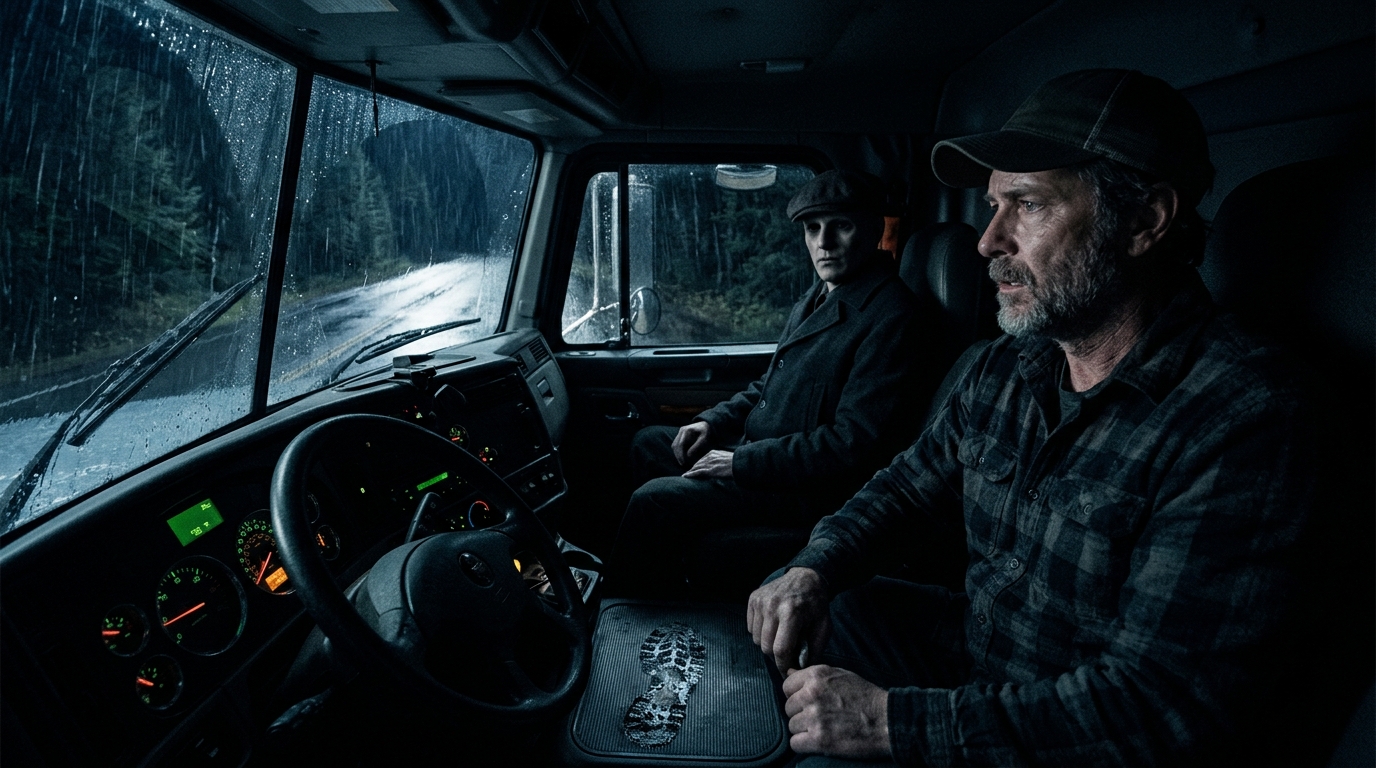
The passenger's clothes were completely dry.
Not damp.
Not wet.
Completely dry.
Water was dripping from the man's shoes onto the floor.
But his jacket was untouched.
Ray looked at him.
"Where do you need to go?"
The man slowly turned.
Ray saw his face.
And nearly crashed.
The man had no eyes.
Only smooth, pale skin where they should have been.
Ray slammed on the brakes.
The passenger seat was empty.
The door was still locked.
Ray drove the rest of the way without stopping.
He reported the incident.
The police found nothing.
The following Thursday, Ray refused to drive.
His supervisor threatened to fire him.
So Ray went.
At 1:40 a.m., the man was there.
Ray didn't slow down.
He didn't look.
He drove straight past.
The passenger door unlocked itself.
Ray heard the click.
He slammed the locks.
The click came again.
Unlocked.
Again.
Ray grabbed the radio.
"Dispatch, I need assistance."
Static.
Then a voice came through.
"Ray."
He froze.
It was his own voice.
"Ray, pull over."
He switched channels.
Every channel carried the same voice.
His voice.
"Pull over."
Then someone knocked on the passenger window.
Ray looked.
The man was walking alongside the truck.
The truck was doing seventy miles an hour.
The man kept pace effortlessly.
Ray accelerated.
The man smiled.
Then disappeared.
Ray drove another twenty miles before stopping at a rest area.
He checked the passenger seat.
There was a wet footprint on the floor.
One footprint.
Nothing else.
The next morning, Ray searched the highway's history.
Mile marker 117 had been the site of a fatal accident in 1989.
A truck had struck a pedestrian.
The pedestrian had been a man named Thomas Bell.
He died instantly.
The report stated that his body was found nearly fifty yards from the road.
Ray recognized the photograph.
It was the man from his truck.
For months, Ray avoided the route.
Eventually, he quit driving.
He moved to another state.
He rarely talked about the incident.
But years later, he received a phone call from his former supervisor.
There had been another driver.
Same route.
Same truck company.
Same Thursday schedule.
The driver had disappeared.
His truck was found abandoned on the shoulder near mile marker 117.
The engine was running.
The driver's door was open.
The passenger door was locked.
Investigators found one strange thing inside.
A wet footprint.
On the passenger-side floor.
And according to the driver's dash camera, the last thing recorded before the truck disappeared was a man's voice.
"Thanks for the ride."
Some hitchhikers are looking for a destination.
Others are looking for someone to take their place.