Case Record
The following record has been compiled from the available account associated with this case.
The Flatwoods Monster: What Did They Encounter on the Hill in 1952?
At approximately 7:15 on the evening of September 12, 1952, several boys in the tiny town of Flatwoods, West Virginia, looked up.
Something brilliant was crossing the sky.
It appeared fiery.
Bright.
Fast.
And low.
The object seemed to descend beyond the surrounding hills.
The boys believed something had landed.
Or crashed.
They did what children have always done when confronted with a potentially extraterrestrial spacecraft.
They went to get someone's mother.
Before the night was over, a small group of residents would climb a dark hillside outside town.
They would encounter a strange odor.
A pulsating red light.
A frightened dog.
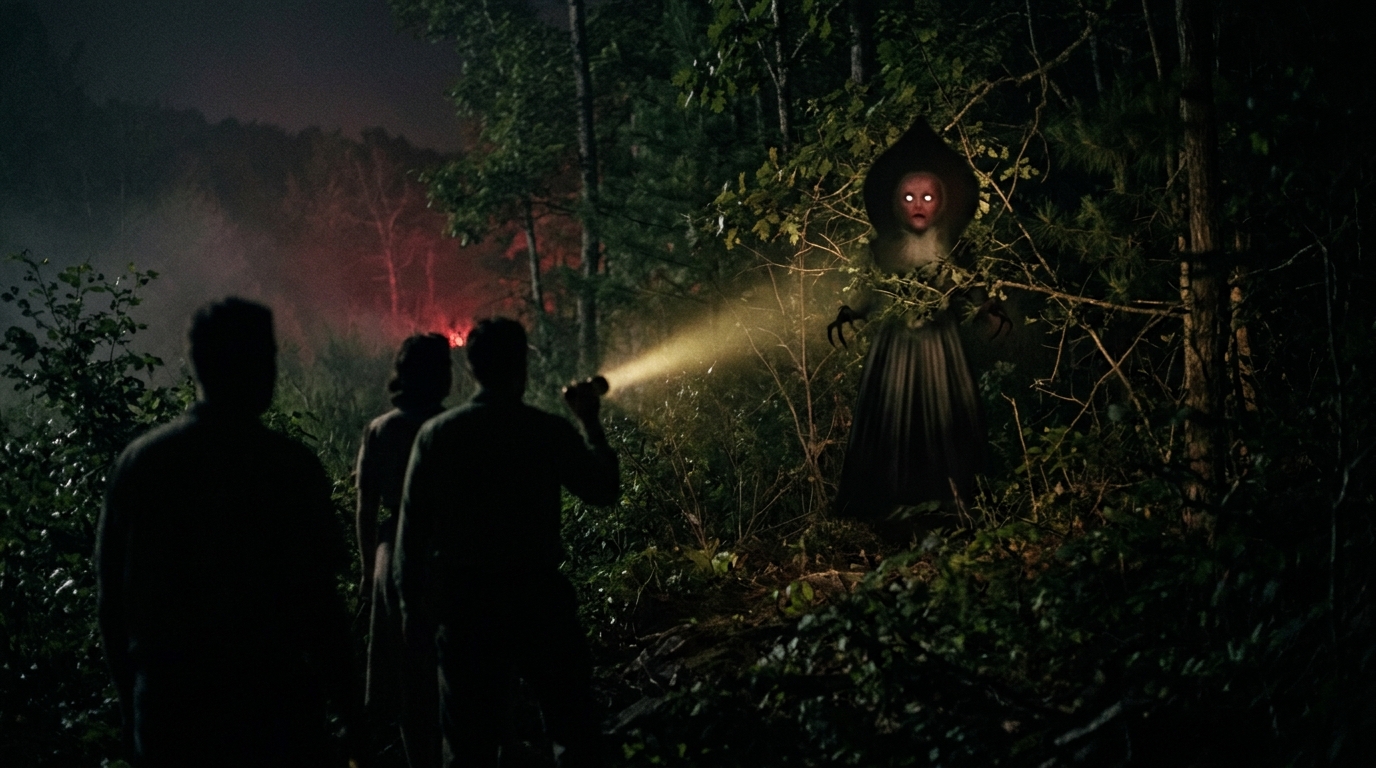
And something standing near the trees.
The figure appeared enormous.
Its face seemed to glow.
Its eyes reflected the beam of a flashlight.
Its head was surrounded by a dark shape resembling a hood or the ace of spades.
Below the head hung something that witnesses would later describe as resembling a long skirt.
Then it moved.
The witnesses ran.
They returned to town frightened enough that people who saw them afterward became convinced of at least one thing:
Whatever happened on that hill, they believed it.
The newspapers arrived.
Investigators arrived.
The story went national.
Soon the creature had a name.
The Flatwoods Monster.
It would also become known as:
The Braxton County Monster.
And eventually:
The Green Monster.
More than seventy years later, the case remains one of the most visually distinctive alleged extraterrestrial encounters in American history.
It also has one of the strongest conventional explanations.
The object crossing the sky may have been a meteor.
The pulsating light may have been an aircraft beacon.
And the towering extraterrestrial?
Possibly an owl.
That sounds almost disappointingly ordinary.
Until you see an owl at night.
Flatwoods, West Virginia
Flatwoods is a small community in Braxton County, near the geographic center of West Virginia.
In 1952, it was even smaller.
The surrounding landscape was rural.
Wooded hills.
Farms.
Fields.
Narrow roads.
Darkness arrived quickly once the sun disappeared behind the ridges.
This was not the desert landscape usually associated with classic American UFO stories.
No secret military base.
No empty New Mexico highway.
No vast western sky.
This was Appalachia.
And on September 12, something crossed the sky above it.
September 12, 1952
It was a Friday evening.
Several local boys were outside near the Flatwoods school.
The exact list and ages vary somewhat among later retellings, but the central witnesses included brothers Edward and Fred May, along with other neighborhood boys.
At around 7:15 p.m., they noticed an unusual light overhead.
It moved rapidly.
Some descriptions characterized it as reddish.
Others as fiery.
The boys watched it travel across the sky.
Then it appeared to descend behind a nearby hill.
The location seemed to be somewhere around the property of local farmer G. Bailey Fisher.
The boys immediately assumed the object had come down nearby.
That assumption changed everything that followed.
Something Had Landed
Imagine being a child in 1952.
You have spent the last several years hearing about flying saucers.
Newspapers print UFO stories.
People discuss strange objects in the sky.
The United States Air Force is publicly investigating reports.
Science-fiction films are filled with visitors from other worlds.
Then something brilliant crosses directly over your town.
It descends behind a hill.
You do not think:
Atmospheric astronomical phenomenon.
You think:
It landed.
The boys ran toward home.
Kathleen May
The boys told Kathleen May, mother of Edward and Fred, what they had seen.
This is where the Flatwoods story becomes unusual.
Kathleen did not simply tell them to stay inside.
She went with them.
The group expanded.
Among those who joined was Eugene "Gene" Lemon, a seventeen-year-old member of the National Guard.
Several boys accompanied them.
A dog came too.
The group headed toward the hill.
They were going to investigate.
This decision has been responsible for approximately seventy-four years of West Virginia tourism.
The Climb
The group crossed the surrounding area and began ascending toward the place where the object appeared to have come down.
It was becoming dark.
The terrain was uneven.
Trees and brush surrounded them.
They carried limited lighting.
Gene Lemon reportedly had a flashlight.
As they climbed, the atmosphere changed.
Witnesses began noticing something unusual.
A smell.
The Smell
The odor was described as strong.
Irritating.
Metallic.
Sulfurous.
Burning.
Some accounts compare it to burnt metal.
Others to sulfur or something chemically unpleasant.
The air itself seemed strange.
Witnesses later reported irritation to their noses and throats.
Some became nauseated.
This odor became one of the most intriguing parts of the case.
Because unlike a distant light or strange silhouette, smell feels physical.
Something in the environment appeared to be producing it.
But exactly what that something was remains uncertain.
The Mist
Some accounts also describe a mist or haze near the top of the hill.
The combination created an eerie environment.
Darkness.
Mist.
Chemical odor.
A supposed spacecraft somewhere ahead.
Children already convinced something had landed.
A nervous dog.
A flashlight.
Psychologically, the group was not approaching the hill neutrally.
They expected to find something.
Then they saw the light.
The Pulsating Red Object
Near the top of the hill, the witnesses reported seeing a glowing or pulsating red light.
This was apparently separate from the creature they would soon encounter.
Some believed it was the object that had descended from the sky.
Descriptions vary.
A glowing object.
A red sphere.
A pulsing light.
Possibly something resting on the ground.
Possibly something farther away.
Distance at night is notoriously difficult to judge.
Especially across uneven terrain.
Whatever the light was, it reinforced the group's expectation.
The thing from the sky was here.
Then the dog reacted.
The Dog
The dog reportedly became frightened or agitated.
It moved toward the darkness.
Then retreated.
Accounts differ on precisely what the animal did, but its fear became part of the legend.
Animals play this role constantly in unexplained encounters.
Dogs bark before ghosts appear.
Horses refuse to approach UFO landing sites.
Pets stare at invisible corners.
The implication is obvious:
Animals cannot be influenced by human imagination.
Therefore, if the animal reacts, something must really be there.
But dogs react to ordinary animals too.
Especially animals hiding in trees.
That detail will matter later.
Gene Lemon Raises the Flashlight
The group heard or noticed something near the trees.
Gene Lemon directed his flashlight toward it.
The beam struck two bright points.
Eyes.
Then the light revealed the thing beneath them.
And everyone ran.
The Creature
The figure was enormous.
Later descriptions commonly place it around ten feet tall, sometimes even taller.
Its face appeared reddish or glowing.
Its eyes were bright.
The head seemed surrounded by a large dark shape.
Pointed above.
Rounded around the sides.
Witnesses compared it to:
A hood.
A cowl.
The ace of spades.
Below the head was a large dark or greenish form.
Some described folds.
Others compared it to a skirt.
Small arms or claw-like hands appeared near the front.
The figure did not look like the classic alien that would dominate later UFO culture.
It did not resemble the small gray beings of modern abduction stories.
It looked stranger.
Almost mechanical.
Almost supernatural.
Almost like someone had combined a robot, a witch, and a playing card.
Then turned off the lights.
The Eyes
The eyes were among the most memorable features.
Large.
Bright.
Reflective.
Some descriptions made them appear orange or red.
Under the flashlight beam, they seemed to glow.
Eyeshine is an important feature in many nighttime creature reports.
Mothman had glowing red eyes.
The Hopkinsville creatures had luminous eyes.
Bigfoot witnesses sometimes report eye reflection.
Many nocturnal animals possess structures that make their eyes highly reflective in low light.
Humans do not.
That makes eyeshine seem profoundly unnatural when encountered unexpectedly.
Especially when the animal attached to the eyes is not immediately recognized.
The Hood
The head was surrounded by one of the strangest features in cryptid history.
A large, dark hood-like outline.
It rose above the head.
Some drawings depict it like an enormous pointed helmet.
Others make it resemble the ace of spades.
The face appears inside this shape.
That single visual feature made the Flatwoods Monster instantly recognizable.
It also became increasingly exaggerated.
Modern illustrations often show a gigantic metallic hood forming part of the creature's body.
But witness interpretation was less certain.
They were trying to describe a silhouette seen briefly at night.
The famous shape came later through drawings.
The Body
Below the head, witnesses described a dark or green body.
It appeared broad toward the bottom.
Some said it resembled a dress or skirt.
Others described vertical folds.
The creature seemed almost to have no visible legs.
That created another famous feature.
The Flatwoods Monster did not walk.
It seemed to glide.
It Moved
According to the witnesses, the figure moved toward them.
Not necessarily quickly.
But enough.
The motion was strange.
Smooth.
Gliding.
Some accounts say it hissed.
Others describe an unusual sound.
Gene Lemon reportedly fell backward.
The group turned and fled.
Nobody stayed to determine whether the creature had diplomatic intentions.
Given the circumstances, this was understandable.
Running Down the Hill
The group raced back toward Flatwoods.
Whatever courage had carried them up the hill disappeared immediately.
They arrived back in town frightened.
Gene Lemon was reportedly particularly shaken.
Contemporary reporter A. Lee Stewart Jr., associated with the Braxton Democrat, later described the witnesses as genuinely terrified.
He knew them.
He questioned them.
He tried to challenge their story.
And he came away convinced of something very specific.
Not that they had seen an extraterrestrial.
That they had seen something.
That distinction is crucial.
"They Sure Saw Something"
Stewart's comments are among the most useful contemporary observations of the case.
He reportedly found the witnesses consistent.
He saw their fear.
Gene Lemon remained reluctant to return to the location.
Stewart did not claim that a ten-foot alien had objectively been established.
He recognized the limits of what he knew.
The witnesses were scared.
Their accounts broadly agreed.
Something on that hill had frightened them badly.
What?
That was the mystery.
The Authorities Are Called
The incident quickly attracted law enforcement attention.
Local authorities investigated the area.
No extraterrestrial creature was captured.
No spacecraft was recovered.
No alien body appeared beneath a tree.
The site contained ambiguous traces.
Disturbed ground.
Tracks or marks.
An unusual smell according to some witnesses.
But nothing conclusively extraterrestrial.
As so often happens in paranormal cases, the strongest evidence had already left.
It was inside people's heads.
Reporter A. Lee Stewart
Stewart became one of the most important early investigators.
He went to the location.
He interviewed witnesses.
He examined the area.
He helped move the story from local panic into documented history.
His account appeared through national wire reporting within days.
That matters enormously.
Flatwoods is not a legend first recorded fifty years later.
The basic encounter entered the press almost immediately.
By September 15, newspapers were already describing a towering, foul-smelling creature with shining or metallic features.
The monster was becoming famous.
Fast.
The Monster of Braxton County
A United Press report published only days after the incident called it:
The Monster of Braxton County.
The story described a towering green-bodied creature.
Bulging eyes.
Claw-like hands.
A metallic-looking face.
A sickening odor.
Those details were circulating nationally almost immediately.
This is important when separating original claims from later mythology.
Some features were not invented decades later.
They were already present in 1952.
Others evolved.
The Original Drawing
A sketch based on witness descriptions soon established the creature's visual identity.
The image is extraordinary.
A huge pointed hood.
Two round eyes.
A dark face.
A long pleated body.
Thin arms.
Clawed hands.
The creature looks nothing like almost any other famous alleged extraterrestrial.
That drawing became the Flatwoods Monster.
Once it existed, later artists copied it.
Then modified it.
Then exaggerated it.
Eventually the drawing became more famous than the witness descriptions themselves.
This creates a common problem.
People now remember the illustration.
Not necessarily what witnesses saw.
How Long Did They See It?
Not long.
This is one of the most important facts in evaluating the encounter.
The group did not spend twenty minutes calmly examining the figure.
They saw something under poor lighting.
A flashlight illuminated it.
They became terrified.
Then they fled.
The observation may have lasted seconds.
Those seconds produced one of the most elaborate creature designs in American folklore.
That does not mean the witnesses invented it.
It means the visual information available to them was limited.
And fear does not improve measurement.
How Tall Was It Really?
The famous estimate is around ten feet.
Some reports go higher.
But height at night is difficult to judge.
Especially when the object's feet are not visible.
Especially on uneven ground.
Especially if the figure is elevated.
If the head belonged to an animal perched several feet above the ground, witnesses could unconsciously connect it to vegetation beneath.
The entire shape would become one towering body.
This is exactly where the owl theory begins.
The Owl
Yes.
An owl.
The leading skeptical explanation for the Flatwoods Monster is that the witnesses encountered a barn owl perched in a tree.
At first this sounds absurd.
The Flatwoods Monster is ten feet tall.
Barn owls are not.
The Flatwoods Monster has a giant hood.
Barn owls do not.
The Flatwoods Monster wears a skirt.
Barn owls rarely dress formally.
But look more closely.
The explanation becomes considerably stronger.
A Barn Owl at Night
Barn owls have remarkable faces.
Their facial disc forms a broad heart-shaped outline.
Their eyes appear dark under ordinary lighting but can produce striking reflections depending on illumination and angle.
They possess sharp talons.
Their pale faces can seem almost luminous.
Their wings create strange shapes when partially spread.
And when perched above ground, the bird's actual body can visually merge with branches and vegetation beneath it.
Now place one in darkness.
Add a flashlight.
Add mist.
Add several frightened children who believe a spacecraft has just landed nearby.
The result does not need to look like an owl.
It only needs to fail to look immediately like one.
The Spade-Shaped Head
This is perhaps the owl theory's best anatomical match.
The famous hood around the monster's head resembles an exaggerated version of the broad facial outline of an owl combined with surrounding branches or leaves.
A startled owl facing directly toward observers presents a symmetrical, mask-like appearance.
In darkness, the outer shape could be difficult to separate from vegetation.
The witnesses see:
Bright eyes.
Pale face.
Dark triangular outline.
Their brains assemble a head.
Later drawings make the outline solid.
The hood is born.
The Claws
The monster had claw-like hands.
Owls have talons.
That one is easy.
The harder question is location.
Witness illustrations sometimes place the claws at the ends of thin arms.
An owl's talons would be beneath its body.
But perspective under poor lighting can distort anatomy dramatically.
Branches can resemble limbs.
Wings can resemble arms.
Talons gripping a branch may appear disconnected from the rest of the animal.
Once again, the owl explanation fits.
Not perfectly.
But enough to remain uncomfortable.
The Glowing Eyes
Another strong match.
Owls are nocturnal predators.
Their eyes are extremely noticeable under direct illumination.
Flashlights can create dramatic eyeshine.
Two bright eyes suddenly appearing in darkness can make the animal look much larger and stranger than it is.
The witnesses were already searching for something extraterrestrial.
Then the flashlight beam catches enormous eyes.
The brain has perhaps half a second to decide:
Bird?
Or creature from the object that just landed?
Context makes the second answer easier than it otherwise would be.
The Hissing
Barn owls can make horrifying sounds.
Not pleasant hooting.
Hissing.
Screeching.
Rasping.
Sounds that seem entirely inappropriate for an animal with feathers.
A frightened barn owl may hiss defensively when disturbed.
If the Flatwoods witnesses heard an eerie hiss from the figure, this is another point in the owl theory's favor.
A creature from another planet could also hiss.
But we know barn owls do.
That matters.
The Gliding
Witnesses said the creature seemed to glide.
Owls are exceptionally quiet flyers.
A bird launching from a branch can appear to move without visible effort.
At night, its wings may disappear against the darkness.
The pale face remains visible.
The body shifts.
The entire thing seems to float.
This is remarkably similar to the "floating" behavior reported in the Kelly-Hopkinsville encounter three years later.
And again:
Owls are involved in the skeptical explanation.
Apparently mid-century Appalachia was an excellent time to be an owl and a terrible time to be correctly identified.
But the Monster Was Ten Feet Tall
This remains the obvious objection.
A barn owl is nowhere near ten feet tall.
Skeptical investigator Joe Nickell proposed that the bird was perched above the ground, perhaps on a branch, while foliage beneath it was interpreted as the creature's body.
This would explain the enormous apparent height.
The witnesses did not clearly see legs.
Instead they saw a long skirt-like lower section.
Vegetation could supply exactly that.
The creature's body was not necessarily a body.
It may have been a tree.
Monster by Assembly
This explanation is psychologically interesting.
The witnesses may have seen several separate objects and assembled them into one creature.
Owl face.
Branch.
Leaves.
Shadow.
Mist.
The brain connects them.
Now:
Head.
Arms.
Body.
Skirt.
Ten-foot monster.
Humans do this constantly.
It is called pareidolia when meaningful forms are perceived in ambiguous visual patterns.
Faces in clouds.
Figures in shadows.
Animals in tree bark.
Usually harmless.
Unless the face in the tree appears five minutes after a UFO lands.
Then things escalate.
But Wouldn't They Know an Owl?
Probably.
People living in rural West Virginia were familiar with wildlife.
This objection deserves respect.
These were not urban tourists encountering their first bird.
But knowing what an owl looks like in daylight does not guarantee identifying one instantly under unusual nighttime conditions.
Especially from an unfamiliar angle.
Especially while frightened.
Even experienced outdoorspeople misidentify animals.
And large nocturnal birds are spectacularly good at looking wrong.
The question is not:
Did they know owls existed?
The question is:
Could they recognize this particular visual stimulus in a few terrified seconds?
Those are different questions.
The Object in the Sky
The creature is only half the case.
What about the object that supposedly landed?
Here the conventional explanation is even stronger.
A meteor.
On the evening of September 12, 1952, a bright meteor or fireball was reportedly observed across a broad region that included parts of Maryland, Pennsylvania, and West Virginia.
The timing aligns closely with the Flatwoods sighting.
That means the boys likely saw a genuine extraordinary object in the sky.
Just not necessarily an artificial one.
Meteors Look Like They Land Nearby
This happens constantly.
A bright meteor crosses the sky.
It approaches the horizon.
An observer perceives it as descending behind a nearby hill.
The natural assumption:
It landed over there.
In reality, the meteor may be dozens or hundreds of miles away.
Distance in the sky is extremely difficult to estimate without reference points.
The same illusion explains countless reports of meteorites supposedly landing just beyond a road or field.
Usually they did not.
The Flatwoods boys may have sincerely watched something "land" that was never remotely near Flatwoods.
A Perfect Chain of Misinterpretation
This creates an elegant conventional reconstruction.
First:
A genuine meteor crosses the sky.
The boys see it.
They believe it lands on a nearby hill.
They tell Kathleen May.
A group goes searching for the crash site.
They are now psychologically primed to find something extraordinary.
Near the hilltop, they encounter unusual lights.
Then a startled owl.
The flashlight hits the owl.
Its eyes reflect.
Its pale face appears inside dark vegetation.
Someone sees a gigantic creature.
Everyone panics.
The owl moves.
They run.
Within hours:
Alien encounter.
Nobody needs to lie.
Nobody needs to hallucinate.
Nobody needs to invent anything deliberately.
That is what makes this explanation powerful.
The Red Light
But what about the pulsating red object near the hill?
Joe Nickell and other skeptics have suggested that visible aircraft warning beacons could account for this.
From the witnesses' position, a distant flashing beacon might appear much closer.
At night, without depth cues, a light can be almost impossible to locate accurately.
If the group expected to find a crashed spacecraft, a flashing red light in the correct direction could become the spacecraft.
Meteor.
Beacon.
Owl.
Three ordinary things.
One extraordinary story.
Is That Too Convenient?
Maybe.
Skeptical explanations can become their own form of storytelling.
Meteor explains this.
Beacon explains that.
Owl explains the monster.
Fear explains discrepancies.
Vegetation explains the height.
Mist explains visibility.
Soon every inconvenient detail has a separate ordinary explanation.
At some point, a theory can become so flexible that it explains anything.
That criticism is fair.
The question is whether these explanations are independently plausible.
In this case, many of them are.
A meteor really was reported.
Owls really live there.
Aircraft beacons really existed.
Fear really affects perception.
The theory is not invented from impossible ingredients.
The Odor
The smell remains more difficult.
Witnesses described a strong, irritating odor near the site.
Some reportedly experienced nausea afterward.
What caused it?
Possibilities include:
Vegetation.
Industrial or agricultural chemicals.
Natural gases.
Smoke.
Environmental contamination.
Psychological response.
Or something associated with the unknown event.
The odor was reportedly noticed by more than one person.
That suggests a genuine environmental stimulus may have existed.
But no preserved air sample exists.
We cannot analyze a smell from 1952.
Science remains annoyingly limited in this area.
The Physical Illness
Some witnesses reportedly became sick afterward.
Nausea.
Throat irritation.
Vomiting.
Symptoms persisted in some accounts.
UFO literature sometimes interprets this as exposure to:
Radiation.
Propulsion exhaust.
Unknown chemicals.
Extraterrestrial contamination.
Those possibilities sound dramatic.
But fear and physical exertion can also cause nausea.
So can irritating fumes.
So can running down a steep hill after encountering what you believe is a ten-foot alien.
Without medical testing establishing an unusual toxin or radiation exposure, the symptoms remain ambiguous.
Was There Radiation?
Claims of radiation sometimes appear in later Flatwoods discussions.
But there is no strong contemporaneous evidence demonstrating dangerous anomalous radiation at the site.
No preserved dosimeter reading establishes it.
No contaminated soil sample became scientific evidence.
No laboratory identified extraterrestrial isotopes.
The idea largely grows from later UFO expectations.
Radiation became associated with UFO encounters.
Therefore old UFO encounters acquired radiation.
Folklore absorbs whatever technology frightens the era telling it.
The Tracks
Investigators reportedly observed marks or tracks in the area.
A. Lee Stewart described disturbed ground.
Some reports mention two long tracks resembling skid marks.
Later paranormal interpretations treated these as possible evidence of a landed craft.
But tracks without controlled documentation are extremely difficult to interpret.
Vehicles.
Farm equipment.
People.
Animals.
Previous activity.
All can produce marks.
And once a site becomes famous, people walk everywhere.
The ground stops being evidence very quickly.
The Oily Substance
Later retellings sometimes mention oily or gummy material found near the site.
Again, this sounds impressive until provenance becomes a problem.
What exactly was collected?
Who collected it?
Where precisely?
Was it preserved?
Was it chemically analyzed?
Can the sample be examined today?
Without a clear chain of custody, mysterious residue remains mysterious mostly because nobody can establish what it was.
Extraterrestrial goo is exciting.
Unidentified farm residue less so.
The evidence does not tell us which.
No Spacecraft
Most importantly:
Nobody found a spacecraft.
The boys believed the aerial object descended near Fisher's farm.
The group reached the supposed area.
No crashed machine was sitting there.
No crater conclusively connected to an impact was found.
No metallic wreckage.
No engine.
No alien technology.
No debris field.
This strongly supports the meteor explanation.
If the aerial object never landed there, there would be nothing to find.
And there wasn't.
No Monster Either
No creature was captured.
No body.
No hair.
No blood.
No tissue.
No footprints conclusively attributable to an unknown organism.
No photograph.
No physical specimen.
The Flatwoods Monster exists entirely through witness testimony and artistic reconstruction.
That does not make the event meaningless.
It limits what conclusions can be supported.
What the Witnesses Actually Prove
They prove that several people went up a hill.
They encountered something they interpreted as extraordinary.
They became frightened.
Their story was documented almost immediately.
They described overlapping visual features.
Their emotional reaction impressed people who knew them.
That is meaningful evidence for an experience.
It is not equivalent to biological evidence for an extraterrestrial organism.
This distinction protects the mystery from both extremes.
You do not need to call the witnesses liars.
You also do not need to call NASA.
The 1952 UFO Wave
Flatwoods did not occur in isolation.
The year 1952 was one of the most important years in early American UFO history.
Reports surged.
Flying saucers were national news.
Military officials were concerned enough to investigate numerous incidents.
That summer, unidentified objects had reportedly appeared on radar near Washington, D.C.
Newspapers exploded with UFO coverage.
The public was looking upward.
Then September arrived.
A fireball crossed West Virginia.
The cultural conditions were perfect.
Washington, D.C.
In July 1952, radar operators around Washington National Airport and Andrews Air Force Base detected unusual targets.
Pilots reported lights.
Interceptors were launched.
The events generated enormous press attention.
The incidents became known as the Washington UFO flap.
The Air Force held a major press conference.
Only weeks later, children in Flatwoods watched something brilliant cross the sky.
The idea that unidentified objects might be visiting American airspace was not fringe background noise.
It was national conversation.
Flying Saucers Were Everywhere
The modern flying-saucer era had begun only five years earlier.
In 1947, pilot Kenneth Arnold reported seeing strange objects near Mount Rainier.
Newspaper coverage popularized the term "flying saucer."
That same year came Roswell.
By 1952, UFOs had become part of American consciousness.
Movies followed.
Books.
Magazine stories.
Government investigations.
Cold War anxiety.
Secret aircraft.
Atomic weapons.
Rockets.
The possibility of space travel no longer felt purely fantastical.
Flatwoods occurred at exactly the right historical moment for a monster on a hill to become an alien.
What Would They Have Called It in 1852?
Imagine the same encounter one hundred years earlier.
A fireball crosses the sky.
People climb a wooded Appalachian hill.
A foul smell fills the air.
A giant hooded figure appears near the trees.
Its eyes glow.
It hisses.
It glides.
Would anyone call it an extraterrestrial?
Probably not.
They might call it:
A witch.
A demon.
A spirit.
An omen.
Something from the mountains.
The experience can remain identical while culture changes the explanation.
That is one of the most fascinating things about paranormal folklore.
The unknown tends to dress appropriately for the century.
The Monster Becomes Mechanical
Later illustrations increasingly depict the Flatwoods Monster as mechanical.
A robot.
A probe.
An armored extraterrestrial.
Its lower body becomes a rigid metallic skirt.
Its hood becomes machinery.
Its arms become robotic appendages.
Some interpretations suggest the witnesses did not see a biological alien at all.
They saw a machine.
Perhaps a remotely operated probe.
This conveniently explains the impossible anatomy.
It also has no physical evidence supporting it.
The machine interpretation solves one mystery by inventing another.
Was the "Monster" Wearing a Suit?
Another popular theory proposes that the figure was an extraterrestrial inside protective equipment.
The hood was a helmet.
The skirt was a pressure suit.
The glowing eyes were lenses.
The claws were mechanical gloves.
The strange gliding movement came from propulsion.
This is possible in the sense that fictional extraterrestrial technology can do anything we permit it to do.
But there is no recovered suit.
No material.
No device.
No technical evidence.
The interpretation comes entirely from trying to make the reported appearance biologically sensible.
The Biology Is Terrible
If the famous drawing depicts the creature literally, evolution has some explaining to do.
The body is enormous and apparently legless.
The head is surrounded by a gigantic structure.
The arms are tiny.
The hands are clawed.
The creature glides rather than walks.
Its center of gravity is questionable.
It looks poorly designed for almost any terrestrial environment.
That may support the extraterrestrial argument.
Alien biology need not resemble ours.
Or it may support the misidentification argument.
The creature looks biologically impossible because nobody actually saw one coherent organism.
The Skirt
The skirt-like body is particularly suspicious.
Witnesses did not clearly describe legs.
Instead, the lower section appeared broad and vertically folded.
This is exactly the sort of visual pattern foliage can create beneath an animal perched above ground.
The brain interprets the shadows as one connected surface.
Later the artist draws that surface.
Then every subsequent illustration copies it.
Eventually the monster has a skirt.
An ambiguous patch of vegetation becomes anatomy.
That is one plausible path from owl to alien.
The Original Monster Was Less Clear
Modern artwork is usually crisp.
Every edge defined.
Every feature visible.
The witness experience was not.
Darkness.
Flashlight.
Trees.
Brief observation.
Fear.
Movement.
The difference between those two situations is enormous.
A modern viewer sees a fully rendered creature and asks:
"How could anyone mistake that for an owl?"
But the witnesses did not see the illustration.
The illustration was created because they could not clearly show what they saw.
That distinction is essential.
The Drawing Creates Certainty
Once an image exists, ambiguity disappears.
The hood has an edge.
The body has a shape.
The arms attach at specific places.
The creature has proportions.
But eyewitness memory is rarely that precise.
The drawing converts uncertain perception into concrete anatomy.
Then researchers treat the anatomy as evidence.
This happens repeatedly in cryptid history.
Sketch becomes creature.
Creature becomes standard model.
Later witnesses report seeing the standard model.
Folklore becomes self-reinforcing.
The National Press
Flatwoods spread rapidly through newspapers.
The combination was irresistible.
Flying saucer.
Children.
Terrified mother.
National Guardsman.
Monster.
West Virginia hillside.
A foul smell.
Glowing eyes.
Journalists did not need to improve the story much.
Although naturally they tried.
The creature became increasingly sensational.
Descriptions sharpened.
Height increased.
Green became greener.
The monster acquired a cultural life independent of the witnesses.
The Green Monster
Green is now strongly associated with Flatwoods.
But descriptions of the color are complicated.
Some early reports describe a green body.
Others emphasize darkness or a skirt-like lower section.
The face was described as red or metallic.
Modern depictions often make the entire creature vivid green.
That visual identity owes as much to decades of illustration and branding as to the brief encounter itself.
This is similar to the Hopkinsville creatures becoming the "little green men."
Apparently unexplained entities in the 1950s were under considerable pressure to become green.
Gray Barker
Another important figure soon entered the story.
Gray Barker, a West Virginia writer fascinated by UFOs, investigated and wrote about Flatwoods.
Barker would later become enormously influential in UFO culture.
His 1956 book They Knew Too Much About Flying Saucers helped popularize one of the strangest concepts in UFO mythology:
The Men in Black.
Flatwoods therefore sits near the beginning of something much larger.
Not just one monster.
An emerging American mythology of hidden visitors, secret knowledge, government interest, and strange encounters.
The Men in Black
The Men in Black legend would eventually become far more famous than Flatwoods.
Mysterious men visit UFO witnesses.
They ask questions.
Issue warnings.
Behave strangely.
Sometimes appear almost human.
Sometimes not quite.
Gray Barker played a major role in shaping these stories.
His connection to Flatwoods demonstrates how closely early UFO investigators and storytellers overlapped.
The people documenting the mythology were sometimes also helping create it.
That does not invalidate every case they touched.
It means source criticism matters.
A lot.
Project Blue Book
Flatwoods is frequently described as a Project Blue Book case.
This needs careful wording.
The Air Force was certainly investigating UFO reports during this period, and the Flatwoods aerial sighting became associated with official UFO records and later discussions.
However, popular retellings often exaggerate the extent of a formal Air Force field investigation into the creature itself.
The safest distinction is this:
The Air Force had a conventional explanation available for the aerial phenomenon.
A meteor.
That does not mean military investigators scientifically captured, examined, and identified the monster.
They did not.
What Blue Book Was
Project Blue Book was the Air Force's long-running program for collecting and evaluating UFO reports.
It operated from 1952 until 1969, succeeding earlier projects.
Its goals included determining whether UFOs represented threats to national security and whether reports contained evidence of advanced technology.
Thousands of cases were examined.
Most received conventional explanations.
A smaller percentage remained unidentified.
"Unidentified" did not mean extraterrestrial.
It meant investigators lacked sufficient evidence for a confident identification.
That distinction remains routinely ignored.
Did the Air Force Say "Owl"?
The owl explanation became most strongly associated with later skeptical investigation.
Claims that the Air Force itself formally solved the entire Flatwoods case as:
meteor + beacon + owl
should be treated cautiously.
The historical record is more complicated than the tidy version repeated online.
The meteor explanation for the aerial object is strong.
The barn owl reconstruction was developed in detail much later.
Different investigators contributed different parts of what eventually became the conventional explanation.
History is rarely as clean as a three-item checklist.
Joe Nickell
In 2000, skeptical investigator Joe Nickell revisited the case for Skeptical Inquirer.
Nickell examined the site.
Considered witness descriptions.
Compared the creature with a barn owl.
Analyzed the meteor reports.
And proposed the now-famous reconstruction.
Meteor in the sky.
Aircraft beacon on the ground.
Barn owl in the tree.
Fear connecting them.
Nickell's explanation remains one of the strongest skeptical analyses of any famous American monster encounter.
Not because it proves what happened.
Because it provides a plausible mechanism.
Skepticism Should Explain, Not Mock
This matters.
Saying:
"Those idiots saw an owl."
Explains nothing.
Why did it appear ten feet tall?
Why the glowing eyes?
Why the hood?
Why the skirt?
Why the gliding movement?
Why did several people agree?
A useful skeptical theory needs to account for those features.
Nickell attempted to do that.
Perched height explains scale.
Facial disc explains head shape.
Eyeshine explains glowing eyes.
Talons explain claws.
Vegetation explains body.
Flight explains gliding.
Expectation explains interpretation.
Now there is an actual hypothesis.
Whether it is correct remains open.
The Owl Problem Returns
Flatwoods is not alone.
Three years later:
Kelly-Hopkinsville.
Strange small creatures with huge eyes and ear-like structures surround a Kentucky farmhouse.
Leading skeptical explanation:
Great horned owls.
Fourteen years after Flatwoods:
Mothman.
Winged humanoid with enormous red eyes appears around Point Pleasant, West Virginia.
Leading conventional explanations include large birds, including owls.
At some point we must confront an uncomfortable truth.
Owls are apparently extremely good at getting themselves accused of paranormal activity.
Why Owls?
Because owls are almost engineered for it.
They are active at night.
They are silent.
Their faces are unusually human-like compared with many birds.
Their eyes face forward.
Their eyes reflect light.
They rotate their heads dramatically.
They can expand their apparent size.
Their calls are bizarre.
Their flight is nearly silent.
Their talons are enormous.
And most people rarely observe them closely under natural nighttime conditions.
An owl encountered unexpectedly is not the cute round bird from a calendar.
It is a nocturnal predator staring directly through you.
Appalachia Makes It Better
Dense Appalachian woods amplify all of this.
Sightlines are short.
Hills distort distance.
Fog forms.
Sounds echo strangely.
Artificial light is limited.
A flashlight illuminates one tiny section of an enormous dark environment.
Everything outside that beam disappears.
Then two eyes appear.
That is enough.
You do not need supernatural forces to make Appalachian woods unsettling after dark.
Geography handles much of the work.
But Why Did Everyone See the Same Thing?
Because they were together.
This is both evidence for and against the extraordinary interpretation.
Multiple witnesses strengthen a case.
But witnesses in a group are not fully independent.
One person points.
"There!"
Everyone looks.
Someone says:
"Look at its eyes!"
Now everyone focuses on eyes.
Someone screams.
The group runs.
Later they discuss what they saw.
Descriptions converge.
This is normal human behavior.
It does not require dishonesty.
Gene Lemon's Fear
Gene Lemon's reaction is particularly important.
He was seventeen.
A National Guardsman.
Not a small child.
People who interviewed him afterward described genuine fear.
He reportedly remained reluctant to return to the location.
This makes a deliberate group hoax less attractive.
It does not make extraterrestrials more likely.
A person who sincerely mistakes an owl for a monster will be sincerely frightened by the monster.
Emotion proves belief.
Not interpretation.
Kathleen May
Kathleen May also remained an important witness.
As an adult accompanying the children, her presence prevented the case from being dismissed simply as a children's story.
She described the figure.
Participated in interviews.
Helped establish the visual image that became famous.
Again:
Adult witnesses can misperceive things.
But her presence strengthens the historical reality of the experience.
Something frightened an adult and several children together.
That is more interesting than a playground rumor.
The Creature Did Not Chase Them Far
Despite later monster-movie imagery, there was no prolonged chase through Flatwoods.
The witnesses encountered the figure.
It moved.
They fled.
The event was brief.
No one was abducted.
No one was physically attacked.
No one disappeared.
The creature did not enter town.
It did not destroy property.
It did not return repeatedly over the following months.
The famous Flatwoods Monster had a surprisingly short career.
A few seconds on a hill.
Seventy-four years of merchandise.
Efficient.
Were There Other Sightings?
Additional strange reports from the surrounding region became connected to the Flatwoods case.
Some involved unusual lights.
Others strange beings.
Researchers have attempted to connect these into a larger wave.
But caution is necessary.
Once a dramatic story enters the news, similar reports tend to increase.
People reinterpret earlier experiences.
New witnesses come forward.
Hoaxes appear.
Ordinary events receive extraordinary attention.
This does not mean every additional report is false.
It means the original case should not automatically absorb them.
Frametown
One nearby report sometimes associated with Flatwoods allegedly involved another strange entity seen around the same period near Frametown, West Virginia.
Descriptions differ.
Some researchers interpret the similarity as evidence that the Flatwoods creature was not an isolated observation.
Others argue that later retellings blurred separate stories together.
The documentation is weaker than the central May-Lemon encounter.
For that reason, the main Flatwoods case should stand on its own.
It does not need extra monsters.
One is sufficient.
Was It an Alien?
There is no direct evidence establishing extraterrestrial origin.
That is the simplest answer.
The witnesses saw an unusual aerial object.
Then an unusual figure.
They assumed the two were connected.
But that connection itself is an inference.
Meteor.
Owl.
If those explanations are correct, the two events were related only through the witnesses' interpretation.
The meteor did not deliver the owl.
The owl was already there.
Probably annoyed.
Could It Have Been a Robot?
Possible.
Unproven.
The mechanical appearance has inspired speculation that the Flatwoods Monster was a probe rather than a living organism.
That would explain its rigid shape and gliding motion.
But it creates new questions.
Where did the probe go?
How did it operate?
Why did it appear beside a tree?
Why no technological debris?
Why did it resemble an owl so conveniently?
Without physical evidence, "alien robot" is an imaginative interpretation.
Not an explanation.
Could It Have Been a Secret Military Device?
1952 was the Cold War.
Secret aircraft existed.
Military technology was advancing rapidly.
It is reasonable to ask whether the aerial object or creature could have been related to classified testing.
But again:
Evidence.
There is no documented secret project matching a ten-foot hooded gliding figure deployed beside a West Virginia farm.
Classified technology should not become a universal placeholder whenever ordinary explanations feel boring.
Sometimes secret military projects exist.
Sometimes a weird thing is just weird.
Could It Have Been a Hoax?
A deliberate hoax is possible but unnecessary.
The witnesses' fear appears genuine.
The meteor provides a real trigger.
The owl provides a plausible creature.
No elaborate hoax mechanism is needed.
No known person confessed to dressing as the monster.
And dressing as a ten-foot alien on a dark hillside while frightened locals approach would be an unusually ambitious Friday-night hobby.
Hoax is possible.
Misidentification is simpler.
Could It Have Been a Person?
A person in unusual clothing might explain the humanoid impression.
But the height becomes difficult.
The glowing eyes become difficult.
The gliding motion becomes difficult.
The location and timing would also require explanation.
Why was someone standing near the supposed landing site?
Why remain silent?
Why frighten children?
Again, possible.
But not especially economical.
Could It Have Been an Unknown Animal?
Cryptozoological interpretations occasionally detach the monster from the UFO.
Perhaps the figure was a rare or unknown terrestrial animal.
This removes the extraterrestrial assumption.
But the morphology remains bizarre.
No known Appalachian species resembles the literal famous depiction.
And an unknown ten-foot gliding humanoid should leave more evidence than one brief encounter.
The owl remains a much better animal candidate.
Because we already know owls exist.
The Monster as Memory
There is another possibility.
The creature did not exist in exactly the form later drawn.
The witnesses saw something ambiguous.
Their memories transformed it.
Not instantly.
Gradually.
Interview by interview.
Drawing by drawing.
Retelling by retelling.
The experience remains real.
The creature evolves.
This may explain why paranormal beings often become more anatomically coherent with time.
Memory hates unfinished shapes.
It completes them.
The Power of the First Drawing
Once the famous illustration circulated, future memory had a reference image.
Witnesses could compare their recollections to it.
Journalists copied it.
Books reproduced it.
Television recreated it.
Eventually everyone knew what the Flatwoods Monster looked like.
Even people who had never read the original testimony.
That image may now be more stable than the historical event itself.
The monster has achieved something humans rarely manage.
A perfectly consistent appearance after death.
The 1950s Needed Monsters From Space
Flatwoods also belongs to its era.
The Second World War had ended only seven years earlier.
The atomic bomb had changed humanity's relationship with technology.
The Cold War was intensifying.
Rockets suggested space travel.
Radar made invisible objects detectable.
Nuclear annihilation seemed possible.
Science promised a spectacular future and a terrifying one.
Then flying saucers appeared.
Extraterrestrials became a new language for old fears.
The monster on the hill arrived at exactly the right time.
Before the Gray Alien
Like the Hopkinsville encounter, Flatwoods predates the standardized gray alien.
There was no universally accepted extraterrestrial design.
Aliens could look like anything.
Robots.
Giants.
Tiny men.
Hairy dwarfs.
Beautiful humans.
Monsters.
Flatwoods contributed one of the strangest designs.
A giant hooded being with a skirt.
UFO mythology was still experimenting.
Later it became much less creative.
The Monster Becomes a Cryptid
Interestingly, the Flatwoods Monster now often appears on lists of cryptids.
That is slightly strange.
The original case was fundamentally a UFO encounter.
The witnesses believed an object came from the sky.
The creature appeared near the supposed landing site.
It was interpreted as an occupant.
Yet modern culture places it alongside:
Bigfoot.
Mothman.
The Jersey Devil.
The Loch Ness Monster.
The distinction between alien and cryptid has blurred.
Once something becomes a monster, taxonomy becomes optional.
Flatwoods and Mothman
The comparison is irresistible.
Both are West Virginia legends.
Both involve frightening nighttime encounters.
Both feature glowing or reflective eyes.
Both have plausible large-bird explanations.
Both became visual icons.
But they occurred fourteen years apart and roughly ninety miles from one another.
There is no strong evidence connecting them.
Mothman belongs to Point Pleasant and the 1966–1967 wave.
Flatwoods belongs to Braxton County and the flying-saucer frenzy of 1952.
West Virginia simply has an impressive paranormal résumé.
Flatwoods and Hopkinsville
The comparison with the Kelly-Hopkinsville encounter is even more interesting.
Flatwoods:
Bright object descends.
Witnesses encounter strange being.
Large luminous eyes.
Owl explanation.
Hopkinsville:
Bright object descends.
Witnesses encounter strange beings.
Large luminous eyes.
Owl explanation.
Both occur in rural Appalachia or its broader cultural region.
Both became major UFO cases.
Both involve observers interpreting strange nocturnal animals after seeing an aerial phenomenon.
If the skeptical explanations are correct, these cases demonstrate the same psychological process remarkably well.
First the Sky, Then the Monster
This sequence matters.
In both cases, witnesses saw something unusual in the sky before encountering the creature.
That establishes expectation.
If Gene Lemon had stumbled across the same owl while hunting on an ordinary night, he might have thought:
That is a strange-looking bird.
But after children report a fiery object landing on the hill?
The same eyes become:
Whatever came out of it.
Expectation does not create the stimulus.
It changes the category assigned to it.
The Brain Wants One Story
Humans dislike unrelated coincidences.
Meteor.
Owl.
Same evening.
Same hill.
Obviously connected.
Except they may not be.
The meteor could have been hundreds of miles away.
The owl could have been sitting on that branch all evening.
The witnesses connected them because that created a coherent explanation.
Ironically, skeptics later separated them again.
Meteor here.
Owl there.
Beacon over there.
Two competing stories assembled from the same pieces.
The Witnesses Were Not Stupid
This deserves emphasis.
Misidentification is not stupidity.
Human vision is extraordinary.
It is also imperfect.
Low light dramatically reduces detail and color perception.
Fear narrows attention.
Expectation shapes interpretation.
Distance becomes uncertain.
Objects merge.
Time perception changes.
Memory reconstructs.
Every human being is vulnerable to these effects.
Experts included.
A person can be intelligent, honest, observant, and completely wrong about what they saw.
That is one reason mysteries exist.
The Witnesses Could Also Have Been Right
Skepticism has limits too.
Perhaps the conventional reconstruction is wrong.
Perhaps the meteor was unrelated.
Perhaps the red light really was nearby.
Perhaps the figure was not an owl.
Perhaps several witnesses accurately described something genuinely unknown.
If so, the evidence does not tell us what it was.
That is where responsible speculation should stop.
Unknown does not automatically become extraterrestrial.
But it also does not automatically become owl.
What We Know
On September 12, 1952, a bright aerial phenomenon was observed around the region.
Young residents of Flatwoods believed it descended near a local farm.
A group including children, Kathleen May, and Gene Lemon went to investigate.
They encountered an unusual light.
They reported a strange odor.
They saw a figure near the trees.
They fled.
Their fear impressed contemporary observers.
Their account reached newspapers within days.
A distinctive drawing based on their descriptions became famous.
Those facts form the historical core.
What We Don't Know
We do not know exactly what visual stimulus produced the monster.
We do not know the precise distance between witnesses and figure.
We do not know how accurately later drawings represent those few seconds.
We do not know what caused the odor.
We do not know exactly what produced the red light.
We do not know whether every later physical-effect claim originated with the earliest testimony.
We do not know whether the owl reconstruction is correct.
And we have no verified extraterrestrial artifact.
The mystery lives inside those gaps.
What Probably Crossed the Sky
A meteor is extremely likely.
The timing and regional reports strongly support it.
This part of the Flatwoods case is far less mysterious than the creature.
A bright meteor can look spectacular.
It can appear to descend nearby.
It can produce exactly the kind of event that sends children running home shouting that something crashed.
The boys probably did see something extraordinary.
Nature is capable of extraordinary things without assistance from extraterrestrials.
What Probably Stood Near the Tree
The barn owl hypothesis is strong.
Not certain.
Strong.
It explains:
The eyes.
The facial shape.
The claws.
The hiss.
The apparent gliding.
The elevated height.
The brief observation.
The nighttime setting.
The surrounding vegetation.
And the creature's disappearance.
That is a substantial amount of explanatory power for one bird.
The lower "body" remains interpretive.
The exact witness descriptions remain imperfectly matched.
But among known animals, the owl is difficult to beat.
The Most Important Question
Perhaps the question is not:
Was the Flatwoods Monster real?
Something was real.
A meteor was real.
The witnesses were real.
Their fear was real.
The thing illuminated by the flashlight was presumably real.
The better question is:
At what point did the thing on the hill become the Flatwoods Monster?
Was it already a monster before the flashlight hit it?
Or did the monster emerge during the few seconds between seeing two glowing eyes and running down the hill?
That is harder.
The Creature That Lasted Seconds
Most famous monsters accumulate sightings.
Bigfoot has thousands.
Mothman had a year.
The Loch Ness Monster has nearly a century of modern reports.
The Flatwoods Monster needed almost none of that.
Its fame rests overwhelmingly on one encounter.
One evening.
One hill.
One group.
One brief look.
That is remarkable.
The creature's physical appearance lasted seconds.
Its cultural appearance never ended.
Flatwoods Embraces the Monster
Today, Braxton County has embraced its strange visitor.
The monster appears on signs.
Murals.
Souvenirs.
Local attractions.
There is a Flatwoods Monster Museum in Sutton.
Visitors travel through the region specifically because of what happened—or supposedly happened—on September 12, 1952.
Like Point Pleasant with Mothman, the community transformed fear into identity.
This happens often enough to qualify as a paranormal lifecycle.
First:
Terror.
Then ridicule.
Then investigation.
Then folklore.
Then gift shop.
The Flatwoods Monster Museum
The museum preserves the history and cultural legacy of the encounter.
Photographs.
Documents.
Artwork.
Memorabilia.
The museum is valuable even if the creature was an owl.
Perhaps especially then.
Because the Flatwoods story is not merely about whether extraterrestrials visited West Virginia.
It is about how a historical event becomes folklore.
The museum preserves that transformation.
A few frightened people on a hill eventually created an icon.
The Monster Chairs
Braxton County has also leaned enthusiastically into the creature's distinctive shape.
Large Flatwoods Monster-themed chairs and public displays appear around the region.
Visitors can follow a trail associated with them.
The ten-foot monster that once sent people running now poses for photographs.
This seems unfair to the original witnesses.
But excellent for tourism.
The monster has mellowed considerably since 1952.
Why We Still Care
Because the case contains almost every ingredient a great unexplained story needs.
A precise date.
Named witnesses.
A real location.
Contemporary reporting.
A mysterious aerial event.
A monster.
Physical symptoms.
Government-era UFO context.
A plausible skeptical explanation.
And just enough uncertainty to keep arguing.
If the story had only the monster, it might have disappeared.
If it had only the meteor, nobody would care.
Together they created something permanent.
If It Was an Owl
Then the Flatwoods case becomes no less fascinating.
In some ways, it becomes more fascinating.
A meteor crosses the sky.
Children believe it lands.
They recruit adults.
The group walks into the darkness.
They find an owl.
For several seconds, context transforms that owl into something impossible.
They flee.
A newspaper records the event.
An artist draws the creature.
National media spreads it.
UFO researchers investigate.
Books preserve it.
Museums celebrate it.
Seventy years later, people across the world recognize the monster.
All because one bird was sitting in exactly the wrong tree.
That is extraordinary.
Just not extraterrestrial.
If It Wasn't an Owl
Then something much stranger happened.
Several witnesses encountered an unknown figure near the location where they believed an aerial object had descended.
The figure possessed unusual morphology.
It appeared extremely tall.
Its eyes glowed.
It moved strangely.
It produced or existed near an irritating odor.
Then it vanished.
No physical evidence capable of identifying it survived.
No repeat encounter provided clarification.
The event ended.
If the witnesses' literal interpretation was correct, the Flatwoods Monster represents one of the most extraordinary close encounters ever reported.
And one of the least cooperative.
It left almost nothing behind.
The Thing Under the Flashlight
Return to the hill.
Before the newspapers.
Before the drawings.
Before Gray Barker.
Before Project Blue Book became mythology.
Before the museum.
Before the souvenirs.
Before anyone had decided what the creature looked like.
There is only darkness.
A group climbs toward a place where children believe something has fallen from the sky.
The air smells wrong.
A red light pulses somewhere beyond the trees.
The dog reacts.
Gene Lemon hears something.
He raises his flashlight.
The beam moves across branches.
Then stops.
Two eyes reflect back.
For one moment, the witnesses see something they cannot identify.
A pale face.
Darkness around it.
A shape beneath.
Maybe claws.
Maybe branches.
Maybe a body.
Then it moves.
Someone screams.
Everyone runs.
That moment is the Flatwoods Monster.
Everything after it is reconstruction.
Maybe the beam illuminated a barn owl.
Maybe vegetation turned a small bird into a ten-foot creature.
Maybe the meteor had nothing whatsoever to do with the thing in the tree.
That explanation is plausible.
Very plausible.
But the people who ran down that hill did not believe they had seen a bird.
They believed something had come out of the sky.
And for a few seconds on a dark West Virginia hillside in September 1952, whatever stood beneath that flashlight looked strange enough to make an adult woman, a National Guardsman, several children, and a dog decide they had seen enough.
The dog, notably, left no formal statement.
The humans did.
And because they did, the thing on the hill never completely disappeared.
Sources and Further Reading
- HISTORY — In 1952, the Flatwoods Monster Terrified 6 Kids, a Mom, a Dog—and the Nation
- Braxton County Convention & Visitors Bureau — The Flatwoods Monster
- Braxton County Convention & Visitors Bureau — Flatwoods Monster Folklore and Historical Archive
- Skeptical Inquirer — Joe Nickell: The Flatwoods UFO Monster
- Skeptical Inquirer — The History Channel Mangles Project Blue Book, Mixing Fact with Fiction
- The Skeptic — What Links the Flatwoods Monster, the Kelly-Hopkinsville Encounter, and Mothman?
- Washington Daily News / United Press — "The Monster of Braxton County," September 15, 1952 archive
- National Archives — Project Blue Book Records
- Edward J. Ruppelt, The Report on Unidentified Flying Objects (1956)
- Gray Barker, They Knew Too Much About Flying Saucers (1956)
Case Status
Unresolved
The classification above describes the current status of this entry within the Forbidden Lore archive. A documented report does not necessarily establish the explanation offered for it as fact.