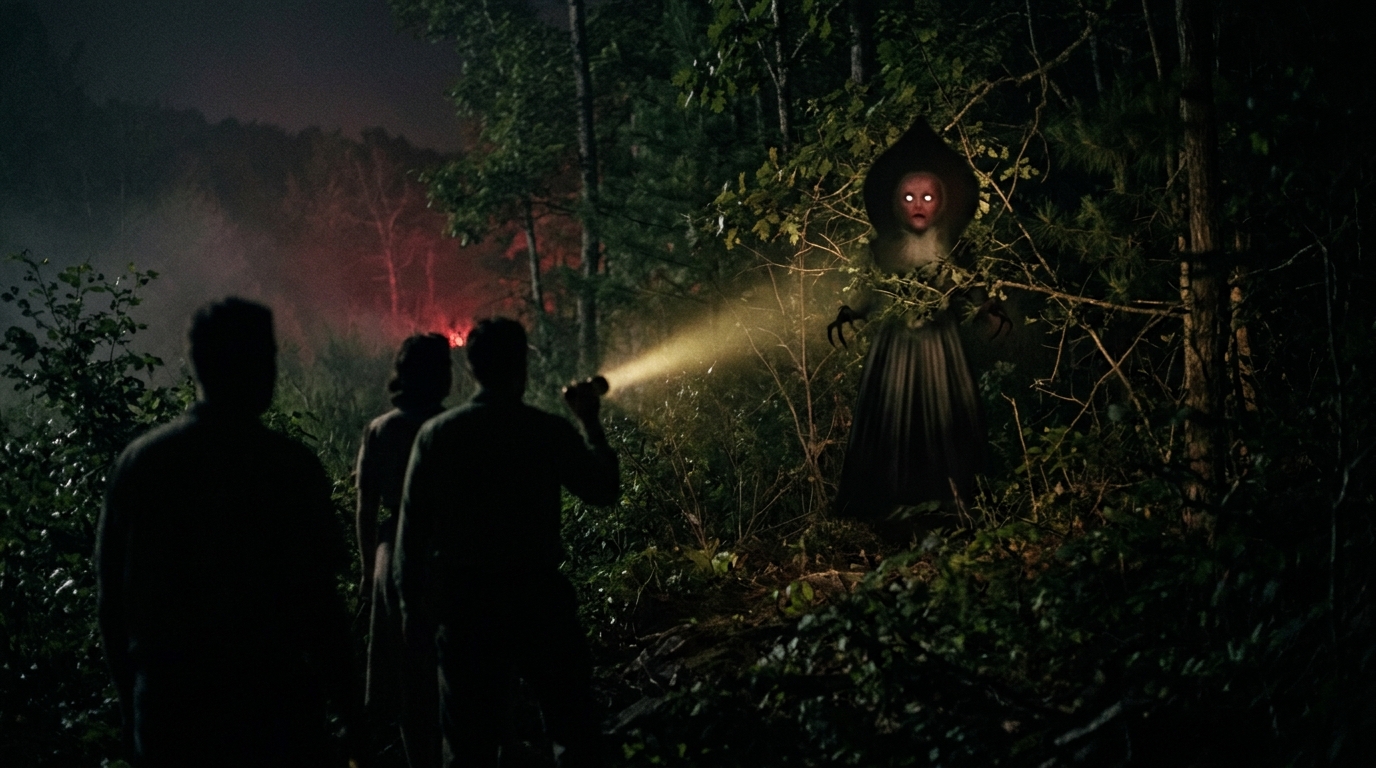
Case Record
The following record has been compiled from the available account associated with this case.
The Hopkinsville Goblins: The Night Something Surrounded a Kentucky Farmhouse
Shortly before midnight on August 21, 1955, two vehicles pulled up outside the police station in Hopkinsville, Kentucky.
The people who climbed out were terrified.
There were adults.
Children.
An entire extended family.
They told police that they had just escaped from a farmhouse several miles outside town.
Something had surrounded the house.
Not people.
Not animals they recognized.
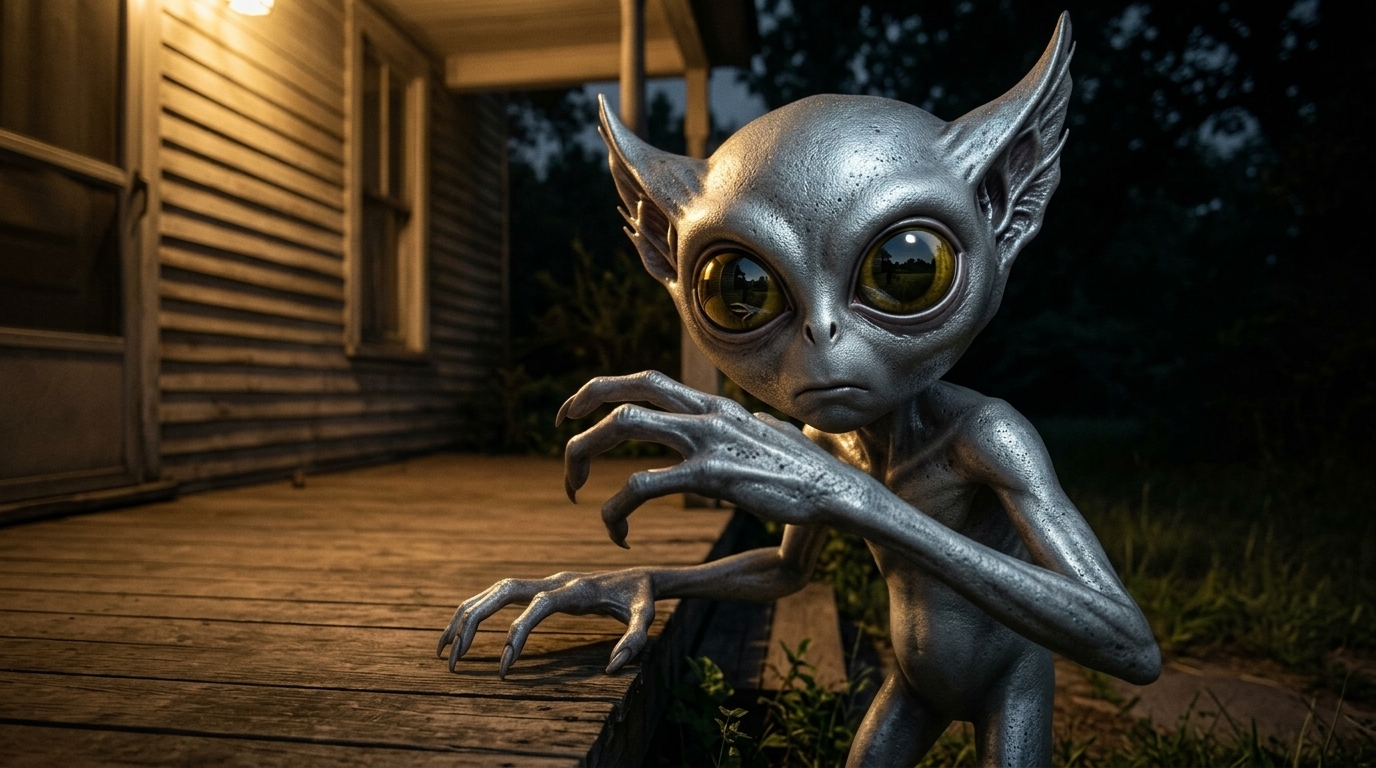
Small creatures.
Three or four feet tall.
Huge heads.
Long arms.
Thin legs.
Large luminous eyes.
They had been appearing at the windows.
Approaching the doors.
Climbing onto the roof.
The men inside had fired at them repeatedly with a shotgun and a rifle.
The creatures kept coming back.
Police could have dismissed the story.
They did not.
Officers drove to the farmhouse.
State police joined them.
Sheriff's deputies responded.
Military police from nearby Fort Campbell were reportedly among those who came to the scene.
They searched the property.
They found frightened witnesses.
They found evidence that guns had been fired.
They did not find a spaceship.
They did not find bodies.
And they did not find the creatures.
Eventually the authorities left.
Then, according to the family, the creatures returned.
The encounter became known by several names.
The Kelly Incident.
The Kelly-Hopkinsville Encounter.
The Hopkinsville Goblins.
And, thanks partly to newspaper coverage and later retellings:
The Kelly Green Men.
Except the witnesses apparently never said the creatures were green.
That detail came later.
Almost everything about the case becomes more complicated the closer you look.
The number of creatures changes depending on the account.
The number of witnesses is reported differently.
The alleged spacecraft was seen by only one person.
Police arrived after the creatures had disappeared.
No body was recovered.
No unquestionably extraterrestrial physical evidence was preserved.
And one of the strongest skeptical explanations proposes that terrified people spent the night shooting at great horned owls.
That sounds ridiculous.
Until you look at a great horned owl.
Then it sounds considerably less ridiculous.
But the owl theory has problems of its own.
The witnesses claimed they saw the creatures at extremely close range.
They described arms.
Hands.
Talons.
Bodies that seemed metallic.
An unusual floating movement.
And they insisted that the figures returned repeatedly over several hours.
Whatever happened at that small Kentucky farmhouse, something frightened those people badly enough that they abandoned the house in the middle of the night and drove directly to the police.
They did not wait until morning.
They did not contact a UFO magazine.
They did not sell tickets.
They went to the cops.
And when they arrived, the police apparently believed one thing immediately.
Whatever the Sutton family thought they had seen, they were genuinely afraid.
Sunday, August 21, 1955
It was a hot Sunday evening in western Kentucky.
The place was a modest farmhouse near the small community of Kelly, several miles north of Hopkinsville in Christian County.
The house belonged to the family of Glennie Lankford, a widow and family matriarch.
Several relatives and visitors were there that evening.
Accounts differ slightly when listing everyone present, but the group included members of the Sutton and Lankford families along with visiting friends Billy Ray Taylor and his wife June.
Billy Ray had previously worked with Elmer "Lucky" Sutton on a traveling carnival.
This detail would later become important.
Skeptics sometimes used the carnival connection to suggest the family might have been involved in a hoax.
But working for a carnival is not evidence of fabricating an alien invasion.
It simply made the story more colorful.
And the story did not need much help.
The Farmhouse
The house was simple.
Rural.
Isolated enough that darkness around it would have been substantial.
There was no running water.
Water had to be collected from a well outside.
There was no telephone available for simply calling police when trouble began.
That detail would become critical later.
If the family wanted help, someone would eventually have to leave.
The surrounding property contained fields, trees, outbuildings, and dark stretches of countryside.
On an ordinary summer evening, none of this was remarkable.
Then Billy Ray Taylor went outside for water.
Something Crossed the Sky
At approximately seven o'clock that evening, Taylor walked toward the well.
While outside, he noticed something in the sky.
He later described a bright object.
Silvery.
Unusual.
Some accounts describe a multicolored or rainbow-like exhaust.
The object allegedly traveled across the sky and descended beyond the farmhouse.
Taylor believed he had seen a flying saucer.
This was 1955.
The phrase was already part of American culture.
Eight years had passed since Kenneth Arnold's famous 1947 sighting helped ignite the modern flying-saucer era.
UFO stories regularly appeared in newspapers.
The United States Air Force was investigating reports through Project Blue Book.
Aliens had already invaded movie theaters repeatedly.
So when Taylor ran back inside and announced that he had seen a flying saucer, the concept was hardly unknown.
The family's response was also understandable.
They laughed at him.
Nobody Believed Billy Ray
Taylor insisted that something had come down nearby.
The others apparently assumed he had seen a meteor or shooting star.
There was no immediate panic.
Nobody barricaded the doors.
Nobody began shooting into the woods.
For a while, the evening continued.
This is a small but important part of the story.
If the entire group had been determined from the beginning to invent an alien encounter, Taylor's dramatic UFO sighting would have been a perfect opening act.
Instead, according to the later accounts, most of the people inside initially thought he was talking nonsense.
Then the dog began barking.
The Dog
The family's dog became agitated.
It barked toward the darkness outside.
Eventually it reportedly retreated beneath the house.
Anyone who has spent time around rural dogs knows this behavior can mean almost anything.
A raccoon.
A snake.
A coyote.
A stranger.
Another dog.
An owl.
Or nothing a human ever manages to identify.
But after Taylor's story about the object in the sky, the dog's behavior carried a different weight.
Lucky Sutton and Billy Ray Taylor decided to investigate.
They approached the rear of the house.
And according to them, something approached back.
The First Creature
The figure was small.
Approximately three to four feet tall.
Its head appeared disproportionately large.
The witnesses described large luminous eyes.
The arms were long.
The hands ended in claws or talons.
The legs appeared thin.
The body seemed to shine or reflect light.
And it was moving toward the house.
Slowly.
With its arms raised.
This posture became one of the most recognizable details in the entire case.
The creature seemed to hold both arms above or beside its head.
Not quite surrendering.
Not quite attacking.
Just approaching.
The men did not wait to discover its intentions.
They opened fire.
The Shotgun and the Rifle
Lucky Sutton had a shotgun.
Billy Ray Taylor had a .22-caliber rifle.
They fired at the figure.
According to the witnesses, they hit it.
The result was not what they expected.
Instead of collapsing, the creature reportedly flipped backward or tumbled away.
Then it disappeared into the darkness.
The men believed they had struck it.
Yet there was no blood.
No body.
No obvious injury.
This pattern repeated throughout the night.
The creatures appeared.
The witnesses fired.
The creatures vanished.
Then they returned.
Something at the Window
Back inside, the family attempted to understand what had happened.
Then another face appeared.
At a window.
The strange oversized head and luminous eyes were reportedly visible through the glass or screen.
Someone fired again.
The window was damaged.
The creature disappeared.
Now the encounter was no longer something happening in a distant field.
Whatever the figures were, they were coming directly to the house.
The Siege Begins
For the next several hours, the farmhouse became the center of one of the strangest alleged encounters in American UFO history.
Figures appeared near windows.
At doorways.
Beside the house.
In trees.
On the roof.
The witnesses claimed the creatures repeatedly approached and withdrew.
The men repeatedly fired at them.
The creatures apparently never attacked with weapons.
They did not force their way through the doors.
They did not abduct anyone.
They did not speak.
They did not communicate.
They simply kept appearing.
That behavior is one of the strangest aspects of the case.
If these were hostile extraterrestrials capable of interstellar travel, their invasion strategy was unusually passive.
If they were animals, their repeated approach toward gunfire was equally peculiar.
If they were hallucinations, several people appeared to be sharing remarkably similar ones.
And if it was a hoax, the family was doing an impressive amount of property damage to sell it.
The Creature on the Roof
At one point, Billy Ray Taylor stepped outside.
A creature allegedly reached down from the roof.
Its clawed hand touched or grabbed at his hair.
Taylor reacted in panic.
The others saw the figure above him.
Gunfire followed.
Again the creature escaped.
This episode would later become central to illustrations of the encounter.
A tiny alien perched above the farmhouse.
Long arms extended.
Huge eyes staring downward.
The image feels almost designed for a 1950s science-fiction movie.
That does not mean it was invented.
But it explains why the story became unforgettable.
They Seemed to Float
Witnesses described another bizarre characteristic.
When the creatures fell or moved from elevated positions, they seemed unusually light.
They did not drop normally.
They floated.
Glided.
Or descended slowly.
One creature allegedly moved from a tree in a way that suggested it was nearly weightless.
This detail became important to believers.
Perhaps the creatures experienced different gravity.
Perhaps they wore some kind of technology.
Perhaps their bodies were naturally lightweight.
Skeptics noticed something else.
Owls also descend from trees without falling like mammals.
They have wings.
The Huge Eyes
The eyes may be the single most important physical feature.
Witness drawings depict an enormous head dominated by two large, luminous eyes.
The eyes appeared bright under illumination.
Possibly yellowish.
Possibly reflective.
This immediately sounds alien to a modern audience.
Large black or luminous eyes have become one of the defining features of extraterrestrial imagery.
But in 1955, the standardized "gray alien" had not yet completely conquered popular culture.
The Hopkinsville drawings are unusual.
The heads are broad.
The ears appear large.
The arms are long.
The bodies are tiny.
They do not look exactly like modern grays.
They look like something stranger.
Almost goblin-like.
Hence the name.
They Were Not Green
This deserves emphasis.
The famous "little green men" of Kelly apparently were not described as green by the witnesses.
Contemporary reporting and later popular culture helped attach that color.
Some descriptions emphasized a silvery appearance.
The creatures seemed metallic or reflective in the light.
The phrase "little green men" was already culturally available as a joking description of extraterrestrials.
The Kelly encounter helped cement the phrase further.
But if the Suttons saw anything that night, they were not necessarily reporting tiny green aliens.
History painted them afterward.
How Many Were There?
This is another problem.
Popular retellings often claim twelve to fifteen creatures surrounded the house.
But it is not clear that witnesses ever simultaneously observed anything close to that number.
They saw figures repeatedly.
One here.
Another there.
Perhaps several at once.
The assumption that each appearance represented a different creature can inflate the total dramatically.
Three creatures appearing repeatedly could become fifteen.
One creature moving around the property could become several.
The number is uncertain.
The experience was not.
The family believed the house was surrounded.
Inside the House
Imagine the scene from inside.
Children crying.
Adults shouting.
Windows open to darkness.
Gunshots exploding inside a small wooden farmhouse.
Shotgun blasts.
A .22 rifle firing through screens.
People moving from room to room.
Something appears at a window.
Someone screams.
A gun fires.
Then silence.
Everyone waits.
Nothing.
Then scratching from the roof.
Another face.
Another shot.
Hours of this would be psychologically exhausting even if every creature ultimately had an ordinary explanation.
Fear feeds itself.
Once the family believed something was attacking the house, every sound mattered.
Why Didn't They Leave Immediately?
Because leaving meant going outside.
The vehicles were outside.
The creatures were outside.
The family had children with them.
If the witnesses genuinely believed unknown beings were surrounding the house, staying behind walls may initially have seemed safer.
Eventually that calculation changed.
The siege had continued too long.
They needed help.
The family decided to make a run for the vehicles.
The Escape
Shortly before midnight, the group left the farmhouse.
They drove into Hopkinsville.
Straight to the police station.
This is one of the strongest elements of the case.
They brought the story to law enforcement immediately.
Not days later.
Not after consulting UFO enthusiasts.
Not after rehearsing it for reporters.
That night.
While frightened.
Police Chief Russell Greenwell and other officers listened.
The story was extraordinary.
The witnesses' emotional state apparently was too.
Authorities decided to investigate.
The Police Response
The response was substantial.
Hopkinsville police officers traveled to the farm.
Kentucky State Police were involved.
Sheriff's personnel came.
Accounts also place military police from nearby Fort Campbell among the responders.
Reporters soon became involved.
The farmhouse that had recently contained a terrified family was suddenly surrounded by law enforcement.
Officers searched the property.
If small humanoids were still present, they declined to introduce themselves.
What Police Found
The police did not find aliens.
That fact needs to remain clear.
No officer produced a body.
No officer photographed a creature.
No spacecraft was discovered in the field.
No alien technology was recovered.
There were, however, signs of the chaos.
Windows and screens had been damaged.
Gunfire had occurred.
The property had clearly experienced a very unusual night.
Investigators searched for tracks and other physical evidence.
Nothing emerged that could establish the presence of an unknown humanoid species.
The case therefore rests primarily on testimony.
A lot of testimony.
But testimony nonetheless.
The Witnesses Were Frightened
Police reportedly found the witnesses genuinely distressed.
This does not prove their interpretation.
People can be sincerely terrified by things they misunderstand.
But it matters when evaluating the hoax theory.
A successful hoax requires either convincing acting or genuine fear generated through some other mechanism.
Multiple adults and children would need to maintain the performance.
They would also need to accept police scrutiny.
And the story would need to remain reasonably consistent.
That is possible.
It is not effortless.
No Smell of Alcohol
One recurring detail in accounts of the police response is that authorities did not believe the family was intoxicated.
This matters because "they were drunk" became an easy explanation for critics.
The Suttons were poor rural people.
Some had carnival connections.
Their story sounded absurd.
Those facts made them easy targets for ridicule.
But police reportedly did not simply dismiss them as intoxicated.
The family claimed they had been drinking water.
The encounter had begun, after all, because Taylor went to the well.
Poverty Became Evidence Against Them
The social treatment of the witnesses deserves attention.
They lived in a modest farmhouse.
They were working-class.
Some had worked in carnivals.
Newspaper descriptions could portray them as unsophisticated rural people.
That created a strange double standard.
If they believed the story, they were ignorant.
If they invented it, they were scheming.
If they disliked reporters, they were suspicious.
If they spoke to reporters, they were seeking attention.
Once a witness becomes culturally ridiculous, almost any behavior can be interpreted against them.
The Suttons discovered this quickly.
The Police Leave
After searching the property and finding no creatures, authorities eventually departed.
The immediate crisis appeared over.
The family returned or remained at the house.
Then, according to the witnesses, the creatures came back.
Around the early morning hours, strange figures reportedly reappeared at the windows.
The siege resumed.
By dawn, the family had had enough.
They left.
The Creatures Were Gone
Morning arrived.
The property remained.
The bullet holes remained.
The witnesses remained.
The creatures did not.
No daylight search revealed an extraterrestrial camp.
No spacecraft sat in the gully.
No wounded goblin crawled from beneath the house.
The physical mystery evaporated with the darkness.
What remained was a story.
And by the next day, that story was becoming news.
The Kentucky New Era
The Kentucky New Era, based in Hopkinsville, reported the encounter almost immediately.
That contemporary coverage is extremely important.
Many paranormal legends are reconstructed decades later.
The Kelly case entered newspapers within hours.
Reporter Joe Dorris investigated.
Witnesses were interviewed.
Descriptions were recorded.
Sketches were produced.
The case began developing a documentary trail while memories were still fresh.
That does not prove the creatures were real.
It does make the case more valuable historically than legends documented generations afterward.
The Drawings
Artist and radio figure Bud Ledwith helped produce drawings based on witness descriptions.
These images became iconic.
The creature has:
A huge rounded head.
Enormous eyes.
Large pointed ears.
A tiny body.
Long thin arms.
Clawed hands.
Short legs.
The arms are often shown raised.
The drawings look simultaneously alien and folkloric.
Not quite a spaceman.
Not quite an animal.
Not quite a demon.
The Hopkinsville Goblin had acquired a face.
And once a mystery has a face, popular culture knows what to do with it.
The Goblins Go National
News of the encounter spread beyond Kentucky.
Wire services carried the story.
Newspapers around the country reported on the strange little creatures.
The phrase little green men became attached to the case.
The family's terrifying night became entertainment.
That transition happened quickly.
One evening they were shooting at something outside their house.
Soon strangers were laughing about Martians.
The encounter had become folklore before the witnesses had much time to understand what happened.
Visitors Arrive
Curiosity seekers descended on the property.
Reporters.
UFO enthusiasts.
Skeptics.
People hoping to see aliens.
The family reportedly became overwhelmed by the attention.
This is another pattern repeated throughout paranormal history.
A person reports something extraordinary.
Then the public arrives.
The original event may last minutes or hours.
The consequences can last years.
The Sutton family did not become wealthy from the encounter.
Instead, they became characters in someone else's mystery.
The Hoax Theory
Could they have invented everything?
Certainly.
No physical evidence rules that possibility out.
Billy Ray Taylor had worked with a carnival.
The story was sensational.
The farmhouse showed damage consistent with people firing weapons.
A hoax could explain why no creatures were found.
But the theory has weaknesses.
Why involve children?
Why go to police while the hoax was supposedly still happening?
Why invite armed officers to inspect the property?
Why fire weapons through your own windows?
Why maintain a story that mostly brought ridicule?
There are possible answers.
None are particularly compelling by themselves.
They Wanted Money
This accusation appeared quickly.
Once crowds arrived, stories circulated that the family intended to charge visitors.
Some reports suggest money was requested from curious people entering the property.
That became evidence of fraud.
But monetizing attention after an event does not prove the event was created for money.
People do this constantly.
A person can sincerely experience something strange and later realize strangers will pay to hear about it.
Conversely, financial opportunity can absolutely encourage exaggeration.
Both possibilities should remain open.
The Carnival Connection
The fact that Lucky Sutton and Billy Ray Taylor had carnival backgrounds is often repeated with a knowing tone.
Carnival workers know tricks.
Therefore:
Hoax.
But this is circumstantial reasoning.
Working around carnival entertainment does not make someone a professional fabricator of elaborate multi-witness UFO encounters.
If anything, Taylor's initial UFO claim being mocked by the others works against the idea of a perfectly coordinated script.
The carnival connection is interesting.
It is not proof.
Could Billy Ray Have Pranked Everyone?
This theory is more intriguing.
Suppose Taylor saw a meteor.
Or invented the spacecraft.
Then someone—perhaps Taylor or another person—created strange figures outside to frighten the family.
The prank escalated.
People started shooting.
At that point, continuing would become extraordinarily dangerous.
Anyone wearing a costume outside the house risked being killed.
The family fired repeatedly.
A human prankster remaining near the windows after the first shotgun blast would need either extraordinary dedication or an unusually weak survival instinct.
No injured prankster ever emerged.
Could Local People Have Done It?
Perhaps outsiders learned of the family's fear and tormented them.
Again, gunfire makes this unlikely.
Once the men began shooting at figures, ordinary pranksters should have retreated permanently.
The witnesses claimed the creatures repeatedly returned.
A hoax involving multiple people would require them to continue approaching an armed farmhouse in darkness.
For a joke.
That is possible.
Humans have done stupider things.
It is not the easiest explanation.
Then There Are the Owls
The strongest naturalistic explanation involves great horned owls.
And unlike many skeptical explanations of famous mysteries, this one deserves serious attention.
Great horned owls live in Kentucky.
They are large.
Nocturnal.
They have enormous reflective eyes.
Prominent feather tufts resembling ears.
Powerful talons.
Broad heads.
And they can assume bizarre postures.
Their wings allow them to descend from branches in exactly the kind of floating motion witnesses described.
Suddenly the goblin drawings look different.
Look at the Ears
The creatures' enormous pointed ears are one of their strangest features.
Great horned owls have prominent feather tufts.
In poor lighting, those tufts could resemble ears.
The huge circular eyes also fit.
The small body beneath an oversized head fits reasonably well.
The claws fit.
The nighttime setting fits.
The trees around the house fit.
The floating descent fits extremely well.
The owl hypothesis did not emerge from nowhere.
There are genuine visual similarities.
But Owls Have Wings
And the witnesses did not emphasize wings.
This is an obvious problem.
If people were staring at great horned owls from only a few yards away, why describe long arms instead of wings?
One possibility is posture.
An owl extending or partially opening its wings can produce a strange humanoid silhouette.
Feathers can obscure body boundaries.
Fear and poor lighting distort proportions.
But the witnesses claimed close encounters.
At some point, "it was dark" stops solving everything.
If Taylor really had a creature directly above him reaching toward his head, an owl should eventually look like an owl.
Unless he had never seen one closely under those conditions.
Great Horned Owls Are Large
People routinely underestimate how strange large birds can look at night.
A great horned owl can stand around two feet tall.
Its wingspan can approach five feet.
Perched upright, it can look compact.
When threatened, owls alter their posture.
Feathers expand or compress.
Eyes dominate the face.
Wings move outward.
Talons become visible.
An owl illuminated suddenly by a flashlight near a rural house can look astonishing.
Not three-and-a-half-foot alien astonishing.
But closer than most people expect.
The Reflective Eyes
This may be the owl theory's strongest point.
The witnesses described eyes that appeared luminous.
Owls possess excellent night vision and pronounced eyeshine.
Light striking the eyes can produce an intense reflection.
Two glowing circles in a large-headed silhouette are exactly what a frightened observer might remember.
Extraterrestrial eyes do not have a known optical mechanism because extraterrestrial eyes have never been scientifically examined.
Owl eyes do.
That gives the natural explanation an advantage.
The Talons
The witnesses also described clawed hands.
Owls have spectacular talons.
If an owl was perched with its feet visible, those talons could be interpreted as claws.
But the witness drawings place the claws at the ends of long arms.
That anatomical mismatch remains.
Could wings have been interpreted as arms and feet as something else?
Possibly.
The drawings were reconstructions after the event.
Human memory is not a camera.
Still, the correspondence is imperfect.
The Floating Motion
Here the owl theory becomes especially persuasive.
The creatures reportedly seemed nearly weightless when struck or when moving from trees.
They floated downward.
An owl dropping from a branch and opening its wings would do exactly that.
A person expecting a mammal-like creature to fall would perceive the descent as unnatural.
The witnesses may not have clearly seen wings.
They would simply see the body refuse to drop normally.
To someone already convinced a spacecraft had landed nearby, that would look extraterrestrial.
Why Didn't the Bullets Kill Them?
Because perhaps the bullets missed.
Shooting at a small moving target at night is difficult.
Especially while frightened.
Especially after several hours of panic.
A shotgun increases the chance of a hit, but distance and angle matter.
The witnesses believed they struck the creatures because the figures reacted.
An owl startled by gunfire could tumble, launch itself, or drop from a perch.
That might look like being hit without producing a body.
Alternatively, pellets may have struck branches or structures.
There is no preserved ballistic evidence demonstrating bullets physically impacted unknown beings.
But Why Would Owls Keep Coming Back?
This is harder.
Repeated gunfire should drive most wildlife away.
Great horned owls are not famous for spending several hours repeatedly presenting themselves as targets to armed humans.
Perhaps different owls were involved.
Perhaps only a few appearances were owls and later sounds or shadows were interpreted as creatures.
Perhaps the witnesses exaggerated the repetition afterward.
Or perhaps the owl theory does not explain everything.
A good skeptical hypothesis does not become sacred merely because it is skeptical.
It has to fit the evidence too.
The Meteor
The spacecraft sighting has a straightforward possible explanation.
A meteor.
Taylor saw a bright object moving across the sky.
It appeared to descend.
He interpreted it as a spacecraft landing.
From a single viewpoint, a meteor traveling toward the horizon can easily appear to descend nearby.
In reality it may be dozens or hundreds of miles away.
If a meteor occurred around the appropriate time, the entire encounter could begin with a sincere misinterpretation.
Taylor sees meteor.
Taylor announces flying saucer.
Later unusual animals appear.
The group connects them.
A story forms.
This is psychologically plausible.
The Timing Matters
The UFO sighting happened first.
The creatures came later.
That sequence created a ready-made explanation.
Without Taylor's sighting, the first strange figure might have been:
An owl.
A weird animal.
A person.
But after Taylor reported a spacecraft landing nearby, a strange figure became:
Whatever came out of the spacecraft.
That is how context changes perception.
The object did not need to be extraterrestrial.
It only needed to establish the possibility in everyone's mind.
Fear Builds a World
Once the first shots were fired, the farmhouse entered a different psychological state.
Every person inside knew something was wrong.
Every sound became evidence.
A scrape on the roof.
Creature.
Movement at a window.
Creature.
Reflective eyes in a tree.
Creature.
A branch moving.
Creature.
An owl landing.
Creature.
This does not require mass hallucination.
It requires ordinary ambiguous stimuli interpreted through extraordinary expectations.
That happens constantly.
Usually without shotguns.
Was It Mass Hysteria?
The term is often used too casually.
The witnesses were not necessarily hallucinating nonexistent beings simultaneously.
A more realistic model is social reinforcement.
One person sees something.
Others look.
Someone identifies it.
"There it is."
Everyone focuses on the same ambiguous shape.
The interpretation spreads.
Fear increases.
Memories converge.
Hours later, witnesses sincerely remember a coherent event.
Nobody needs to be lying.
Nobody needs to be psychotic.
Human perception is collaborative more often than we like to admit.
The Children
Children were present throughout the ordeal.
Their testimony complicates the case.
Children are highly suggestible.
They can absorb adult fear.
But they are also witnesses.
If adults are shouting that monsters are outside, children will experience the night through that framework.
Later recollections may blend direct observation with stories repeated for years.
This is one reason immediate documentation matters.
Unfortunately, not every witness was interviewed independently under controlled conditions.
This was a police response to frightened people, not a laboratory experiment.
The Adults Did Not All See the Same Things
Another important point.
Not everyone in the house witnessed every manifestation.
The most dramatic encounters were concentrated among particular adults.
Others heard the gunfire.
Saw some figures.
Experienced the fear.
But the encounter was not eleven people standing in a line calmly observing the same alien under bright light.
Popular summaries can accidentally create that impression.
The actual event was chaotic.
Different people saw different things at different times.
That makes the testimony more difficult to evaluate.
It also makes it more realistic.
The Case Was Never a Perfect UFO Case
UFO literature sometimes describes Kelly-Hopkinsville as one of the strongest close encounters ever recorded.
It certainly has unusual strengths.
Multiple witnesses.
Long duration.
Rapid police response.
Contemporary journalism.
Witness drawings.
A specific location.
But it lacks the evidence that would make the case scientifically extraordinary.
No verified landing trace conclusively connected to a craft.
No biological material.
No artifact.
No clear photograph.
No radar confirmation.
No creature seen by responding police.
The case is strong as testimony.
That distinction matters.
Project Blue Book
The relationship between the Kelly encounter and the United States Air Force's Project Blue Book is frequently misstated.
Popular accounts sometimes imply that Blue Book conducted a major official investigation and failed to explain the case.
The documentary history is more complicated.
Material related to the incident circulated within UFO-investigation networks, and references to Air Force interest appear in later literature.
But claims about precisely how Blue Book classified or investigated Kelly vary among sources.
This is one of those places where repetition has created false certainty.
Saying "Project Blue Book investigated it" sounds authoritative.
The surviving record is not that simple.
Civilian Investigators
The most detailed later investigations were conducted by civilian UFO researchers.
Isabel Davis and Ted Bloecher became particularly important.
Their work, eventually published as Close Encounter at Kelly and Others of 1955, attempted to reconstruct the event through interviews, maps, witness testimony, and site information.
For anyone seriously examining the case, this material matters enormously.
It also demonstrates how quickly UFO research became its own historical discipline.
By the time later writers approached Kelly, they were no longer investigating only what happened.
They were investigating what earlier investigators said happened.
Layers accumulate.
J. Allen Hynek
Astronomer J. Allen Hynek also discussed the case.
Hynek had served as a scientific consultant to the Air Force's UFO investigations and later became one of the most influential figures in UFO studies.
He developed the famous close encounter classification system.
The Kelly-Hopkinsville incident fit naturally into what would become known as a close encounter of the third kind:
A UFO event involving reported occupants or entities.
Before Spielberg made that phrase globally famous, cases like Kelly helped give it meaning.
Spielberg
The encounter eventually influenced popular culture far beyond Kentucky.
Steven Spielberg has discussed the Kelly story in connection with the development of a darker extraterrestrial project called Night Skies.
That project evolved and fragmented.
Elements eventually contributed to films including E.T. the Extra-Terrestrial.
The connection is strangely appropriate.
A terrifying farmhouse siege involving small alien beings helped inspire ideas that eventually contributed to one of cinema's friendliest extraterrestrials.
The Sutton family probably would not have found E.T. reassuring.
Night Skies
Spielberg's unrealized Night Skies concept reportedly involved extraterrestrial creatures terrorizing a rural family.
That premise is unmistakably Kelly-like.
Aliens around a farmhouse.
People trapped inside.
Uncertain intentions.
The idea later changed dramatically.
But the influence demonstrates the encounter's cultural power.
Kelly did not merely enter UFO books.
It entered the visual vocabulary of extraterrestrial fiction.
Little Green Men
The phrase existed before 1955.
But the Kelly encounter became deeply associated with it.
Newspaper writers described the creatures as little green men even though witness accounts emphasized silvery or dark appearances rather than green skin.
This is a perfect example of media language reshaping memory.
Today many people encounter the case under the name:
Kelly Green Men.
The color is embedded before they learn anything else.
Repeat an inaccurate detail for long enough and it becomes folklore.
Why Goblins?
"Goblins" may actually fit the witness descriptions better.
Huge ears.
Large eyes.
Claws.
Small bodies.
Strange movement.
They resemble supernatural creatures from European folklore more than modern extraterrestrials.
If the same encounter had supposedly occurred in 1755 rather than 1955, nobody would have called them aliens.
They would have been:
Goblins.
Fairies.
Imps.
Demons.
Night spirits.
The interpretation available to witnesses depends on the culture surrounding them.
In 1955, things descended from the sky in flying saucers.
So the goblins became extraterrestrials.
What Would People Have Called Them in 1855?
This is worth considering.
Imagine the identical sequence one century earlier.
A bright object crosses the sky.
Strange small beings appear around a farmhouse.
Their eyes shine.
They float from trees.
Bullets do not kill them.
Nobody in 1855 says:
Extraterrestrial occupants of a technologically advanced spacecraft.
They might say:
Witches.
Demons.
Fair folk.
Ghosts.
The phenomenon can remain identical while the explanation changes.
That does not prove the creatures were supernatural or extraterrestrial.
It demonstrates how much interpretation depends on vocabulary.
The Encounter Resembles Folklore
The creatures behave strangely for space travelers.
They lurk.
Peer through windows.
Touch someone's hair.
Sit in trees.
Retreat when approached.
Return after authorities leave.
They act almost like trickster spirits.
There is no clear mission.
No communication.
No technology.
No attempt to enter forcibly.
No obvious interest in resources.
No abduction.
No medical examination.
No message for humanity.
They simply torment a household.
That behavior resembles a haunting more than an invasion.
The Farmhouse as a Haunted House
Remove the spacecraft sighting and the story changes genre.
An isolated family hears noises.
Small figures appear at windows.
Something moves across the roof.
Invisible or elusive beings refuse to leave.
The family fires weapons.
Authorities arrive and find nothing.
The entities return after the authorities depart.
That is structurally a haunting story.
Billy Ray Taylor's initial aerial sighting transforms it into a UFO story.
One event changes the entire category.
Could the UFO Be Unrelated?
Absolutely.
This possibility is often ignored.
Taylor may have seen a meteor.
Later, the family may have encountered owls or something else.
The two events may have had no connection whatsoever.
Humans naturally connect events occurring close together.
Especially unusual events.
A strange light descends.
An hour later a strange creature appears.
Obviously they are related.
Except "obviously" is doing enormous work.
Correlation becomes narrative.
What About the Landing Site?
Taylor reportedly indicated where he believed the object had descended.
Investigators did not recover a spacecraft.
Accounts sometimes mention possible disturbed vegetation or a glow in the area.
None of this produced decisive evidence.
If a physical craft landed near the farm, the lack of a strong trace is disappointing.
A vehicle capable of traveling between star systems apparently left less evidence than a pickup truck.
That is possible.
It is not helpful.
No Radiation
Later UFO cases often involve radiation claims.
Burned soil.
Electromagnetic effects.
Compass disturbances.
Radio interference.
Increased background readings.
Kelly does not possess convincing physical evidence of this kind.
There was no preserved anomalous material from a landing site that could later be tested.
This is unfortunate because physical evidence could have transformed the case.
Instead we have descriptions.
Powerful descriptions.
But descriptions.
No Photographs
Nobody photographed the creatures during the encounter.
This was 1955.
That is not surprising.
Families did not carry cameras in their pockets.
Even if a camera was available, taking photographs while believing hostile creatures surrounded the house may not have been anyone's priority.
Today, the absence of imagery feels frustrating.
At the time, it was normal.
The drawings therefore became the visual evidence.
And drawings depend on memory.
Why the Drawings Matter Anyway
Witness sketches are valuable.
Not because they prove the subject existed exactly as depicted.
Because they preserve how witnesses conceptualized what they saw.
The Kelly drawings were created close to the event.
They show remarkable recurring features.
Large head.
Huge eyes.
Pointed ears.
Long arms.
Raised hands.
Small body.
Those consistencies require explanation.
Shared observation is one possibility.
Witnesses influencing one another is another.
Both may have occurred.
Did the Witnesses Compare Stories?
Of course.
They spent hours inside the same house discussing what was happening.
Their accounts were never independent in the strict scientific sense.
If Lucky described a creature to someone who had not seen it clearly, that description could shape the second person's memory.
If a drawing was shown around, later descriptions could converge on it.
This does not invalidate the testimony.
It limits what consistency can prove.
Eleven similar stories are less independent when eleven people experienced the event together.
The Problem With "Eleven Witnesses"
The phrase sounds overwhelming.
Eleven witnesses saw aliens.
But that is too simple.
Different witnesses observed different events.
Some saw creatures directly.
Others experienced the broader siege.
Children were present.
Accounts were shared.
The group reinforced itself.
The strongest case therefore comes from the witnesses who claimed clear direct observation.
Their testimony remains intriguing.
It is not multiplied automatically by everyone who happened to be inside the farmhouse.
Were There Twelve Witnesses?
Even the number of people present varies in retellings.
Some sources describe eleven.
Others twelve.
Lists of names differ depending on whether particular relatives or visitors are counted.
This is not unusual in historical cases.
But it is a reminder that even basic facts can become unstable.
If we struggle to establish exactly how many humans were inside the house, confidently establishing how many extraterrestrials were outside becomes ambitious.
The "Siege" May Have Been Shorter Than Remembered
Popular accounts often describe four hours of continuous attack.
The actual sequence likely included long periods of waiting.
A figure appears.
Shots.
Nothing.
Another appearance.
More waiting.
Fear stretches time.
Retellings compress the intervals.
Eventually the event becomes a continuous four-hour alien assault.
That version is more dramatic.
Reality may have been intermittent.
Intermittent encounters fit the owl hypothesis better.
They also fit a psychological escalation model.
Why Didn't Police See Them?
Believers can answer easily.
The creatures left when police arrived.
Then returned after police departed.
That is what the witnesses claimed.
Skeptics find the timing suspicious.
The beings appear when the family is alone.
Disappear when independent observers arrive.
Return when those observers leave.
This pattern appears constantly in paranormal reports.
It can indicate a phenomenon avoiding outsiders.
It can also indicate that the phenomenon depends on the original witnesses' interpretation.
There is no way to decide from timing alone.
The Military Police
The involvement of personnel connected with Fort Campbell adds another layer of credibility in popular retellings.
Military involvement sounds official.
Secretive.
Potentially extraterrestrial.
But Fort Campbell was nearby.
Military police responding to a bizarre armed disturbance in the region would not necessarily indicate UFO interest.
The farmhouse contained frightened people firing guns.
That alone justified concern.
Authorities did not need to believe in aliens to investigate.
Guns Complicated Everything
Police responding to the Sutton farm faced an immediate practical question.
Were armed people shooting at actual intruders?
At animals?
At each other?
At imaginary creatures?
The UFO aspect was secondary to public safety.
This explains why law enforcement took the incident seriously without necessarily accepting the extraterrestrial claim.
When several people arrive saying they have spent hours firing weapons around children, you investigate.
Even if they add that the targets have giant ears.
Especially then.
Could Someone Have Been Killed?
Very easily.
The encounter could have ended as tragedy.
Shots were fired through windows and around a dark property.
Multiple people were moving through the house.
Children were present.
Responding officers later entered the scene.
A ricochet or mistaken target could have killed someone.
Instead, the story became famous because nobody was seriously injured.
That outcome was fortunate.
Whatever the creatures were, the humans were carrying the more demonstrably dangerous technology.
The Creatures Never Fired Back
This remains bizarre.
If extraterrestrials surrounded the house, they tolerated repeated gunfire without obvious retaliation.
They had supposedly crossed space.
Yet they possessed no visible weapons.
They approached with raised hands.
They peered through windows.
They touched Taylor's hair.
Perhaps they were curious.
Perhaps they were deliberately provoking the humans.
Perhaps the raised hands were defensive.
Or perhaps these were frightened animals reacting unpredictably to frightened humans.
The encounter's apparent aggression came overwhelmingly from inside the farmhouse.
That detail is often forgotten.
Were the Goblins Actually Friendly?
Consider the story from the creatures' hypothetical perspective.
You land.
Approach a farmhouse.
Raise your hands.
The residents shoot you.
You return.
They shoot you again.
You look through a window.
They shoot through the window.
You climb onto the roof.
More gunfire.
If the Kelly creatures were extraterrestrial visitors, humanity's first impression was not particularly diplomatic.
Of course, repeatedly creeping around someone's windows at night is also poor interplanetary etiquette.
Responsibility may be shared.
The Raised Hands
The raised-arm posture is fascinating because witnesses interpreted it as strange rather than explicitly threatening.
The creature approached with arms elevated.
That could indicate:
Surrender.
Balance.
Anatomical resting position.
Threat display.
Wings partially extended.
Or misidentified owl posture.
The same physical configuration can produce entirely different interpretations.
The drawings freeze the gesture without explaining it.
That ambiguity is part of what makes them so unsettling.
Owls Also Raise Their Wings
A threatened owl may spread its wings to appear larger.
Viewed head-on, those wings can create an arm-like appearance.
Combine that with prominent ear tufts and glowing eyes.
Now place the owl at night.
Illuminate it suddenly.
Have someone beside you shouting about a flying saucer.
The transformation from bird to goblin becomes psychologically understandable.
Not certain.
Understandable.
But What About the Long Arms?
Witness drawings show appendages extending nearly to the ground.
Owl wings are certainly long relative to the body.
Folded or partially extended, they can create unusual silhouettes.
Yet the drawings depict articulated humanoid arms ending in hands.
That is harder.
Either witnesses genuinely perceived limb structure unlike a bird's, or memory translated wings and talons into familiar anatomy.
Without photographs, we cannot reconstruct exactly what was visible.
The drawing records the remembered creature.
Not necessarily the optical stimulus.
Why the Owl Theory Became Popular
Skeptical investigator Joe Nickell argued that the encounter could be explained through a combination of meteor activity, great horned owls, expectation, and excitement.
The theory is attractive because it does not require anyone to lie.
Taylor sincerely sees a meteor.
The group later sees owls.
The UFO story shapes interpretation.
Fear escalates.
Gunfire causes chaotic animal movements.
Multiple sightings become one narrative.
This is a much stronger skeptical model than simply declaring the witnesses stupid.
Good explanations preserve sincerity whenever possible.
Does It Explain Everything?
No.
The owl theory struggles with claimed close-range observations.
The repeated appearances.
The detailed humanoid descriptions.
The alleged touch to Taylor's hair.
The reported metallic appearance.
The family's insistence that they knew what owls looked like.
But an explanation does not need to reproduce every remembered detail perfectly if memory itself changed during and after the event.
That is the central disagreement.
Believers treat detailed testimony as evidence the owl theory fails.
Skeptics treat those details as precisely the part most vulnerable to perception and memory.
Both sides are arguing about the reliability of experience.
What Would Settle It?
Physical evidence.
A body.
A feather conclusively connected to a sighting.
A photograph.
A preserved projectile containing unknown tissue.
A landing trace with anomalous material.
Anything independently testable.
None exists.
That leaves us reconstructing one hot August night through human memory.
Which is exactly where mysteries become difficult.
The Suttons Did Not Become UFO Celebrities
Another interesting feature is how uncomfortable the family became with attention.
Some witnesses resisted interviews.
Some resented ridicule.
The property attracted visitors.
Their story became detached from them.
This is not the classic pattern of people building long careers from paranormal claims.
Again, that does not prove the event.
It makes a simple profit-motivated hoax less satisfying.
If fame was the goal, the aftermath seems to have disappointed nearly everyone involved.
The Community Eventually Embraced It
The broader region eventually did what communities often do with strange history.
It turned the encounter into identity.
Kelly became associated permanently with the Little Green Men.
Festivals and commemorations followed.
Visitors came.
The story became local heritage.
This transformation does not require belief.
A town can celebrate aliens without officially concluding aliens landed there.
Folklore becomes tourism.
Tourism keeps folklore alive.
Kelly Little Green Men Days
The community has commemorated the encounter through Kelly Little Green Men Days.
The event transformed one family's terrifying night into something playful.
Alien costumes.
Local history.
Visitors.
Celebration.
That may seem strange.
But time does this to frightening events.
The danger disappears.
The story remains.
Eventually people sell T-shirts.
The Hopkinsville Goblins moved from alleged attackers to mascots.
That is a substantial improvement in public relations.
The Creatures Changed Too
Modern artwork often makes the goblins literally green.
Some give them antennae.
Others make them look like classic gray aliens.
The original drawings are stranger.
Those enormous ears matter.
The tiny bodies matter.
The clawed hands matter.
The raised arms matter.
When modern artists simplify the creatures into generic aliens, something important is lost.
The Kelly beings were not generic.
They were weird even by UFO standards.
They Look Almost Like Pokémon
Modern viewers sometimes notice that the creatures resemble later fictional monster designs.
Large head.
Huge eyes.
Pointed ears.
Tiny torso.
Long arms.
That resemblance is accidental.
But it illustrates how visual culture changes our interpretation.
A 1955 audience saw Martians.
A medieval audience might have seen goblins.
A modern audience sees a creature design.
The image stays.
The cultural category changes.
The Case Before Abduction Lore
The encounter also occurred before the famous alien-abduction narrative became standardized.
Betty and Barney Hill's experience would occur in 1961 and become widely publicized later.
Kelly contains none of the later familiar structure.
No missing time.
No medical examination.
No telepathic gray aliens.
No reproductive procedures.
No hypnotic regression.
No star map.
Instead, the case is physical and chaotic.
Creatures outside.
People inside.
Gunfire.
It belongs to an earlier era of UFO mythology.
1950s Aliens Were Different
Extraterrestrials of the 1950s came in almost every form imaginable.
Tall blond humans.
Robots.
Hairy dwarfs.
Tiny humanoids.
Monsters.
Beautiful space people.
One-eyed creatures.
Metallic beings.
UFO culture had not yet standardized the alien.
Kelly emerged during that experimental period.
Its goblins are products of an era when nobody knew what an alien was supposed to look like.
That makes the witness descriptions more interesting.
And harder to compare with modern expectations.
The Gray Alien Takes Over
By the late twentieth century, the gray alien became dominant.
Large black eyes.
Small mouth.
Hairless gray skin.
Large cranium.
Thin body.
The Hopkinsville creatures share some features.
Huge eyes.
Large heads.
Small bodies.
But they also have enormous ears and clawed hands.
They are almost a missing link between fairy folklore and modern extraterrestrial imagery.
Not biologically.
Culturally.
Were They Wearing Suits?
Some descriptions suggest the creatures had a metallic or silvery appearance.
Believers have proposed that this could represent clothing.
A pressure suit.
Protective equipment.
Reflective material.
That would explain why bullets seemed ineffective.
Perhaps the creatures were armored.
But this interpretation is retrospective.
The witnesses did not recover fabric.
No suit fragment remained.
No technology was found.
"Metallic" may describe reflected light rather than material composition.
Again, description becomes theory very quickly.
Could Their Skin Have Reflected Light?
Many animals' eyes reflect light strongly.
Feathers can also produce unexpected sheen.
An owl illuminated by a flashlight or exterior light can appear pale or silvery.
Under stress, witnesses may describe that effect as metallic.
The same word does not necessarily mean the same substance.
A metallic-looking object is not automatically made of metal.
Ask anyone who has purchased cheap plastic furniture.
Why Didn't They Find Feathers?
If the men repeatedly fired at owls, skeptics might expect feathers.
Perhaps they missed.
Perhaps feathers were present but ignored.
Perhaps nobody preserved them.
Perhaps the creatures were not owls.
The absence cuts both ways.
No owl remains.
No alien remains.
The night was not processed like a modern forensic scene.
Evidence that might have mattered later could easily have disappeared unnoticed.
The Scene Was Contaminated Immediately
Police.
Family.
Reporters.
Neighbors.
Curiosity seekers.
UFO investigators.
People moved around the property.
Any subtle tracks would quickly become compromised.
The scene was never sealed as an extraterrestrial crime scene.
Nobody anticipated that researchers would debate footprints seventy years later.
This limits what physical conclusions can be drawn.
Once the creatures were gone, the strongest evidence was already inside the witnesses' memories.
Memory Does Not Stay Still
Every retelling modifies memory slightly.
Questions introduce possibilities.
Newspaper articles provide wording.
Drawings solidify shapes.
Family conversations reinforce shared details.
Years later, witnesses may remember the drawing as strongly as the original sighting.
This does not mean they become dishonest.
Memory is reconstructive.
That fact is uncomfortable because eyewitness testimony feels direct.
We remember remembering.
We do not see the editing.
Yet Something Happened
This is where dismissive explanations fail.
Something happened at the Sutton farmhouse.
That statement is safe.
People fired guns.
They fled to police.
Authorities responded.
The incident reached newspapers immediately.
The witnesses described unusual beings.
The question is not whether an event occurred.
The question is what kind of event it was.
That is much harder.
Possibility One: Extraterrestrial Visitors
The most dramatic interpretation accepts the witnesses largely at face value.
Taylor saw a spacecraft descend.
Its occupants approached the farmhouse.
The beings possessed unusual physiology or technology.
Gunfire failed to injure them.
They moved in a low-gravity or floating manner.
They observed the humans for several hours.
Then departed.
This interpretation explains why the creatures looked unfamiliar.
It also introduces enormous unanswered questions.
Where is the craft?
Why approach this farmhouse?
Why no communication?
Why tolerate gunfire?
Why leave no evidence?
Why return after police left?
Extraterrestrial intelligence explains the creatures by creating a much larger mystery.
Possibility Two: Owls and a Meteor
The strongest conventional model.
Taylor sees a meteor.
Believes it lands.
Later, great horned owls appear near the farmhouse.
Their eyes reflect light.
Their ear tufts look enormous.
Their wings resemble long arms.
Their talons appear clawlike.
They float from trees.
The frightened witnesses fire.
The birds move.
More ambiguous sights and sounds follow.
Fear magnifies everything.
By midnight, the family sincerely believes extraterrestrial creatures are surrounding the house.
This requires no conspiracy.
No unknown species.
No aliens.
It is elegant.
Perhaps too elegant.
Possibility Three: Hoax
Someone invented or staged the encounter.
The UFO story provided the setup.
Figures or props created the creatures.
Gunfire and property damage made the story convincing.
Police were drawn into it.
Media attention followed.
Possible.
But no convincing confession or mechanism has emerged that explains the entire episode.
A hoax hypothesis without a hoaxer is still a hypothesis.
Possibility Four: A Mixture
This may be the most realistic.
Taylor sees a meteor.
The family sees one or more unusual animals.
Someone misidentifies them.
Gunfire begins.
Fear escalates.
Some later sightings are shadows.
Others are owls.
Some details become exaggerated.
Newspapers simplify the story.
The phrase little green men appears.
Later investigators standardize the timeline.
Popular culture adds another layer.
No single person lies.
No alien lands.
And a genuine frightening experience becomes one of America's great UFO legends.
Complex events often have complex explanations.
Possibility Five: Something We Still Cannot Identify
There is also the intellectually uncomfortable option.
The witnesses encountered something unusual that available evidence cannot identify.
That does not automatically mean extraterrestrial.
"Unknown" is not a synonym for "alien."
It means unknown.
Perhaps an animal behaved strangely.
Perhaps an escaped exotic species was present.
Perhaps an unusual sequence of ordinary events produced extraordinary observations.
Perhaps something genuinely rare occurred.
The surviving evidence cannot settle it.
That uncertainty is allowed.
The Mistake of Requiring a Winner
Mysteries attract teams.
Aliens.
Owls.
Hoax.
Pick one.
Defend it.
But historical evidence does not always produce a winner.
The correct answer may be:
We cannot know exactly what every witness saw.
That is less satisfying.
It is also more responsible.
The Kelly encounter happened seventy years ago.
No physical specimen survives.
No photograph exists.
The witnesses cannot be placed back inside the farmhouse.
The night cannot be rerun.
Uncertainty is not failure.
It is the condition of the evidence.
What the Police Response Proves
It proves the family sought help.
It proves authorities took the situation seriously enough to respond.
It supports the claim that gunfire occurred.
It supports the witnesses' genuine distress.
It does not prove the targets were extraterrestrial.
Police respond to sincere reports of things that later turn out to be ordinary all the time.
The distinction between:
Police investigated
and
Police verified aliens
is enormous.
Popular retellings sometimes blur it.
They should not.
What the Drawings Prove
They prove witnesses described a distinctive creature.
They preserve the reported morphology.
They allow comparison with animals such as owls.
They demonstrate that the modern goblin image was not invented entirely decades later.
They do not prove the depicted organism existed.
A drawing is testimony in visual form.
Useful.
Compelling.
Still testimony.
What the UFO Sighting Proves
Billy Ray Taylor reported seeing an unusual aerial object.
That is all.
Without independent confirmation, radar data, photography, or physical evidence, the nature of that object cannot be established.
Meteor is plausible.
Aircraft is possible.
Misinterpretation is possible.
Fabrication is possible.
Extraterrestrial spacecraft is possible only in the broad logical sense.
The evidence does not allow us to rank it highly simply because creatures appeared later.
What the Case Does Better Than Most
It happened fast.
Witnesses reported it immediately.
Police responded that night.
The press documented it immediately.
Descriptions were recorded early.
The witnesses were numerous.
The alleged encounter lasted a long time.
Those features protect Kelly from becoming pure campfire folklore.
There is a historical event beneath the legend.
The argument concerns its interpretation.
That is why the case has survived.
The Farmhouse Is Gone
The original Sutton farmhouse no longer stands as it did in 1955.
Time changed the landscape.
Buildings vanish.
Roads change.
Witnesses die.
But the location remains connected to the story.
This is another reason historical mysteries feel different from invented horror.
You can drive through Kelly.
You can stand beneath the same Kentucky sky.
The goblins are absent.
Probably.
Kelly Remembers
The local community has not forgotten.
What once brought ridicule became heritage.
The story appears in local tourism.
Festivals commemorate it.
Historical discussions revisit it.
The transformation mirrors the Jersey Devil, Roswell, Point Pleasant, and other communities associated with unexplained phenomena.
At first:
Embarrassment.
Then curiosity.
Then identity.
Eventually the monster gets merchandise.
Folklore is patient.
Why the Story Still Works
Because the setting is simple.
A farmhouse.
A family.
Darkness.
Something outside.
You do not need elaborate mythology.
There is no secret government laboratory.
No ancient prophecy.
No conspiracy spanning centuries.
No recovered alien alloy.
No hypnotic regression.
The horror is immediate.
Something is looking through the window.
That is enough.
The Window
Perhaps that is the central image of the entire encounter.
Not the spacecraft.
Not the police.
Not even the gunfire.
A family inside a small house.
Dark countryside outside.
Then a face appears at the window.
Huge eyes.
Huge ears.
Tiny body.
Watching.
Whether it was an owl, alien, prank, or terrified misperception almost becomes secondary.
Windows are supposed to separate inside from outside.
Safety from wilderness.
Known from unknown.
The Kelly encounter puts something directly against the glass.
The Creatures Never Needed to Enter
That may be why the story is more unsettling than many alien-abduction accounts.
The beings never need to break inside.
Their presence outside is enough.
They appear.
Disappear.
Move across the roof.
Reach down.
Look through windows.
The family knows the walls are thin.
The darkness is enormous.
And the nearest police are miles away.
The farmhouse becomes a tiny illuminated box surrounded by uncertainty.
That is effective horror because it was also the witnesses' practical reality.
The Dog Under the House
And somewhere beneath all of it is the dog.
Barking.
Then hiding.
Animals appear constantly in unexplained encounter stories.
They notice something first.
Mothman's witnesses mention frightened animals.
Bigfoot stories involve dogs refusing to pursue.
Haunting accounts describe pets staring into empty rooms.
The behavior is powerful because animals seem free from human imagination.
But dogs become frightened by ordinary wildlife too.
The dog proves something outside disturbed it.
It does not tell us what.
Unfortunately, dogs remain poor interview subjects.
What Would an Owl Have Seen?
There is another perspective.
A great horned owl lands near a farmhouse.
Humans emerge.
The owl freezes.
Its eyes reflect their light.
One human points.
Then the forest explodes with gunfire.
The owl launches itself from the branch.
The humans scream because it floats.
Later another owl appears.
More gunfire.
By midnight, police cars fill the property.
If the owl theory is correct, August 21, 1955 was also an extremely confusing evening for Kentucky wildlife.
What Would an Alien Have Seen?
The alternative is even stranger.
A small exploratory craft descends onto rural Kentucky.
Its occupants investigate a nearby dwelling.
They approach with raised arms.
The inhabitants immediately open fire.
The visitors retreat.
Curiosity apparently overcomes common sense.
They return.
More gunfire.
They look through a window.
Gunfire.
They touch one resident's hair.
Gunfire.
Eventually police arrive.
The extraterrestrials hide.
Police leave.
The extraterrestrials return.
If this happened, the visitors learned something about humanity.
Mostly that knocking first would have been advisable.
The Case Refuses to Behave
That is what keeps Kelly interesting.
The extraterrestrial explanation has problems.
The owl explanation has problems.
The hoax explanation has problems.
The mass-panic explanation has problems.
Every interpretation fits some evidence beautifully and other evidence poorly.
The case refuses to become clean.
Real historical mysteries often do.
It Is Not Roswell
Roswell became buried beneath decades of government documents, witness controversies, alleged bodies, military secrecy, and conspiracy theories.
Kelly is different.
There is almost no grand conspiracy.
The authorities showed up.
Looked around.
Found nothing.
Left.
The mystery remained local and immediate.
Nobody needed to hide a crashed spacecraft in a secret hangar.
The goblins simply disappeared into the Kentucky night.
That simplicity may be why the case remains so effective.
It Is Not Mothman Either
Mothman became connected to prophecy, disaster, Men in Black, and the collapse of the Silver Bridge.
Kelly has no catastrophe attached.
The creatures did not predict anything.
They did not warn anyone.
They did not become omens.
They appeared.
They frightened a family.
Then they vanished.
The lack of mythology is almost refreshing.
The encounter is weird enough by itself.
And It Is Not a Ghost Story
Nothing in the original account required dead humans.
No murdered settler.
No cursed land.
No cemetery.
No séance.
No possession.
The beings seemed physical.
The witnesses believed bullets struck them.
They moved through the environment.
They climbed.
Floated.
Approached.
Whatever they were, the Suttons did not think the house was haunted.
They thought something had arrived.
That distinction places Kelly firmly within the emerging UFO mythology of the 1950s.
A New Kind of Folklore
For thousands of years, people reported strange beings in wilderness.
Fairies.
Goblins.
Demons.
Little people.
Forest spirits.
Then technology changed.
Human beings built aircraft.
Rockets appeared.
Science fiction imagined other planets.
Suddenly strange beings did not need to come from the forest.
They could come from the sky.
Kelly sits directly inside that transition.
An ancient type of story wearing modern machinery.
A goblin with a spacecraft.
The UFO May Be the Least Important Part
Only Taylor reportedly saw the object.
Multiple people reported the creatures.
If Taylor's aerial sighting is removed, the mystery survives.
Something still appeared around the house.
Something still frightened the family.
Police still responded.
The goblins remain.
That is unusual for a UFO case.
The occupants are more famous than their vehicle.
Nobody remembers the exact spacecraft design.
Everyone remembers the ears.
Those Ears
They are enormous.
Almost comical in daylight.
Terrifying in the drawings.
They make the creatures distinctive.
They also make the owl explanation difficult to ignore.
Great horned owl.
Horn-like tufts.
Large eyes.
Small body.
Claws.
Silent flight.
Nocturnal.
Trees.
Kentucky.
It is almost annoyingly plausible.
Then you read the witness descriptions again.
Long arms.
Close distances.
Repeated approaches.
A hand touching Taylor's hair.
And certainty disappears.
That tension is the case.
Could Everyone Have Been Wrong?
Yes.
Groups can be wrong.
Multiple witnesses do not transform perception into objective measurement.
History contains countless examples of crowds misidentifying astronomical objects, aircraft, animals, sounds, and each other.
But multiple witnesses do make a case more complicated.
Especially when their descriptions overlap.
The correct response is not:
Eleven people cannot be wrong.
Nor is it:
People are stupid, therefore owls.
The correct response is to examine what each person actually observed.
Unfortunately, seventy years later, that examination has limits.
Could Everyone Have Been Right?
Possibly.
Perhaps they accurately described exactly what stood outside.
If so, the implications are enormous.
Unknown intelligent beings appeared in rural Kentucky.
They possessed anatomy unlike known humans.
They may have arrived in an aerial vehicle.
They interacted with a family for hours.
They survived gunfire.
Then vanished without leaving recoverable physical evidence.
That would be one of the most important events in human history.
Evidence proportional to that conclusion would be desirable.
We do not have it.
Extraordinary Claims and Ordinary Evidence
This is the problem with almost every great paranormal case.
The claim is enormous.
The evidence is human-sized.
A frightened witness.
A damaged screen.
A footprint.
A newspaper article.
A drawing.
A memory.
Those things matter.
But they cannot carry unlimited conclusions.
Kelly gives us excellent evidence that people experienced something frightening.
It gives us weak evidence about the ultimate nature of what frightened them.
Those are different questions.
What Probably Happened?
The most conservative reconstruction is something like this:
Billy Ray Taylor saw a bright meteor or other aerial phenomenon and believed it descended nearby.
Later, one or more nocturnal animals—possibly great horned owls—appeared around the property.
Already primed by Taylor's UFO story, witnesses interpreted the animals as occupants of the craft.
Gunfire and panic escalated the situation.
Additional ambiguous sights and sounds were incorporated into the same interpretation.
The family's fear was genuine.
Their police report was sincere.
Later newspaper coverage simplified and sensationalized details.
Over time, the encounter became the story of twelve or fifteen little green aliens attacking a Kentucky farmhouse.
That explanation requires nothing unknown.
It is probably the strongest overall conventional model.
But "probably" matters.
What Doesn't Fit?
The alleged close encounters.
The repeated humanoid anatomy.
The claimed hand above Taylor.
The apparent resistance to gunfire.
The consistency of several visual features.
The duration.
The family's insistence that what they saw was unlike ordinary wildlife.
Those details prevent the case from collapsing neatly into:
They saw an owl.
Perhaps they did.
Perhaps they saw several owls under extraordinary psychological conditions.
Perhaps some remembered details grew afterward.
Or perhaps something else was there.
The evidence cannot force a final answer.
That Is Why Kelly Survived
Easy mysteries die.
A photograph gets identified.
A hoaxer confesses.
An animal is captured.
A weather phenomenon is reproduced.
The story becomes an anecdote.
Kelly never received that ending.
No confession settled it.
No creature was recovered.
No photograph emerged.
No explanation satisfied everyone.
So the goblins remained outside the farmhouse.
Waiting.
The Night Has Become Larger Than the People
The witnesses are now historical figures in UFO culture.
Their individual lives disappear behind the encounter.
Lucky Sutton.
Billy Ray Taylor.
Glennie Lankford.
The others.
For most people reading their names, they exist only during a few hours in August 1955.
That is what famous mysteries do.
They compress entire human lives into one impossible night.
It is worth remembering that these were real people.
Whatever happened, they had to live with everyone else's version afterward.
The Little Green Men Were Never Really Green
Perhaps that is the perfect summary of the entire case.
One of its most famous details is something the witnesses did not actually emphasize.
Culture added it.
Then repeated it.
Then named festivals after it.
Then illustrated it.
The false detail became inseparable from the true history.
If something as simple as color can change that easily, imagine what can happen to more complicated details.
How many creatures?
How tall?
How close?
How long?
Did the bullet hit?
Did it float?
Did it touch him?
Historical mysteries are not static.
They evolve every time they are told.
But Before the Legend, There Was a House
Strip everything away.
The merchandise.
The UFO books.
The skeptical arguments.
The Spielberg connection.
The phrase little green men.
The festival.
The modern illustrations.
Return to August 21, 1955.
A small farmhouse in western Kentucky.
A hot night.
No telephone.
Children inside.
A dog barking into darkness.
A young man has just claimed something luminous descended beyond the property.
Nobody believes him.
Then Lucky Sutton walks toward the back door.
Something is standing outside.
Small.
Large-headed.
Its eyes catch the light.
Its arms rise.
For several seconds, nobody knows what it is.
That moment is the real mystery.
Everything afterward is interpretation.
The Thing Outside the Window
Maybe it was an owl.
That is entirely possible.
Maybe Taylor had seen a meteor.
Probably.
Maybe the creatures never numbered more than two or three animals moving around the property.
Maybe fear did the rest.
Maybe newspaper writers painted them green.
Maybe decades of UFO literature transformed a chaotic rural panic into a clean extraterrestrial encounter.
All of that could be true.
But it still leaves us with the people who were there.
They did not behave as though they had spotted a mildly confusing bird.
They behaved as though the world outside their farmhouse had changed.
They fired.
They waited.
They fired again.
Eventually they gathered their children, ran through the darkness, climbed into their vehicles, and drove to Hopkinsville looking for armed police officers.
Whatever they believed was outside, they were willing to look ridiculous rather than remain alone with it.
Police searched the property.
Nothing was there.
The officers left.
And according to the family, sometime around three in the morning, the eyes appeared outside again.
That is where the Kelly-Hopkinsville encounter has remained ever since.
Not inside a government warehouse.
Not aboard a recovered spacecraft.
Not preserved in a laboratory.
Outside a farmhouse window.
Just beyond the light.
Close enough to see.
Never close enough to prove.
Sources and Further Reading
- HISTORY — How the "Little Green Men" Phenomenon Began on a Kentucky Farm
- Visit Hopkinsville — Kelly Encounter
- PBS Kentucky Life — Little Green Men
- NICAP — The Sutton (Kelly/Hopkinsville) Encounter
- NICAP — 1955 UFO Chronology: Creatures at Kelly
- UFOs at Close Sight — Kelly-Hopkinsville Case Archive
- UFOs at Close Sight — August 22, 1955 Kentucky New Era Coverage
- UFOs at Close Sight — Contemporary Creature Sketches
- UFOs at Close Sight — Kelly-Hopkinsville Timeline
- Isabel Davis and Ted Bloecher, Close Encounter at Kelly and Others of 1955
- J. Allen Hynek, The UFO Experience: A Scientific Inquiry
- Joe Nickell, "Siege of 'Little Green Men': The 1955 Kelly, Kentucky, Incident," Skeptical Inquirer, November/December 2006
Case Status
Unresolved
The classification above describes the current status of this entry within the Forbidden Lore archive. A documented report does not necessarily establish the explanation offered for it as fact.