Case Record
The following record has been compiled from the available account associated with this case.
The Case
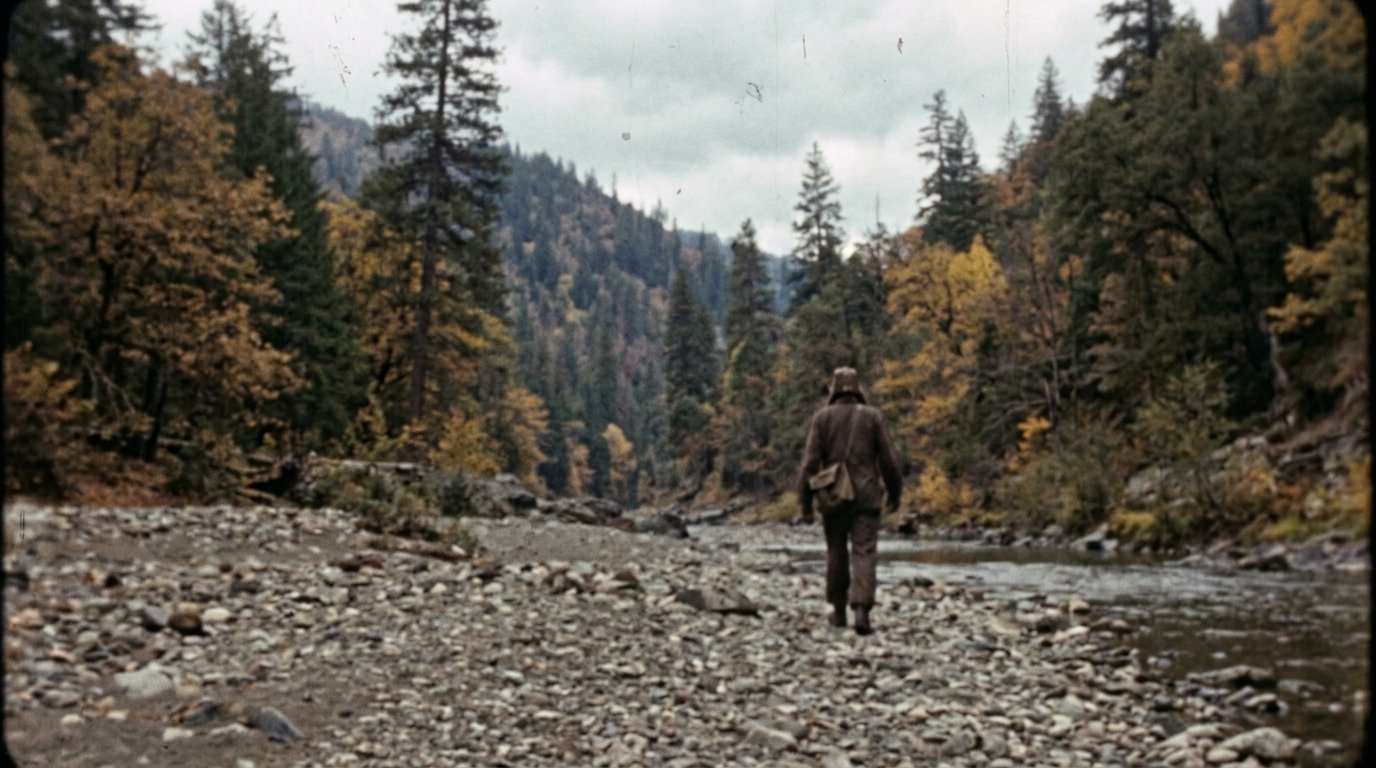
On October 20, 1967, Roger Patterson and Bob Gimlin were riding horses along Bluff Creek in Northern California.
They were searching for evidence of the creature commonly called Bigfoot.
According to their account, they encountered something unexpected.
Patterson reached for a camera.
The resulting film lasts less than a minute.
It became one of the most famous pieces of cryptid evidence ever recorded.
The Film
The footage shows a large, apparently humanlike figure walking away from the camera across a gravel bar.
The figure turns briefly toward Patterson before continuing into the trees.
Patterson later called the creature "Patty."
The film contains no audio of the encounter and provides no physical specimen.
Everything depends on what the viewer believes the image represents.
The Bigfoot Interpretation
Supporters argue that the figure's proportions and movement are difficult to reproduce with a conventional costume.
Particular attention has been paid to the apparent musculature, stride, arm length and body proportions.
Some researchers have argued that the figure's gait is inconsistent with an ordinary person wearing a simple costume.
The film has therefore remained central to modern Bigfoot research.
The Hoax Theory
The alternative explanation is straightforward.
The figure was a person wearing a costume.
Critics have pointed to Patterson's financial interest in Bigfoot, the limitations of the film, and the lack of independent physical evidence.
Some researchers have attempted to recreate the figure using costumes available at the time.
Others argue that the movement and proportions visible in the footage are difficult to reproduce convincingly.
The Film Itself
One important distinction is often lost in the debate.
The existence of the film is not disputed.
The question is what appears in it.
The footage has been examined repeatedly over the decades.
Researchers have studied individual frames, image quality, gait and apparent anatomy.
One published analysis by researchers associated with Idaho State University concluded that the film showed no evidence of deceptive alteration and argued that the image quality was sufficient for detailed analysis.
That conclusion does not establish that the subject was a previously unknown primate.
It establishes only that the footage itself remains worthy of examination.
The Missing Evidence
There is no body.
There is no skeleton.
There is no confirmed DNA sample.
There is no independently verified biological specimen from the encounter.
That absence is critical.
If the figure represents an unknown species, the film is extraordinary evidence.
If it represents a person in a costume, the film is an extraordinary piece of filmmaking and an enduring hoax controversy.
Either way, the historical event is real.
What Remains
The Patterson–Gimlin Film cannot prove Bigfoot exists.
It also cannot simply be dismissed by pointing out that a costume could theoretically exist.
The question is whether the specific figure shown in the footage was a person in a costume.
More than fifty years later, that question remains disputed.
The film survives.
The figure survives on celluloid.
The answer does not.
Case Status
Disputed
The classification above describes the current status of this entry within the Forbidden Lore archive. A documented report does not necessarily establish the explanation offered for it as fact.