Case Record
The following record has been compiled from the available account associated with this case.
The Case
On July 8, 1947, the United States Army issued one of the most extraordinary announcements in the history of the UFO phenomenon.
Personnel from Roswell Army Air Field had recovered a "flying disc."
The announcement did not come from an anonymous witness.
It did not appear first in a UFO magazine.
It came from the military.
Within hours, the story changed.
The strange object was not a flying disc, officials said.
It was a balloon.
Photographs were taken showing military officers with pieces of foil, rubber and radar-reflector material.
The excitement subsided.
For roughly three decades, the incident remained relatively obscure.
Then Roswell returned.
Beginning in the late 1970s, researchers reopened the case and interviewed people connected to the 1947 recovery.
Former intelligence officer Jesse Marcel said the material he handled had been extraordinary.
Additional witnesses emerged.
Stories appeared about unusual wreckage.
Then came stories of a second crash site.
Bodies.
A military cover-up.
Secret autopsies.
Government documents.
Underground facilities.
Eventually, Roswell became something far larger than the event that occurred in 1947.
It became the foundational crash-retrieval story of modern UFO culture.
But beneath more than seventy years of mythology lies a historical event that can actually be investigated.
Something fell or was deposited on a ranch in New Mexico.
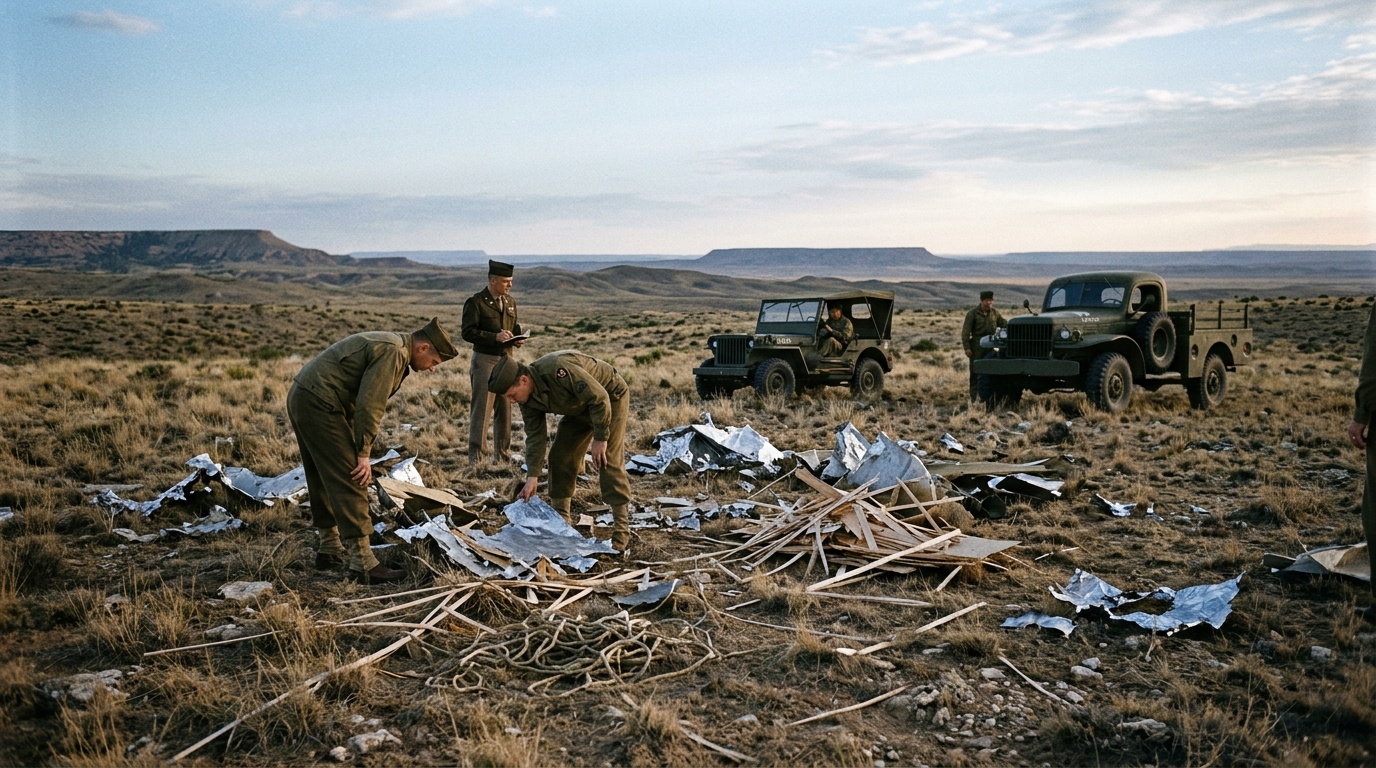
William "Mac" Brazel found debris.
Military personnel recovered it.
The Roswell Army Air Field announced that it had captured a flying disc.
The Army quickly withdrew that description.
And decades later, the United States Air Force identified the debris as belonging to Project Mogul, a classified balloon program connected to early efforts to monitor Soviet nuclear activity.
That explanation accounts remarkably well for the original debris.
It does not explain every story later attached to Roswell.
That is partly because many of those stories did not exist in the documented 1947 record.
To understand Roswell, the legend has to be dismantled and rebuilt chronologically.
The question is not simply:
Did a UFO crash at Roswell?
The better question is:
What actually happened in New Mexico in 1947, and when did the rest of the Roswell story appear?
America in the Summer of 1947
Roswell did not happen in isolation.
The summer of 1947 marked the beginning of the modern flying-saucer era.
On June 24, private pilot Kenneth Arnold reported seeing nine unusual objects while flying near Mount Rainier in Washington State.
Arnold described their movement in a way that inspired journalists to use expressions such as "flying saucers" and "flying discs."
The terminology exploded.
Newspapers across the United States began publishing reports of mysterious objects in the sky.
Hundreds of sightings followed.
Some were almost certainly aircraft.
Some were astronomical objects.
Some were hoaxes.
Some remain difficult to reconstruct.
But culturally, something important had happened.
America was suddenly looking for flying discs.
Then came Roswell.
Roswell Army Air Field
Roswell, New Mexico, was not an insignificant military outpost.
Roswell Army Air Field was home to the 509th Bomb Group.
At the time, the 509th occupied an extraordinarily sensitive position in the American military.
It was the unit associated with the atomic bombing mission during World War II and remained part of the United States' early nuclear strike capability.
This detail would later become central to the Roswell legend.
If the military recovered something extraordinary, believers argued, the personnel at Roswell were not inexperienced amateurs likely to mistake a weather balloon for an alien spacecraft.
They belonged to an elite unit operating at the beginning of the atomic age.
That is true.
But expertise in nuclear bombing operations does not necessarily mean every officer was familiar with every classified balloon system being operated elsewhere.
Compartmentalization is a fundamental feature of military secrecy.
William "Mac" Brazel
The physical story begins with rancher William Ware "Mac" Brazel.
Brazel worked on the Foster ranch, a remote property northwest of Roswell.
At some point in June or early July 1947, he discovered unusual debris scattered across part of the ranch.
The exact chronology has been reconstructed differently over the years.
Contemporary newspaper accounts provide the most valuable evidence because they were recorded before Roswell became a legend.
According to those reports, Brazel found material that included combinations of:
foil-like material,
rubber,
paper,
sticks or lightweight structural pieces,
and other debris.
Nothing in the earliest public accounts clearly resembles a complete metallic spacecraft.
There is no contemporary description of an intact saucer.
There are no contemporary photographs of an exotic engine.
There is no documented alien body.
There is debris.
The Debris Field
Brazel's discovery was spread across an area of the ranch rather than concentrated as a recognizable aircraft wreck.
This is important.
A crashed conventional aircraft normally leaves substantial components.
Engines.
Structural pieces.
Wiring.
Seats.
Mechanical systems.
A spacecraft capable of interstellar travel would presumably contain complex machinery of some kind.
The debris described publicly in 1947 was very different.
Lightweight material.
Foil.
Rubber.
Paper-like material.
Sticks.
That description is far more compatible with balloon equipment than a sophisticated vehicle.
Later accounts dramatically changed the nature of the material.
But those later descriptions must be evaluated separately.
Brazel Hears About Flying Saucers
Flying-saucer reports were receiving national attention.
Brazel eventually connected his strange debris with the phenomenon being discussed in newspapers and on radio.
He brought the discovery to the attention of local authorities.
The information reached the sheriff's office in Roswell.
From there, the military became involved.
Sheriff George Wilcox
Brazel reportedly contacted Chaves County Sheriff George Wilcox.
Wilcox then communicated with Roswell Army Air Field.
The military dispatched personnel to investigate.
One of them would become the most important witness in the later Roswell controversy.
Major Jesse Marcel.
Jesse Marcel
Jesse Marcel served as an intelligence officer with the 509th Bomb Group.
He was sent to examine the debris along with Counterintelligence Corps officer Sheridan Cavitt.
Marcel recovered material from the ranch.
At the time, the incident did not transform him into a public UFO celebrity.
That happened decades later.
In 1978, UFO researcher Stanton Friedman interviewed Marcel.
Marcel then described the material as extraordinary.
His testimony helped resurrect Roswell.
Without Jesse Marcel's later account, the modern Roswell legend might never have developed in its familiar form.
What Marcel Later Remembered
Marcel said the debris did not resemble an ordinary weather balloon.
He described lightweight material with unusual properties.
Some accounts attributed to him included foil-like material that resisted damage or returned to its original shape.
Other later Roswell witnesses offered increasingly exotic descriptions.
Metal that could not be cut.
Material that could not be burned.
Strange symbols.
Extremely strong lightweight beams.
These descriptions became central to the extraterrestrial interpretation.
But they present an evidentiary problem.
They were recorded decades after the event.
The physical material itself was no longer available for independent testing.
Memory had become the evidence.
Sheridan Cavitt
Sheridan Cavitt accompanied Marcel to the ranch.
His later recollections differed significantly from the extraordinary interpretation.
Cavitt described material consistent with balloon debris.
That disagreement matters.
Two military personnel associated with the same recovery eventually described its significance very differently.
Marcel became one of the strongest witnesses for something extraordinary.
Cavitt did not.
This is a recurring feature of Roswell.
The closer one examines the witness record, the less unified it becomes.
The Debris Is Taken to Roswell
Material from the ranch was brought back to Roswell Army Air Field.
At this point, something remarkable happened.
The military public-information office prepared a press release.
July 8, 1947
On July 8, 1947, Roswell Army Air Field announced that personnel from the 509th Bomb Group had recovered a flying disc.
The release was distributed to local media.
The Roswell Daily Record and other newspapers reported the development.
The wording was sensational.
The military had apparently confirmed what the country had been talking about for weeks.
A flying disc had been captured.
For UFO believers, this remains one of the most important documents in the entire history of the phenomenon.
The Army itself said it.
Then the story changed.
Walter Haut
The press release was issued through the base public-information officer, Lieutenant Walter Haut.
Haut would later become another significant figure in the Roswell controversy.
In 1947, his role was straightforward.
He distributed the statement authorized by his superiors.
Decades later, statements attributed to Haut would become much more extraordinary, including claims connected to recovered craft and bodies.
As with many Roswell witnesses, the timing of those later claims is critical.
The 1947 record and the decades-later record are not the same thing.
Why Would the Army Say "Flying Disc"?
This is one of the strongest rhetorical questions in the Roswell case.
If the debris was merely balloon equipment, why did military personnel announce that they had recovered a flying disc?
There are several possibilities.
Personnel may genuinely have been confused.
The phrase "flying disc" was new and poorly defined.
The debris may have appeared unusual to people unfamiliar with the classified equipment.
The announcement may have been issued too quickly.
Military bureaucracy is not immune to mistakes.
The fact that the announcement was made is significant.
It proves the military initially described the recovered object publicly as a flying disc.
It does not prove that the recovered object was extraterrestrial.
The Story Reaches Fort Worth
The recovered material was sent through military channels.
Brigadier General Roger Ramey, commander of the Eighth Air Force in Fort Worth, Texas, became involved.
The public explanation changed.
The debris was identified as balloon-related equipment.
Photographers were invited.
The famous Fort Worth photographs were taken.
The Ramey Photographs
The photographs show military personnel posing with debris.
Among those photographed were Jesse Marcel and General Roger Ramey.
The material visible on the floor appears mundane.
Foil-like material.
Rubber.
Light structural components.
A radar reflector.
To skeptics, the photographs are devastating to the alien-spacecraft interpretation.
The visible material looks exactly like the kind of lightweight balloon equipment later associated with Project Mogul.
Believers respond with an important allegation.
They argue that the debris in the photographs was substituted.
Was the Debris Switched?
Jesse Marcel later claimed that the material photographed in Fort Worth was not the extraordinary debris he had recovered from the ranch.
According to this interpretation, military officials replaced the genuine material with ordinary weather-balloon equipment before allowing photographers into the room.
This claim solves an obvious problem for the extraterrestrial theory.
If the photographed debris looks like balloon equipment, then it was not the real debris.
But this creates another evidentiary challenge.
Once substitution is assumed, the photographic evidence becomes impossible to falsify.
Any mundane material can be dismissed as planted.
The claim therefore depends heavily on Marcel's later memory.
No surviving photograph conclusively shows the allegedly exotic debris.
The Weather Balloon Explanation
The Army's immediate revised explanation was essentially that the material came from a weather balloon and radar target.
This was incomplete.
The equipment was balloon-related.
But the program connected to it was more sensitive than ordinary weather observation.
That distinction would become important decades later.
Project Mogul
Project Mogul was a classified American program developed during the early Cold War.
The United States wanted a way to detect evidence of Soviet nuclear weapons testing.
One proposed method involved high-altitude balloon systems carrying acoustic equipment capable of detecting low-frequency sound generated by nuclear explosions.
The project involved balloon trains and associated equipment.
Its purpose was highly classified.
This created exactly the kind of situation capable of producing a misleading public explanation.
The military could acknowledge a balloon.
It could not necessarily explain what the balloon was actually doing.
Why Project Mogul Was Secret
In 1947, the Soviet Union had not yet publicly tested an atomic bomb.
Determining whether Moscow was developing nuclear weapons was a matter of enormous strategic importance.
A system intended to monitor Soviet nuclear activity was therefore not something the military wanted described in local newspapers.
Calling the recovered equipment a weather balloon protected the underlying mission.
This distinction helps explain why a mundane object could still produce genuine secrecy.
Secrecy does not automatically imply aliens.
Sometimes the secret is military intelligence.
The Mogul Balloon Trains
Project Mogul experiments could involve large arrays of balloons carrying equipment and radar reflectors.
These systems were much more elaborate than the small weather balloon an ordinary person might imagine.
A balloon train could travel considerable distances.
If it descended in a remote ranching area, it could scatter lightweight material across the ground.
Rubber components could degrade after exposure to sunlight.
Radar reflectors could break apart.
Foil and structural material could spread over a wide area.
This matches the basic physical character of the original Roswell debris surprisingly well.
The Radar Reflectors
Radar reflectors used with balloon systems were designed to make the balloon visible to radar.
They included lightweight structural components and metallic foil-like material.
Some reflectors used materials manufactured by toy or novelty companies.
This becomes relevant because later witnesses described unusual markings or symbols on pieces of debris.
The "Hieroglyphics"
One of the most famous Roswell details involves strange symbols supposedly seen on lightweight beams.
Witnesses later described markings resembling:
hieroglyphics,
flowers,
geometric designs,
or unusual writing.
For believers, these could represent extraterrestrial symbols.
The Project Mogul explanation provides a remarkably mundane alternative.
Some radar-reflector components reportedly used decorative tape produced by a toy manufacturer.
The tape carried colorful designs.
Seen decades earlier and remembered decades later, such markings could plausibly become "hieroglyphics."
This does not prove every symbol story originated with decorative tape.
But it provides a specific conventional mechanism.
Flight 4
Roswell discussions frequently focus on a particular Project Mogul launch commonly identified as Flight 4.
Records surrounding early Mogul operations are incomplete enough to have generated extensive debate over whether the relevant balloon train actually launched as reconstructed.
Researchers supporting the Mogul explanation argue that a June 1947 balloon operation provides the best match for the debris found by Brazel.
Critics challenge aspects of the launch chronology.
This is one of the more technical disputes in the Roswell case.
But the broader evidence does not depend entirely on assigning the debris to one numbered flight with absolute certainty.
The central point is that classified balloon operations using materials resembling the recovered debris were occurring in the region.
Charles B. Moore
Atmospheric scientist Charles B. Moore was involved with Project Mogul and later became an important source for reconstructing the program.
Moore argued that a Mogul balloon train could have traveled into the area where Brazel found the debris.
He analyzed winds and flight paths in support of that interpretation.
UFO researchers challenged aspects of his reconstruction.
The debate became highly technical.
Wind direction.
Launch dates.
Balloon configurations.
Recovery records.
But the existence of Project Mogul itself is not disputed.
The question is whether its equipment produced the specific Roswell debris.
Why Wasn't Mogul Mentioned in 1947?
Because it was classified.
This is one of the strongest aspects of the official explanation.
Critics often ask why the military lied about a weather balloon.
The answer is that the balloon system's actual purpose was secret.
A cover story involving weather research would have been entirely normal for classified military activity.
The military could therefore have concealed the truth in 1947 without concealing extraterrestrials.
The Story Fades
After the balloon explanation, Roswell largely disappeared from national attention.
This is one of the most striking facts in the history of the case.
If the event had immediately been understood as the recovery of alien bodies and a crashed spacecraft, one might expect a persistent underground legend.
Instead, Roswell remained comparatively obscure for decades.
The modern story did not explode in 1947.
It exploded around 1980.
Thirty Years of Relative Silence
The gap matters.
During the 1950s and 1960s, UFO culture grew enormously.
There were flying-saucer clubs.
Books.
Magazines.
Contactees.
Government investigations.
Congressional interest.
Project Blue Book.
Famous cases.
Yet Roswell was not the central UFO crash story it would later become.
That suggests that the elaborate modern narrative was not widely circulating immediately after the event.
This does not prove the event was mundane.
But it creates a historical problem for claims that dozens or hundreds of people knew about recovered aliens from the beginning.
Stanton Friedman Reopens the Case
In 1978, nuclear physicist and UFO researcher Stanton Friedman encountered Jesse Marcel.
Marcel described the 1947 recovery.
Friedman recognized the potential importance of the story.
Research began.
Other witnesses were contacted.
The forgotten incident returned.
This moment effectively marks the birth of the modern Roswell case.
The Roswell Incident
In 1980, Charles Berlitz and William Moore published The Roswell Incident.
The book brought the story to a large audience.
The narrative now involved much more than strange debris.
A crashed flying saucer.
Military secrecy.
Possible bodies.
A government cover-up.
Roswell had been transformed from a newspaper curiosity into a major UFO mystery.
The Story Expands
Once researchers began looking for witnesses, more stories appeared.
People remembered conversations.
Relatives repeated deathbed claims.
Former military personnel described unusual security.
Civilians remembered roads being blocked.
Nurses became part of the narrative.
Morticians.
Pilots.
Intelligence officers.
Over time, the number of alleged crash sites increased.
The number of claimed witnesses increased.
The descriptions became more extraordinary.
This is both the strength and weakness of Roswell.
There is an enormous witness literature.
Much of it appeared decades after the event.
The Bodies Enter the Story
The most dramatic modern Roswell claim is that alien bodies were recovered.
These bodies are now inseparable from popular culture's version of the incident.
Small humanoids.
Large heads.
Unusual eyes.
Military autopsies.
Sealed crates.
Secret flights.
But the earliest contemporary reporting does not mention bodies.
Mac Brazel's 1947 newspaper accounts do not describe alien occupants.
The July 8 military press release does not mention bodies.
The Fort Worth photographs show debris.
The alien-body narrative develops later.
That chronological distinction is critical.
Where Were the Bodies Supposedly Found?
Later Roswell literature introduced additional locations beyond Brazel's debris field.
Some accounts described a more substantial crash site elsewhere in New Mexico.
Others described an intact or partially intact craft.
Bodies were allegedly found nearby.
Different researchers proposed different locations.
This creates a major problem.
If the original ranch debris and the alleged body site are separate, evidence for one does not automatically establish the other.
The well-documented Brazel debris recovery cannot be used as direct proof of a second undocumented crash site.
The San Agustin Plains Story
One alternate crash narrative placed wreckage on the Plains of San Agustin.
This story became associated with witness accounts developed during later investigations.
Its reliability has been heavily disputed.
The geography is far removed from the original Brazel ranch debris field.
Connecting the sites requires a much more complicated crash scenario.
The farther Roswell expands geographically, the more independent evidence each location requires.
Glenn Dennis
Roswell mortician Glenn Dennis became one of the most famous witnesses connected to the alien-body narrative.
Dennis claimed that personnel from the air base contacted him with unusual questions about small caskets and preserving bodies.
He also told a story involving a nurse who allegedly described strange bodies at the base hospital.
This account became enormously influential.
It seemed to provide a direct connection between the military and nonhuman corpses.
But serious problems emerged.
The Missing Nurse
The nurse in Dennis's story proved extremely difficult to verify.
Names and identifying details changed or could not be confirmed satisfactorily.
Researchers attempting to match the alleged nurse to personnel records encountered problems.
If the central corroborating witness cannot be established, the story becomes significantly weaker.
Dennis remained convinced of his account.
But conviction cannot substitute for independent documentation.
Frank Kaufmann
Another celebrated Roswell witness was Frank Kaufmann.
Kaufmann claimed high-level involvement and knowledge of extraordinary events surrounding the crash.
His testimony was initially treated seriously by some researchers.
After his death, evidence emerged indicating that important parts of his story were unreliable and that documents associated with his claims had been fabricated.
This is a crucial lesson in the Roswell investigation.
Not every witness who sounds authoritative is reliable.
Why Bad Witnesses Matter
A weak witness does not prove every Roswell claim false.
But unreliable testimony contaminates the historical record.
Once dramatic stories enter books and documentaries, they are difficult to remove.
Later writers cite earlier writers.
Claims become detached from their original source.
Eventually, a questionable story can appear to have dozens of independent confirmations when all versions trace back to one unreliable witness.
Documented-case research must continually work backward toward the original evidence.
Walter Haut's Later Affidavit
Walter Haut, the public-information officer who issued the original press release, later became associated with a much more extraordinary account.
An affidavit released after his death described claims involving a craft and bodies.
Supporters consider this highly significant because Haut was unquestionably connected to the original incident.
Critics point to the late date of the statement, the circumstances surrounding its preparation and inconsistencies with earlier accounts.
Again, Roswell confronts the same problem.
The witness is historically real.
The later extraordinary testimony is difficult to verify independently.
Jesse Marcel Jr.
Jesse Marcel's son, Jesse Marcel Jr., also became part of the case.
He recalled his father bringing pieces of unusual debris home and showing them to the family.
Marcel Jr. described material containing unusual markings.
His testimony provides some support for the claim that the debris impressed Marcel before the material reached Fort Worth.
But Marcel Jr. was a child in 1947.
His detailed recollections were recorded much later.
The same memory limitations apply.
Marcel's Family Sees the Debris
According to later accounts, Jesse Marcel stopped at home with some of the recovered material.
Family members examined it.
This detail is interesting because it would be a remarkably casual action if Marcel knew he was transporting debris from an extraterrestrial spacecraft under extreme military secrecy.
But at that moment, he may not have known what the material represented.
If it was unusual balloon equipment, bringing some home to show his family is easier to understand.
The behavior itself does not settle the question.
Was Marcel an Expert Who Couldn't Be Fooled?
Roswell believers frequently emphasize Marcel's position as an intelligence officer.
Surely an intelligence officer at the world's only atomic bomber base would recognize a balloon.
But this argument overstates the situation.
Project Mogul was classified.
Its balloon trains could include unusual combinations of materials.
An intelligence officer does not automatically possess knowledge of every compartmentalized research project.
Marcel could sincerely believe the debris was unusual while still being mistaken about its origin.
Expertise reduces some kinds of error.
It does not eliminate them.
Marcel's Later Embellishments
Critics of Marcel have also identified apparent exaggerations or inaccuracies in statements he made about aspects of his military career.
Those issues complicate assessment of his testimony.
They do not prove he fabricated the Roswell story.
But when a case relies heavily on decades-later recollection, witness credibility matters.
Marcel remains one of Roswell's most important witnesses.
He is not an infallible one.
The Ramey Memo
One of the strangest pieces of Roswell evidence appears in the Fort Worth photographs.
General Ramey is shown holding a piece of paper.
The text is tiny and partially obscured.
Researchers realized that modern image enhancement might recover some of the words.
Thus began the controversy over the Ramey memo.
What Does the Ramey Memo Say?
Different researchers have claimed to identify different words.
Some believe the memo contains language consistent with the balloon explanation.
Others claim to see words such as "victims" or references that might support a crash-retrieval interpretation.
The image quality is simply not good enough to produce universally accepted transcription.
This makes the memo fascinating but inconclusive.
If a high-resolution original revealed clear text mentioning bodies, it could transform the case.
The surviving imagery does not provide that certainty.
The Problem With Image Enhancement
Enhancement cannot create information that the original photograph never captured.
Software can increase contrast.
Sharpen edges.
Enlarge pixels.
Apply statistical reconstruction.
But once letters fall below the image's true resolution, interpretation becomes subjective.
People begin seeing the words they expect.
The Ramey memo is therefore a classic example of evidence sitting at the boundary between data and pattern recognition.
Majestic 12
In the 1980s, another explosive Roswell development appeared.
Documents surfaced describing a secret government organization known as Majestic 12, supposedly established to manage the recovery and study of extraterrestrial technology.
If authentic, the documents would represent extraordinary evidence.
Their authenticity became intensely controversial.
Most historians and skeptical investigators regard them as fraudulent.
The MJ-12 Documents
The documents appeared through mysterious channels rather than through a clean archival discovery.
Researchers examined:
typefaces,
signatures,
formatting,
terminology,
historical inconsistencies,
document markings,
and provenance.
Serious authenticity problems emerged.
The documents have never achieved credible acceptance as genuine government records.
They remain important culturally because they helped shape the mythology of a permanent UFO cover-up.
They are not reliable proof of Roswell aliens.
Why Provenance Matters
A sensational document is only as strong as its origin.
If someone produces a government memorandum proving alien recovery, investigators need to know:
Where was it stored?
Who created it?
How was it obtained?
Does it match archival practices?
Can related records be found?
Can signatures and dates be verified?
Without provenance, a document can be manufactured.
MJ-12 demonstrates why dramatic content alone is not enough.
The Alien Autopsy Film
In 1995, Roswell mythology reached another extraordinary stage.
Film producer Ray Santilli presented footage allegedly showing the autopsy of an extraterrestrial recovered near Roswell.
The images became a worldwide sensation.
Television audiences watched medical personnel apparently dissect a humanoid body.
For many viewers, it looked like the ultimate proof.
It was not.
The Santilli Film
The alleged alien-autopsy footage displayed a small humanoid figure with unusual anatomy.
The film was promoted as historic military footage.
Questions quickly emerged about:
the medical procedures,
equipment,
film stock,
set design,
provenance,
and anatomy.
Eventually, the story collapsed.
Santilli acknowledged that the widely seen footage was a reconstruction, while maintaining that it had been inspired by original footage he claimed to have viewed.
No verifiable original film establishing an alien autopsy has surfaced.
The famous footage is not authentic evidence of Roswell bodies.
Why the Alien Autopsy Matters Anyway
The autopsy film illustrates how Roswell mythology feeds itself.
A real 1947 debris recovery creates a mystery.
The mystery creates expectations of alien bodies.
Those expectations make an alien-autopsy film believable.
The film then becomes part of public memory of Roswell.
Years later, people may remember that "there was footage of the bodies" without remembering that the footage was discredited.
Myth accumulates faster than correction.
The Air Force Reopens Roswell
By the early 1990s, Roswell had become so prominent that official investigations revisited the case.
The U.S. Air Force examined historical records in an attempt to determine what had been recovered in 1947.
Its conclusion centered on Project Mogul.
The 1994 Air Force Report
The Air Force published The Roswell Report: Fact vs. Fiction in the New Mexico Desert.
The report concluded that the debris recovered by Brazel and the military was associated with a classified balloon project rather than an extraterrestrial spacecraft.
Project Mogul provided the central explanation.
The report examined surviving documentation, personnel accounts and balloon operations.
For the original debris field, the explanation is strong.
The 1997 Air Force Report
A second report addressed the increasingly prominent claims involving bodies.
This report proposed that some later memories of bodies might have incorporated military anthropomorphic test dummies used in high-altitude research during later years.
It also discussed accidents and other military incidents that could have become conflated with Roswell.
This explanation became much more controversial.
The Test Dummy Problem
There is an obvious chronological difficulty.
Anthropomorphic test-dummy programs associated with New Mexico largely occurred years after 1947.
How could witnesses remember 1950s dummies as bodies recovered in 1947?
The Air Force argued that memories of different military events may have merged over decades.
That is psychologically possible.
But it is not a clean explanation for every body claim.
This is one reason even some skeptics consider the body portion of the Air Force explanation less satisfying than the Project Mogul explanation for the debris.
Two Different Questions
This distinction is essential.
Question one: What was the debris found by Mac Brazel?
Project Mogul provides a strong answer.
Question two: Why did people decades later report seeing bodies?
That is a different historical problem.
Test dummies may explain some memories.
Aircraft accidents may explain others.
Some witnesses may have misunderstood events.
Some stories may have been embellished.
Some were demonstrably unreliable.
There does not need to be one explanation for every later body account.
The Myth of a Perfect Government Explanation
The official explanation does not need to explain every sentence ever spoken about Roswell to be correct about the original event.
Over fifty years, unrelated stories can attach themselves to a famous mystery.
If one witness tells an unreliable body story in 1989, Project Mogul does not need to produce a 1947 balloon component resembling that body.
The witness story may simply be wrong.
This sounds obvious.
But much Roswell debate assumes that unless the government can explain every later claim, the extraterrestrial theory remains equally viable.
That is not how historical evidence works.
The Myth of a Perfect UFO Narrative
The extraterrestrial interpretation has the opposite problem.
There is no single consistent Roswell crash story.
Where exactly did the craft crash?
How many sites were there?
How many bodies?
Was one alive?
Where were they transported?
What did the craft look like?
Who saw it?
Why do the earliest records focus on lightweight debris?
Why did major body stories emerge decades later?
Different Roswell researchers have offered different answers.
The phrase "the Roswell crash" suggests a unified event that the witness record does not actually provide.
Were There Two Crash Sites?
Some researchers attempted to reconcile the debris field with body stories by proposing multiple sites.
Perhaps the spacecraft began breaking apart over the Brazel ranch.
Then the main craft traveled farther before crashing elsewhere.
This allows lightweight debris at one location and bodies at another.
It is physically possible as a narrative.
But each additional site requires independent evidence.
A well-documented debris field cannot automatically authenticate a second alleged crash.
The Archaeological Problem
If a substantial spacecraft crashed in the New Mexico desert, physical traces might remain.
Fragments.
Disturbed soil.
Unusual materials.
Environmental contamination.
Metallic debris.
Researchers have searched alleged locations.
No universally accepted extraterrestrial artifact has been recovered.
That absence is important.
A crashed technological vehicle should leave physical evidence.
The Roswell case instead relies overwhelmingly on testimony and historical documents.
Where Is the Alien Metal?
This is one of the simplest questions in the case.
If Marcel and others handled material with extraordinary physical properties, where is it?
No piece has been produced that can be independently tested and conclusively traced to the Roswell recovery.
Various alleged UFO materials have surfaced over the decades.
None has established a Roswell extraterrestrial origin.
Without physical material, extraordinary descriptions remain stories.
What Would Alien Material Look Like?
It does not necessarily need to contain an element unknown to science.
An extraterrestrial civilization might use ordinary elements.
The relevant evidence could instead involve:
unusual isotopic ratios,
manufacturing structures impossible for 1947 technology,
engineered metamaterials,
microscopic fabrication,
or other demonstrably anomalous properties.
No authenticated Roswell sample has produced such evidence.
Why Didn't Anyone Keep a Piece?
Some later witnesses claimed small fragments were retained.
If so, none has emerged with an unbroken chain of custody and extraordinary properties.
Military confiscation could explain why most material disappeared.
But every missing artifact cannot automatically become evidence of confiscation.
Historical claims require surviving evidence whenever possible.
Roswell's most important physical evidence is precisely what is missing.
The Military Secrecy Was Real
One mistake is to assume skeptics must deny secrecy.
They do not.
Military secrecy absolutely surrounded activities in New Mexico during the early Cold War.
Nuclear weapons.
Missile development.
Balloon surveillance.
Radar.
High-altitude research.
Intelligence programs.
Roswell Army Air Field itself was part of a highly sensitive military infrastructure.
The question is not whether secrets existed.
They did.
The question is what those secrets were.
Project Mogul provides a documented secret directly relevant to the debris.
Secrecy Creates Legends
A government cover story can have consequences decades later.
Suppose the military tells the public that classified surveillance equipment is merely a weather balloon.
Years later, people discover that the explanation was incomplete.
Suspicion follows.
If officials concealed one thing, what else did they conceal?
This reasoning is understandable.
But it can produce an evidentiary leap.
The discovery that the government hid Project Mogul does not imply that it also hid aliens.
In fact, Mogul explains why secrecy was necessary without aliens.
Roswell and the Nuclear Age
The timing of Roswell helped give it enormous symbolic power.
World War II had ended only two years earlier.
Atomic weapons had changed civilization.
The Cold War was beginning.
Military technology was advancing rapidly.
Rockets captured from Germany were being studied in New Mexico.
Secret bases dotted the desert.
Then came reports of flying discs.
Roswell sat perfectly at the intersection of nuclear secrecy and extraterrestrial imagination.
The Nearby Missile Testing Culture
New Mexico was one of the most technologically unusual places in America during the 1940s.
The Trinity nuclear test had occurred there in 1945.
White Sands hosted rocket research.
Military aircraft crossed remote desert areas.
Classified experiments were routine.
For civilians, strange equipment could appear without explanation.
This environment makes both interpretations psychologically understandable.
It was exactly where secret human technology might be encountered.
And exactly where people might imagine secret nonhuman technology being hidden.
Roswell Before Area 51
Today, Roswell and Area 51 are often mentioned together.
Historically, they represent different eras and locations.
Area 51 became associated with classified aircraft testing in Nevada.
Roswell involved a 1947 debris recovery in New Mexico.
Popular culture merged them into a general mythology of government UFO secrecy.
This illustrates how separate historical mysteries gradually become one cultural narrative.
Roswell and Hangar 18
Stories also developed around supposed facilities where alien bodies or spacecraft were stored.
"Hangar 18" became a recurring term in UFO culture.
Different versions placed secret material at different military installations.
Again, documentary evidence establishing an actual alien-storage facility has not emerged.
The idea became culturally powerful because it answered the obvious question:
If the military recovered a spacecraft, where did it go?
The answer became another layer of legend.
Wright Field
Some Roswell accounts claim debris or bodies were transported to Wright Field in Ohio, later Wright-Patterson Air Force Base.
The base had major expertise in foreign technology and technical intelligence.
If the military recovered an unknown aircraft, sending material there would make logical sense.
That plausibility has helped the story persist.
But plausible procedure is not evidence that extraterrestrial material actually arrived.
No authenticated record establishes such a transfer.
General Ramey
Roger Ramey occupies a complicated place in Roswell history.
In the extraterrestrial narrative, he becomes one of the first officials involved in suppressing the truth.
In the conventional narrative, he was the senior officer correcting an embarrassing premature identification.
The historical evidence confirms his involvement in presenting the balloon explanation.
It does not reveal his private thoughts.
Assigning motive requires inference.
The Famous Office Photographs
The Fort Worth photographs remain among the most valuable pieces of contemporary evidence because they were created immediately.
Unlike decades-later testimony, the photographs do not have memory.
They show material physically present in the room.
The material appears compatible with balloon equipment.
That fact carries considerable evidentiary weight.
The extraterrestrial theory must therefore either explain the material or argue that it was substituted.
Contemporary Evidence Versus Retrospective Testimony
This is perhaps the most important methodological principle in Roswell.
Evidence created in July 1947 generally deserves more weight than recollections first recorded in the 1980s or 1990s.
That does not mean later witnesses are automatically wrong.
It means memories can change.
Stories can merge.
Media coverage can influence recollection.
People can unintentionally incorporate information learned later.
Some can exaggerate.
A few can fabricate.
Contemporary documentation avoids many of those problems.
What the 1947 Newspapers Actually Show
The newspapers establish several important facts.
Mac Brazel found debris.
The military recovered it.
Roswell Army Air Field initially described it as a flying disc.
The explanation quickly changed to balloon equipment.
Brazel publicly described lightweight debris.
No contemporary newspaper account establishes alien bodies.
No contemporary newspaper photograph shows a spacecraft.
This is the historical core.
Everything beyond it requires additional evidence.
Did Brazel Change His Story?
Later researchers argued that Brazel's public statements may have been influenced by military pressure.
Some accounts suggest he was held or questioned.
The evidence for coercion varies substantially depending on the source.
It is plausible that military officials wanted to control information about classified equipment.
That does not establish that they threatened Brazel into concealing aliens.
Again, ordinary military secrecy can produce behavior that looks suspicious decades later.
Was Brazel Detained?
Claims that Brazel was detained by the military became part of later Roswell narratives.
Contemporary documentation does not provide a clear record of an extraordinary imprisonment connected to alien secrecy.
He may have spent time interacting with military personnel while the incident was investigated.
The stronger claims of intimidation rely heavily on later testimony.
They should therefore be treated cautiously.
The Cover-Up Hypothesis
The full extraterrestrial interpretation requires a major cover-up.
Military personnel recover a crashed spacecraft.
Bodies are found.
The wreckage is transported.
Witnesses are threatened.
Documents are classified or destroyed.
A weather-balloon explanation is released.
For decades, the operation remains hidden.
Such a cover-up is possible in principle.
Governments have successfully concealed classified programs.
But the scale of the alleged Roswell secret creates difficulties.
How Many People Would Have Known?
A crash retrieval involving:
military police,
medical personnel,
intelligence officers,
pilots,
transport crews,
scientists,
commanders,
base personnel,
and recovery teams
could involve dozens or hundreds of people.
Keeping an event of that magnitude secret for decades would be difficult.
Supporters argue that military discipline, compartmentalization and threats could achieve it.
Critics point out that despite thousands of later claims, no authenticated alien material or decisive documentary record has emerged.
Deathbed Confessions
Roswell literature contains numerous stories of witnesses revealing secrets late in life.
Deathbed testimony has emotional power.
A dying person appears to have little reason to lie.
But deathbed status does not make memory accurate.
People can sincerely believe false memories.
They can repeat stories heard from others.
They can exaggerate.
They can seek significance.
Each statement must be evaluated on evidence, not on proximity to death.
Secondhand Testimony
Many Roswell claims are secondhand.
"My father told me."
"My husband saw."
"A nurse said."
"Someone at the base told us."
Such testimony can preserve real history.
It is also inherently weaker than direct evidence.
Each transmission introduces another opportunity for misunderstanding.
A documented archive should distinguish clearly between firsthand and secondhand accounts.
The Roswell Witness Explosion
By the 1990s, the number of people connected to Roswell had become enormous.
This creates the impression of overwhelming corroboration.
But witnesses were not all describing the same event.
Some saw debris.
Some heard rumors.
Some described bodies.
Some described military activity.
Some repeated family stories.
Some were later discredited.
Counting witnesses without evaluating what each actually knew produces a misleading picture.
Independent Corroboration
True corroboration requires independent witnesses describing the same specific detail without influencing one another.
If five books repeat one witness's story, that is not five sources.
It is one source reproduced five times.
Roswell research is particularly vulnerable to this problem because decades of books cite earlier books.
Tracing claims to their first documented appearance is essential.
Memory After Forty Years
Psychological research demonstrates that memory is reconstructive.
People do not store perfect recordings of events.
Each recollection can modify the memory.
Later information can become incorporated.
This becomes particularly serious when someone is asked in 1989 to remember an unusual event from 1947.
Forty-two years have passed.
That does not make the memory worthless.
It makes precise extraordinary details less reliable.
Could Witnesses Remember Something This Important?
Yes.
People can remember extraordinary events for decades.
But they may remember the central event while changing details.
A witness may accurately remember:
"The military recovered strange material."
while inaccurately remembering:
the exact date,
the dimensions,
the wording of a conversation,
or the precise appearance of markings.
Historical investigation must separate durable core memory from fragile detail.
Why Roswell Researchers Disagree
Roswell investigators do not divide neatly into believers and skeptics.
Even researchers convinced something extraordinary happened disagree about:
crash locations,
witness reliability,
body stories,
documents,
timelines,
and military involvement.
Some reject MJ-12.
Some reject Glenn Dennis.
Some accept Marcel but reject later embellishments.
Some believe Mogul explains the debris but not other reports.
This disagreement is evidence of how complicated the record has become.
Could Project Mogul Really Fool the 509th?
This remains one of the most emotionally persuasive objections.
The 509th was elite.
How could its intelligence officer mistake balloon debris for a flying disc?
But the argument assumes that "flying disc" in July 1947 meant "extraterrestrial spacecraft."
It did not.
The term was new.
Nobody knew what flying discs supposedly were.
An unusual collection of lightweight debris associated with a classified program could be interpreted within the frenzy of contemporary saucer reports.
The initial identification may simply have been premature.
The Press Release May Be Less Extraordinary Than It Sounds
Today, the words "flying disc" immediately evoke alien spacecraft.
In July 1947, the phrase was less fixed.
People were reporting mysterious discs across the country.
The military did not necessarily mean:
We have captured an extraterrestrial spacecraft.
It may have meant:
We recovered something we believe corresponds to the objects currently being called flying discs.
That is still remarkable.
But it changes the historical context.
The Government's Changing Story
The rapid shift from "flying disc" to "weather balloon" remains suspicious-looking.
That suspicion is justified.
The public was not initially given the complete truth.
If Project Mogul was responsible, the military concealed the project's actual purpose.
The critical question is whether the concealment involved extraterrestrials or classified Cold War surveillance.
The documented existence of Mogul makes the latter explanation much stronger.
Was Project Mogul Invented as a Later Cover Story?
Some Roswell proponents argue that Mogul itself became a convenient retroactive explanation.
But Project Mogul is independently documented.
Its existence does not depend on the Roswell controversy.
Records, personnel and technical history establish the program.
The remaining debate concerns whether the specific debris recovered near Roswell came from one of its balloon trains.
That is very different from claiming the entire program was fabricated to explain Roswell.
The Physical Match
The Project Mogul explanation is strongest where historical explanations should be strongest:
the physical evidence.
Balloons explain rubber.
Radar reflectors explain foil.
Lightweight structural components explain sticks or beams.
Decorative manufacturing tape can explain strange markings.
A balloon train can explain a wide debris field.
Classification explains secrecy.
A weather-balloon cover story explains the misleading public statement.
Few extraordinary assumptions are required.
Occam's Razor and Roswell
Occam's Razor does not mean the simplest story is automatically true.
It means explanations should avoid unnecessary assumptions when multiple theories fit the evidence.
Compare two hypotheses.
Project Mogul
A classified balloon system falls on a ranch.
A rancher finds debris.
Military personnel unfamiliar with its exact origin investigate.
The base prematurely announces a flying disc.
Senior officials recognize balloon equipment.
The military conceals the classified purpose.
Decades later, memory and UFO culture expand the story.
Extraterrestrial Crash
An alien spacecraft crashes.
The military recovers debris and bodies.
Officials substitute fake wreckage.
Witnesses are silenced.
Material is secretly transported.
Records are hidden.
Multiple crash sites become involved.
The operation remains concealed for decades.
Later witnesses reveal fragments of the truth, but no authenticated alien material survives publicly.
The second hypothesis is possible.
It requires far more unsupported assumptions.
But Occam's Razor Is Not Proof
A simpler explanation can still be wrong.
Project Mogul should not be accepted merely because it is conventional.
It should be accepted to the extent that evidence supports it.
Its strength comes from documented balloon operations and the physical match to the original debris.
If authenticated exotic material appeared tomorrow, the conclusion would need to change.
Historical investigation must remain evidence-driven.
What About Alien Bodies?
Project Mogul does not contain alien bodies.
That is often presented as a fatal problem.
But only if the body stories are assumed to be true.
The better approach is to evaluate them independently.
The body accounts appeared primarily decades later.
Some important witnesses proved unreliable.
Some stories changed.
No contemporary medical documentation establishes nonhuman corpses.
No photographs with authenticated provenance exist.
No biological sample exists.
The body claim therefore has much weaker evidence than the debris recovery.
The Bodies Are the Weakest Part of the Case
Ironically, the most famous part of Roswell may be its least historically secure.
The debris is documented.
The military recovery is documented.
The press release is documented.
The retraction is documented.
Project Mogul is documented.
Alien bodies are not documented at the same level.
They depend largely on retrospective testimony.
That does not make them impossible.
It makes them evidentially weak.
Why Bodies Became Necessary
Once Roswell became a crashed-spacecraft story, bodies were almost inevitable.
If a spacecraft crashed, people ask:
Who was flying it?
The narrative naturally develops occupants.
Then autopsies.
Then secret medical facilities.
Then government biological research.
Stories fill gaps.
This does not mean every body witness deliberately invented their account.
It demonstrates how narratives evolve.
The Roswell Museum Era
Roswell eventually embraced its association with UFOs.
Museums.
Festivals.
Alien imagery.
Tourism.
Gift shops.
The city became internationally synonymous with extraterrestrials.
This commercial culture developed long after the original event.
It should not be used as evidence for or against what happened in 1947.
But it demonstrates how completely the legend transformed the identity of a real place.
Roswell in Popular Culture
Films, television programs, novels, documentaries and video games repeatedly returned to Roswell.
The incident became shorthand for:
alien crashes,
government conspiracies,
secret autopsies,
Men in Black,
underground laboratories,
and hidden technology.
By the twenty-first century, many people knew the cultural Roswell story without knowing the historical one.
The mythology had eclipsed the debris.
Roswell and The X-Files
Popular television in the 1990s reinforced the idea that governments possessed recovered alien technology.
Roswell fit perfectly into that narrative.
The relationship worked in both directions.
Roswell inspired fiction.
Fiction then influenced how audiences imagined Roswell.
Separating cultural memory from historical evidence became increasingly difficult.
The Internet Era
The internet multiplied Roswell claims.
Documents circulated without provenance.
Photographs were miscaptioned.
Quotes lost their sources.
Witness stories were shortened into memes.
Discredited claims continued circulating alongside legitimate archival material.
This makes Roswell an ideal example of why source hierarchy matters.
Not all information is evidence.
Not all evidence has equal weight.
The Strongest Evidence for Something Unusual
The extraterrestrial case does have legitimate points worth considering.
The military initially announced recovery of a flying disc.
Jesse Marcel later insisted the debris was extraordinary.
Some witnesses described unusual material.
The public explanation changed rapidly.
Military secrecy surrounded the event.
Later witnesses claimed knowledge of additional recovery operations.
The Ramey memo remains difficult to read conclusively.
These facts explain why Roswell continues to attract serious interest.
The Strongest Evidence for Project Mogul
The conventional case is considerably stronger.
Project Mogul existed.
It operated in New Mexico.
It used balloon trains.
Its equipment included materials broadly matching contemporary descriptions of the debris.
Its purpose was classified.
Classification explains why the military would not give a complete public account.
The Fort Worth photographs show balloon-like debris.
Contemporary descriptions emphasize lightweight material rather than sophisticated machinery.
The elaborate body narratives appear much later.
No authenticated extraterrestrial material has surfaced.
Taken together, these points provide a coherent explanation of the original event.
What Is Actually Documented?
The following can be established with relatively strong historical evidence.
In 1947, Mac Brazel found unusual debris on a ranch northwest of Roswell.
The debris was reported to local authorities.
Personnel from Roswell Army Air Field investigated and recovered material.
Major Jesse Marcel participated in the recovery.
On July 8, the base issued a statement saying it had recovered a flying disc.
The military quickly changed the public explanation to balloon equipment.
Photographs taken in Fort Worth show lightweight debris consistent with a balloon and radar reflector.
Project Mogul was a real classified American balloon program operating during this period.
Later Air Force investigations concluded that Mogul equipment best explained the original debris.
Decades after the event, numerous witnesses made more extraordinary claims.
Some of those witnesses have serious credibility problems.
No authenticated physical evidence establishes an extraterrestrial spacecraft.
No authenticated biological evidence establishes alien bodies.
What Is Not Established?
It has not been established that an extraterrestrial spacecraft crashed near Roswell.
It has not been established that nonhuman bodies were recovered.
It has not been established that one alien survived.
It has not been established that a spacecraft was transported to Wright-Patterson Air Force Base.
It has not been established that Majestic 12 existed as described in the famous documents.
It has not been established that the Santilli alien-autopsy film depicts a genuine 1947 event.
It has not been established that the Fort Worth debris was substituted.
It has not been established that the unreadable portions of the Ramey memo mention alien victims.
And it has not been established that every later Roswell witness was describing the same event.
What Roswell Does Prove
Roswell proves something less sensational but historically important.
The United States military recovered unusual-looking debris during the first major American flying-saucer wave.
The military initially publicly identified that debris using the language of the flying-saucer phenomenon.
The explanation was changed almost immediately.
The actual military activity associated with the likely source of the debris was classified.
That combination created perfect conditions for suspicion.
And once the secret program was forgotten, the incomplete explanation became fertile ground for a much larger mystery.
Why the Official Explanation Is Persuasive
A strong explanation should account for multiple facts at once.
Project Mogul does.
Why was balloon-like debris found?
Because a balloon system came down.
Why was the debris unusual?
Because it was part of specialized equipment.
Why was the military interested?
Because the system was associated with classified national-security research.
Why wasn't its real purpose announced?
Because it was classified.
Why was a weather balloon mentioned?
Because weather research provided a convenient public explanation.
Why did later discovery of secrecy generate suspicion?
Because the government had indeed withheld information.
The explanation fits without requiring extraterrestrial technology.
Why Roswell Still Feels Unresolved
Because historical explanation and cultural mystery are not the same thing.
Project Mogul can explain the original debris.
It cannot erase decades of witness testimony.
Some of those witnesses were sincere.
Some remain difficult to evaluate.
The original flying-disc press release is still astonishing.
The government's changing story still looks suspicious when removed from classified-program context.
And the possibility of extraterrestrial life carries enormous emotional weight.
A balloon cannot compete with an alien spacecraft as a story.
The Evidence Hierarchy
If the Roswell evidence is ranked by reliability, the picture becomes clearer.
At the top are contemporary documents and photographs.
Then come records of Project Mogul and military operations.
Then contemporary witness accounts.
Farther down are decades-later firsthand memories.
Below those are secondhand stories.
Then anonymous claims.
Then documents of uncertain provenance.
Then fictionalized reconstructions and outright hoaxes.
Much of the extraterrestrial Roswell narrative depends on evidence from the lower half of that hierarchy.
The Project Mogul explanation depends heavily on the upper half.
That difference matters.
Could New Evidence Change the Verdict?
Absolutely.
Suppose a piece of debris emerged with documented chain of custody from the Brazel ranch.
Independent laboratories analyze it.
The material contains engineered structures impossible for 1947 manufacturing.
Its isotopic composition is inconsistent with terrestrial sources.
Military documents independently verify its recovery.
That would radically change Roswell.
Or suppose authenticated 1947 records clearly describe nonhuman bodies.
Again, the conclusion would change.
The problem is that after nearly eight decades, such evidence has not emerged.
What Evidence Would Prove the Alien Crash?
At minimum, something would need to move the case beyond retrospective testimony.
Authenticated wreckage.
Authenticated biological material.
Clear contemporary photographs.
Military records with secure provenance.
Independent documentation from multiple archival sources.
Something physically or historically incompatible with Project Mogul and conventional military activity.
Roswell has produced enormous quantities of claims.
It has not produced that decisive evidence.
The Most Likely Reconstruction
The available evidence supports a reconstruction substantially less dramatic than the legend.
During June 1947, a balloon system connected to classified American atmospheric research comes down in rural New Mexico.
The equipment scatters across the Foster ranch.
Mac Brazel eventually discovers the debris.
The country is meanwhile experiencing a wave of reports about "flying discs."
Brazel reports the material.
The Roswell military becomes involved.
Jesse Marcel and Sheridan Cavitt inspect and recover it.
Personnel unfamiliar with the exact classified project interpret the strange lightweight material in the context of the flying-disc craze.
Roswell Army Air Field issues a premature press release announcing recovery of a flying disc.
The debris reaches higher command.
It is recognized as balloon-related material.
Officials retract the flying-disc announcement.
Because the underlying program is classified, the public receives the simpler explanation of a weather balloon.
The story fades.
Thirty years pass.
Jesse Marcel tells UFO researchers that the material had been extraordinary.
Researchers reopen the case.
Additional witnesses are sought.
Some provide genuine memories.
Some provide secondhand accounts.
Some exaggerate.
Some are unreliable.
Stories of additional crash sites and bodies develop.
Books popularize them.
The government's original incomplete explanation increases suspicion.
Roswell becomes a national mystery.
Eventually, Project Mogul is declassified and identified as the likely source of the debris.
But by then the historical event has become something much larger.
It has become mythology.
Why "Explained" Fits the Case
Calling Roswell explained does not mean every statement ever made about Roswell has been individually solved.
It means the central historical event—the recovery of unusual lightweight debris from the Brazel ranch—has a well-supported conventional explanation.
Project Mogul existed.
Its equipment matches the basic contemporary debris descriptions.
Its classification explains military secrecy.
The surviving photographs are consistent with balloon equipment.
No physical evidence requires an extraterrestrial explanation.
Later claims involving bodies, additional crash sites and secret operations remain disputed.
But disputed later testimony does not outweigh stronger contemporary evidence about the original recovery.
The Difference Between Roswell the Event and Roswell the Legend
There are really two Roswells.
The first occurred in 1947.
A rancher found debris.
Military personnel recovered it.
A press release called it a flying disc.
Officials quickly changed the explanation.
The second Roswell developed after 1978.
A crashed spacecraft.
Alien bodies.
Autopsies.
Multiple crash sites.
MJ-12.
Secret hangars.
Deathbed confessions.
Government conspiracies.
The first Roswell is well documented.
The second is largely constructed from retrospective testimony, disputed documents and cultural accumulation.
Confusing them is the source of much of the mystery.
The Verdict
Status: Explained
Something real happened near Roswell, New Mexico, in the summer of 1947.
Debris was found on the Foster ranch.
Military personnel recovered it.
Roswell Army Air Field publicly announced that it had obtained a "flying disc."
The announcement was quickly withdrawn.
Those events are documented.
The strongest available evidence indicates that the recovered material came from equipment associated with Project Mogul, a classified American balloon program developed during the early Cold War to help detect Soviet nuclear activity.
That explanation accounts for the lightweight debris.
It accounts for balloon and radar-reflector material.
It accounts for military interest.
It accounts for genuine secrecy.
And it explains why officials in 1947 could acknowledge a balloon while concealing its actual purpose.
The extraterrestrial interpretation requires substantially more.
It requires accepting that the photographed debris was substituted.
It requires believing decades-later accounts of extraordinary materials over the surviving contemporary evidence.
The more elaborate version requires additional crash sites.
Bodies.
Secret transport operations.
Medical examinations.
Threatened witnesses.
Hidden records.
And a government cover-up maintained for generations.
None of those claims has produced authenticated physical evidence establishing an extraterrestrial origin.
The famous alien-autopsy film is not authentic evidence.
The Majestic 12 documents have severe authenticity problems.
Several once-prominent witnesses have been discredited or challenged.
Other witnesses may have been completely sincere but were recalling events after enormous spans of time.
Roswell therefore remains culturally mysterious while being historically much less mysterious than its reputation suggests.
The military did hide something.
That part of the story is true.
But the best evidence indicates that the secret was not a dead extraterrestrial pilot.
It was an American intelligence program trying to listen for the Soviet Union's first atomic bomb.
And perhaps that is the most important lesson of Roswell.
A government does not need to hide aliens to create an alien conspiracy.
It only needs to hide something.
In July 1947, the United States military had something worth hiding.
A classified surveillance project.
A premature announcement transformed its debris into a flying disc.
A hurried correction created suspicion.
Three decades of silence created space for reinterpretation.
And decades of books, testimony, hoaxes, documentaries and popular culture transformed a scattered field of foil, rubber and lightweight equipment in the New Mexico desert into the most famous alleged extraterrestrial crash site on Earth.
The debris was recovered.
The secrecy was real.
The first explanation was incomplete.
The alien spacecraft remains unproven.
And that distinction is the difference between the Roswell incident and the Roswell legend.
Case Status
Explained
The classification above describes the current status of this entry within the Forbidden Lore archive. A documented report does not necessarily establish the explanation offered for it as fact.