Case Record
The following record has been compiled from the available account associated with this case.
The Case
On the evening of March 13, 1997, something unusual crossed the skies of Arizona.
Then, hours later, something unusual appeared again.
Witnesses from widely separated parts of the state reported lights moving through the night in formations that appeared enormous, silent and unlike ordinary aircraft.
Some saw a line of lights.
Others described a V.
Some reported a triangle.
Several insisted that the lights were not independent objects at all but were attached to one vast dark structure passing overhead.
Later that night, another group of brilliant lights appeared southwest of Phoenix.
They seemed to hover.
They remained visible for extended periods.
They slowly disappeared one by one.
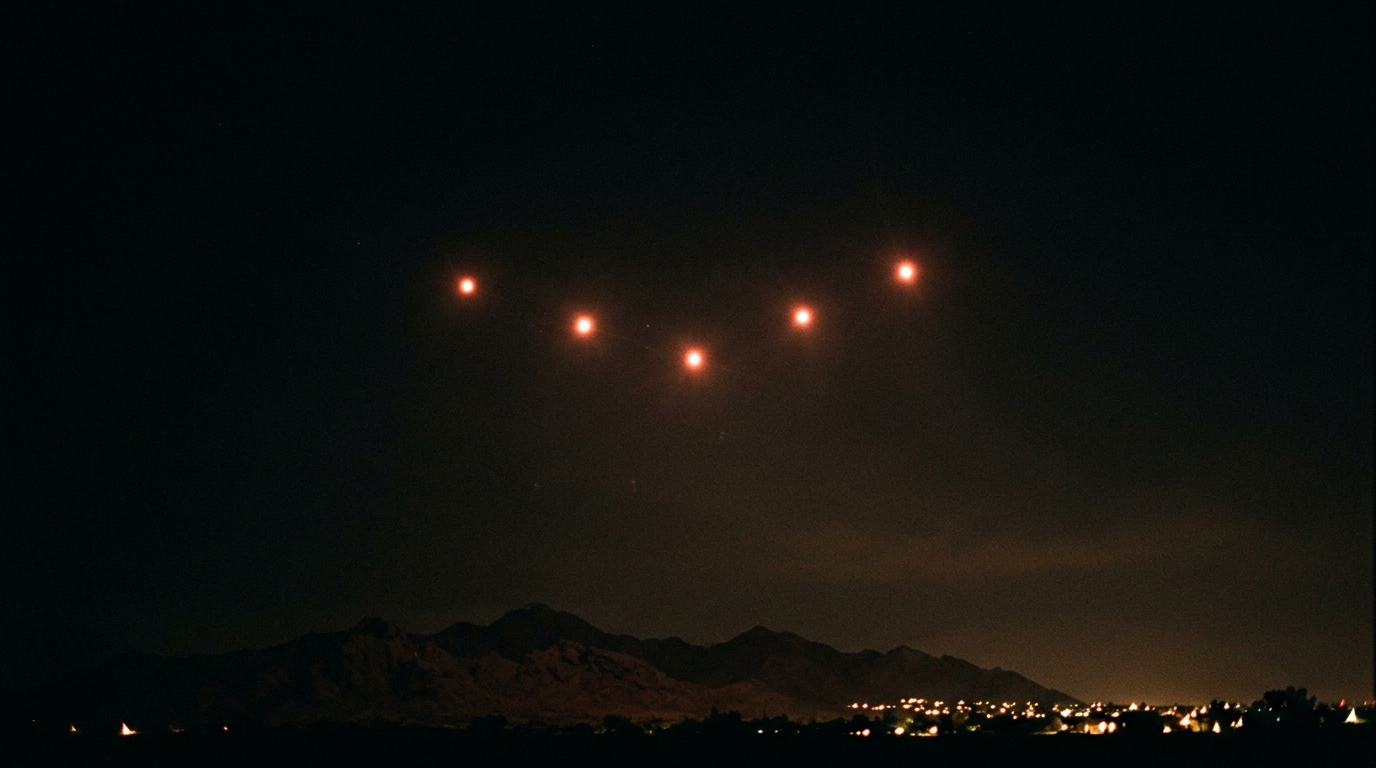
Those lights were captured on videotape and became the most famous visual imagery associated with the event.
Together, the sightings became known as the Phoenix Lights.
But that name creates a problem.
It suggests one event.
The evidence indicates that at least two substantially different events occurred that night.
The earlier reports involved lights traveling south across Arizona.
The later reports involved bright lights that appeared relatively stationary southwest of Phoenix.
The second event has a strong conventional explanation involving military illumination flares.
The first is more complicated.
For decades, the two have been blended together in documentaries, television specials, UFO literature and internet retellings.
That blending makes the mystery seem simpler than it really is.
The central question is not merely:
What were the Phoenix Lights?
It is:
What did different witnesses see at different times across Arizona on March 13, 1997?
March 13, 1997
Arizona in March 1997 was not waiting for a UFO event.
There had been no warning.
No predicted celestial phenomenon was expected to produce a statewide panic.
No major UFO convention had gathered thousands of observers.
People were driving.
Eating dinner.
Walking outside.
Looking through windows.
Working.
Watching television.
Then reports began.
Lights were seen in the northern part of the state.
Later, similar reports came from farther south.
The movement appeared to progress generally toward central Arizona.
By the time the phenomenon reached the Phoenix metropolitan area, witnesses were calling police, local news stations and organizations that collected UFO reports.
The night would eventually become one of the most famous mass-sighting episodes in American UFO history.
Why the Phoenix Lights Became Famous
Most UFO reports involve one witness.
Perhaps two.
A light appears.
The observer watches for seconds.
No photograph is taken.
The report remains impossible to verify.
The Phoenix Lights were different.
Large numbers of people reported observations.
Witnesses were spread across a considerable geographic area.
Some were pilots.
Some were law-enforcement personnel.
Some were ordinary residents with no apparent connection to UFO research.
Video recordings exist.
Government officials became involved.
Military activity occurred in the region that night.
And years later, the governor of Arizona stated that he had personally witnessed the earlier phenomenon.
The event therefore accumulated exactly the kind of evidence that keeps a UFO case alive.
Not proof.
But layers.
One Name, Multiple Events
The phrase "Phoenix Lights" commonly refers to everything strange reported over Arizona that evening.
That is historically convenient.
It is analytically dangerous.
At minimum, the reports can be divided into two broad categories.
The first involved moving lights or an apparent moving formation traveling generally from northern Arizona toward Phoenix and farther south.
The second involved bright lights southwest of Phoenix that appeared stationary or slowly descending.
These events occurred at different times.
They displayed different behavior.
They may have had completely different causes.
Any serious investigation must therefore avoid assuming that solving one automatically solves the other.
The Earlier Formation
The earlier reports began before the famous flare footage was recorded.
Witnesses described a series of lights moving across Arizona.
Some reported five lights arranged in a V.
Others described a row.
Some saw additional lights trailing behind the main formation.
The exact number varied.
That variation is not surprising.
Witnesses observed the phenomenon from different locations and angles.
The sky was dark.
Viewing times were limited.
Objects moving in formation can appear very different depending on perspective.
But many accounts shared several themes.
The lights appeared coordinated.
They moved generally together.
They seemed unusually quiet.
And in some accounts, they suggested an enormous structure.
Northern Arizona Reports
Some of the earliest reports associated with the event came from northern Arizona.
Witnesses in areas around Prescott and farther north described lights moving southward.
The phenomenon appeared to travel rather than remain fixed in one location.
This is one reason the later flare explanation cannot simply be applied to every report.
Military illumination flares descend.
They do not travel hundreds of kilometers across a state as a coherent formation.
If the earlier witnesses accurately described a moving formation, a separate explanation is necessary.
The V-Shaped Formation
The V became the defining shape of the earlier event.
Five or more lights arranged in a broad V can create an extraordinary visual illusion.
If the sky between the lights is dark, the mind may connect them into a single outline.
Humans naturally perceive patterns.
Separate points become edges.
Edges become shapes.
A V-shaped formation of aircraft can therefore appear like one triangular or boomerang-shaped craft.
But some Phoenix Lights witnesses rejected that interpretation.
They reported seeing darkness between the lights that appeared different from the surrounding sky.
Some claimed stars were blocked as the object passed.
Some said they could see a solid structure.
Those accounts are central to the mystery.
If accurate, they argue against a simple formation of independent aircraft.
One Enormous Craft?
The most dramatic interpretation is that witnesses saw a single enormous vehicle.
Descriptions varied.
Triangle.
V.
Boomerang.
Chevron.
Some witnesses claimed it was hundreds of feet across.
Others thought it might be far larger.
Certain retellings eventually described an object stretching more than a mile from wingtip to wingtip.
Such estimates should be treated cautiously.
Judging the size of an unknown object in a dark sky is extremely difficult.
Without knowing distance, apparent angular size cannot be converted reliably into physical dimensions.
A small object nearby and a huge object farther away can occupy the same portion of the sky.
Still, the impression of enormous scale was genuine for many witnesses.
Whatever they were seeing, it looked big.
The Problem of Distance
Distance is one of the most important variables in UFO reports.
At night, an observer often has few depth cues.
A light could be several hundred meters away.
Several kilometers away.
Or tens of kilometers away.
If witnesses assume an object is farther away than it really is, they will overestimate its size.
If they assume it is closer, they may underestimate it.
This makes claims such as "the Phoenix craft was one mile wide" inherently uncertain unless supported by reliable triangulation.
The visual impression is evidence of what witnesses perceived.
It is not a direct measurement.
The Silence
Many witnesses emphasized silence.
An enormous conventional aircraft passing overhead should produce noise.
Helicopters are loud.
Jets are loud.
Large transport aircraft are loud.
If the Phoenix formation was extremely close and massive, the reported silence becomes difficult to explain conventionally.
But sound perception depends on distance, wind, terrain and ambient noise.
Aircraft flying higher than witnesses assume may appear nearly silent.
Multiple small aircraft at altitude could produce far less noticeable noise than a huge low-flying vehicle.
The silence is important.
Its significance depends entirely on the actual distance and altitude.
Stars Behind the Object
One of the strongest arguments for a solid craft comes from witnesses who said stars disappeared behind it.
If stars were visibly obscured between the lights, that would suggest a physical structure.
But this kind of observation is difficult to verify retrospectively.
Night vision is imperfect.
Bright lights reduce sensitivity to dim stars.
An observer looking directly at bright lights may simply lose visibility of nearby background stars.
Thin clouds or atmospheric haze can create similar effects.
A witness may sincerely perceive an opaque object where no actual solid surface exists.
This does not mean the witnesses were lying.
It means the visual system itself can create ambiguity.
Witnesses Beneath the Formation
Some residents described the formation passing almost directly overhead.
These accounts are particularly important because close overhead observations should provide better information about shape and sound.
Several witnesses later described a massive dark object moving slowly and silently.
Some said it seemed low enough that conventional aircraft should have been obvious.
Others reported seeing separate lights rather than a clearly visible structure.
The differences are difficult to reconcile.
It is possible that witnesses observed different parts of the same formation.
It is also possible that different objects were in the sky.
Or that perception transformed a formation of lights into a solid craft for some observers.
Multiple Witnesses, Multiple Descriptions
Mass sightings are often assumed to be inherently stronger than individual reports.
In some ways they are.
If hundreds of unrelated people report unusual lights, it becomes difficult to argue that nothing at all happened.
But mass sightings create another challenge.
Witness accounts diverge.
One sees a triangle.
Another sees five separate lights.
One hears no sound.
Another hears aircraft.
One estimates an altitude of several hundred feet.
Another thinks the lights are miles away.
These contradictions do not make the event imaginary.
They demonstrate the limitations of eyewitness observation.
The Phoenix Lights are strongest as evidence that something unusual was widely observed.
They are weaker as evidence establishing exactly what that something was.
Calls Begin Coming In
As the night progressed, witnesses contacted authorities and media organizations.
Police departments received calls.
News outlets heard reports.
People attempted to determine whether an accident, military exercise or unknown aircraft was involved.
No immediate explanation unified the reports.
This uncertainty allowed speculation to grow rapidly.
If thousands of people were seeing lights, someone expected the government to know what they were.
When no immediate answer appeared, UFO interpretations gained momentum.
Phoenix
The Phoenix metropolitan area offered an enormous population of potential witnesses.
By the time reports reached the city, awareness of something unusual may already have been spreading.
Residents looked outside.
Some saw moving lights.
Others later saw the much more famous stationary lights southwest of the city.
These overlapping observations became fused into one event in public memory.
The phrase "Phoenix Lights" eventually referred to both.
Fife Symington
At the time, Arizona's governor was Fife Symington III.
His role in the Phoenix Lights story is unusual because his public behavior in 1997 and his later statements were dramatically different.
During the public frenzy, Symington treated the incident humorously.
At a press conference, he introduced a member of his staff dressed in an alien costume.
The stunt was meant to reduce tension and mock the escalating speculation.
For years, that moment defined his association with the event.
Then Symington revealed something unexpected.
He said he had seen the earlier phenomenon himself.
What Symington Later Said
Years after leaving office, Symington stated that he had observed a large craft or formation that night.
He described it as enormous and unlike anything he recognized.
His later testimony became one of the most cited pieces of evidence supporting the extraordinary interpretation.
A former governor was not merely commenting on someone else's UFO story.
He claimed to be a witness.
This strengthened the case culturally.
But his account still faces the same limitations as other eyewitness testimony.
Political office does not grant special ability to identify unknown objects at night.
Symington's testimony is significant because of his position and because he initially concealed or minimized his experience.
It is not proof of an extraterrestrial craft.
Why Did Symington Joke About It?
Symington later explained that he was trying to calm the public atmosphere.
A governor openly announcing that he had seen an enormous unexplained craft could have intensified concern.
The alien-costume press conference instead made the situation humorous.
Supporters interpret his later admission as evidence that officials privately took the event more seriously than they admitted.
Skeptics see no contradiction.
A politician can witness something he does not understand while still believing public hysteria is unwarranted.
Both can be true.
The Alien Press Conference
The alien-costume stunt became famous in its own right.
It is often presented in UFO documentaries as an example of official ridicule.
And it did ridicule the public discussion.
For many witnesses, that was frustrating.
People believed they had seen something extraordinary and felt their accounts were being dismissed.
This dynamic appears repeatedly in UFO history.
Humor can defuse anxiety.
It can also discourage witnesses from reporting observations for fear of embarrassment.
The Second Event
Later that evening, a very different display appeared southwest of Phoenix.
Bright lights seemed to hang in the sky.
Unlike the earlier V-shaped formation, these lights did not appear to travel rapidly across the state.
They remained visible.
They descended slowly.
They disappeared one after another.
Residents recorded them on consumer video cameras.
These recordings became the iconic footage shown in almost every documentary about the Phoenix Lights.
And this second event has a strong conventional explanation.
The Famous Video
The widely circulated Phoenix Lights video shows bright lights arranged in a rough line or arc.
Against a black sky, they appear suspended.
There is little visible reference information.
No aircraft body is visible.
No stars provide obvious scale.
No ground feature immediately tells the viewer how far away the lights are.
This makes the footage visually dramatic.
The lights can look like the edge of a gigantic craft.
But the camera records lights.
It does not record a visible solid object connecting them.
Military Illumination Flares
The leading explanation for the later lights is military illumination flares.
Military flares are designed to produce intense light over a battlefield or training area.
They may be deployed from aircraft.
Once ignited, they descend beneath parachutes.
From a distance, they can appear to hover.
Their movement may be extremely slow.
Because each flare is released separately, several can form a line.
As they descend behind terrain, they disappear.
This matches key aspects of the later Phoenix sightings.
The Barry M. Goldwater Range
Southwest of Phoenix lies the Barry M. Goldwater military training range.
Military aircraft were operating in the region that night.
Illumination flares were reportedly dropped during training activity.
This provides a specific source rather than a generic suggestion that "maybe the military did something."
The location matters.
Observers in Phoenix looking southwest would see the direction of the training range.
The lights appeared in the same general region.
The Mountain-Line Evidence
One of the strongest arguments for the flare explanation involves the Estrella Mountains.
From Phoenix, the mountains lie between observers and the military training areas farther southwest.
If flares were descending behind the mountains, they would remain visible until they passed below the line of sight created by the terrain.
Then they would seem to disappear.
Analysts comparing video with the mountain profile argued that this is exactly what happened.
Individual lights disappeared as they descended behind the ridge.
This provides a physical explanation for one of the most mysterious features of the footage.
They did not switch off while floating mysteriously over Phoenix.
They descended below a visible obstruction.
Why the Mountains Are Hard to See
At night, the mountains themselves can be almost invisible on consumer video.
The camera records bright flares easily.
The dark ridge beneath them may disappear into the black sky.
This creates the illusion that the lights are suspended in empty space.
A viewer watching the footage without geographical context sees only glowing points.
Once the terrain is mapped onto the image, the flare interpretation becomes much stronger.
Why Did the Lights Seem Stationary?
Distance.
A flare descending slowly tens of kilometers away produces very little apparent movement.
From Phoenix, a parachute flare could remain visible for minutes while seeming almost motionless.
People naturally judge objects in the sky using familiar categories.
An ordinary aircraft moves noticeably.
A flare does not.
That unusual motion encourages the impression that something is hovering.
Why Did They Form a Pattern?
Multiple flares dropped from aircraft can create geometric-looking arrangements.
If several aircraft release flares along a flight path, the resulting lights can form a line or arc.
Perspective can make the formation appear rigid.
Human perception then connects the lights.
What may actually be several unrelated points of light becomes the edge of one enormous object.
This is one of the most important perceptual effects in the Phoenix Lights case.
Why Didn't Everyone Hear Aircraft?
The aircraft releasing the flares were far from many observers.
The lights themselves were also distant.
Someone in central Phoenix might see a brilliant flare over the training range without hearing the aircraft that released it.
The absence of audible engines therefore does not create a serious problem for the later-event flare explanation.
Were the Flares Confirmed?
Military sources eventually identified training activity and illumination flares as the likely source of the later lights.
The explanation has become widely accepted among skeptical investigators.
It matches the timing.
It matches the direction.
It matches the behavior.
It matches the slow descent.
It matches the disappearance behind terrain.
This is far stronger than merely saying "those were probably planes."
For the later lights, the case is largely explainable.
Why Some Witnesses Reject the Flare Explanation
Not every witness accepts it.
Some insist that what they saw was too large, too structured or too close to be distant flares.
This may be because they were describing the earlier moving formation rather than the later lights.
It may also reflect differences in observation.
A person who watched a V-shaped object pass overhead is understandably frustrated when shown an explanation for stationary lights appearing hours later.
They are not necessarily talking about the same thing.
This is precisely why separating the events matters.
The Biggest Misunderstanding
One of the most persistent mistakes in discussions of the Phoenix Lights is this:
The military explained the Phoenix Lights as flares.
That statement is too broad.
Military flares provide an excellent explanation for the later stationary lights.
They do not automatically explain every report from earlier in the evening.
The earlier moving formation requires separate analysis.
This distinction is the foundation of any serious treatment of the case.
The Aircraft Formation Theory
A major conventional explanation for the earlier event is that witnesses observed military aircraft flying in formation.
A group of planes seen at night can produce exactly the kind of V-shaped pattern reported.
Navigation lights or other illumination can create visible points.
The aircraft bodies may disappear against the dark sky.
If they fly at sufficient altitude, their sound may be weak or delayed.
Under these conditions, separate aircraft can appear to form one enormous silent craft.
A-10 Aircraft
A-10 Thunderbolt II aircraft have frequently appeared in discussions of the Phoenix Lights.
Military units operating in the region conducted training activity around the relevant period.
A formation of A-10s could account for at least some witness descriptions.
However, assigning a specific aircraft type to every earlier sighting remains difficult.
The reported timeline extends across a wide area.
Witness accounts vary.
Documentation of exactly which aircraft were in which location at every moment is incomplete in popular reconstructions.
The aircraft explanation is plausible.
The precise identification of the earlier formation is less certain than the later flare explanation.
Formation Flying at Night
Aircraft flying in formation often maintain relatively stable spacing.
From the ground, the lights can appear locked together.
As the formation turns, the apparent shape changes.
A V can become a line.
A line can become an arc.
One light may disappear behind another.
A viewer who does not hear engines may naturally assume the formation is one object.
This is especially likely if the aircraft bodies are not visible.
Why Would Military Aircraft Be There?
Arizona contains major military facilities and training areas.
Military aviation activity is common.
Exercises at night are not unusual.
The existence of aircraft in the region therefore requires no special conspiracy.
The more difficult question is whether known training activity can account for the exact path and timing of the earlier reports.
That has never been demonstrated to everyone's satisfaction.
Did Luke Air Force Base Scramble Jets?
Some versions of the Phoenix Lights story claim that military jets were launched to intercept an unknown object.
Such claims should be treated carefully.
UFO cases often accumulate stories about jets being scrambled after the event becomes famous.
Without clear operational records, these accounts can be difficult to verify.
Military aircraft already operating in the region may later be reinterpreted as evidence of an interception.
The presence of military jets alone does not establish that officials were chasing a UFO.
The National Guard
Arizona National Guard activity became central to the explanation of the later flare event.
This is significant because the explanation connects to specific training operations rather than a vague government denial.
Military personnel involved in exercises later discussed the use of flares.
Again, this makes the second phase of the Phoenix Lights far less mysterious than the earlier reports.
What Did the Videos Actually Capture?
Most famous recordings capture the later lights.
That distinction is critical.
People often watch the video and assume they are seeing the same enormous V-shaped craft described by earlier witnesses.
They probably are not.
The video documentation strongly supports the reality of bright lights over the Phoenix area.
It does not directly record a gigantic solid triangle moving across Arizona.
The strongest extraordinary claims are therefore supported primarily by eyewitness testimony rather than clear imagery.
Why Isn't There Better Footage of the Earlier Object?
This question has become more significant with time.
In 1997, consumer video cameras were common but not universal.
People did not carry high-quality cameras in their pockets.
Digital smartphones did not exist.
Seeing something unexpectedly in the sky did not guarantee immediate recording.
Still, an event witnessed by large numbers of people might reasonably be expected to produce more useful photographic evidence.
Some images and videos have been associated with the earlier event, but none clearly establishes a gigantic structured craft.
The absence does not prove the object was conventional.
It limits what can be concluded.
The Limits of 1997 Video
Video technology in 1997 was dramatically different from modern smartphone cameras.
Low-light performance was poor.
Zoom degraded image quality.
Autofocus struggled.
Bright lights became blobs.
Dark aircraft bodies vanished.
Distance was difficult to judge.
This technology was almost perfectly suited to creating ambiguous UFO footage.
The cameras could prove lights existed.
They often could not reveal what produced them.
Were There Thousands of Witnesses?
The Phoenix Lights are often described as having been witnessed by thousands or even tens of thousands of people.
Exact numbers are difficult to establish.
There was no complete census of observers.
Many people called authorities or media organizations.
Others reported experiences later.
The event clearly produced a large witness pool.
But precise figures should be treated as estimates rather than scientifically counted totals.
The significance lies in the scale.
This was not a report from one household.
Mass Sighting Does Not Mean One Object
A common logical mistake is assuming that because many people saw something unusual on the same evening, all witnesses must have observed one object.
That is not necessarily true.
Different aircraft can appear at different times.
Military exercises can produce lights.
Commercial traffic continues.
Stars and planets remain visible.
Flares are deployed.
An unusual formation may pass overhead.
A widely publicized event can collect unrelated observations into one narrative.
Mass sightings therefore require careful timeline reconstruction.
The Timeline Problem
The farther apart reports occur in time and geography, the harder it becomes to determine whether witnesses saw the same object.
If a formation is reported near northern Arizona and later over Phoenix, investigators can estimate the speed required to connect the reports.
But witness times may be approximate.
People do not always look at a clock during surprising events.
A five-minute memory error can dramatically change speed calculations.
Later retellings can make approximate times sound precise.
This complicates attempts to reconstruct one continuous flight path.
Could Commercial Aircraft Explain Some Reports?
Almost certainly some unusual lights reported during any major skywatching event will be ordinary aircraft.
Phoenix has busy airspace.
Commercial planes produce landing lights visible from great distances.
At certain angles, landing lights can appear almost stationary before suddenly changing direction or disappearing.
This does not explain the entire Phoenix Lights event.
It likely explains some individual reports incorporated into the larger story.
Could Stars and Planets Be Involved?
Bright astronomical objects are commonly misidentified as UFOs.
But the coordinated moving formations central to the Phoenix case are not easily explained by planets.
Astronomical misidentification may account for isolated reports.
It is not a strong explanation for the major event.
Hale-Bopp
The Phoenix Lights occurred during a period when Comet Hale-Bopp was prominent in the night sky.
The comet was widely observed and attracted public attention.
Some discussions mention it as part of the astronomical context.
But Hale-Bopp cannot account for a moving V-shaped formation or descending lights.
Its relevance is mainly that people were looking skyward more often during this period.
That could increase the number of observers noticing unusual aircraft or military activity.
Did Public Awareness Amplify the Event?
Probably.
Once people hear that unusual lights are being reported, they look outside.
When they look outside, they notice lights they might normally ignore.
Some of those lights are ordinary.
They call in additional reports.
News coverage increases.
More people look up.
This creates a feedback loop.
The original event may be genuinely unusual.
The number of associated reports grows beyond it.
This phenomenon is common during mass UFO sightings.
Eyewitness Memory
Memory is not a video recording.
When witnesses repeatedly tell a story, details can shift.
Descriptions can become more confident.
A rough estimate becomes a precise number.
"Large" becomes "a mile wide."
"I couldn't see stars" becomes "it blocked out the stars."
"I didn't notice sound" becomes "it was completely silent."
This does not require dishonesty.
Human memory naturally reconstructs experiences.
For a case dating to 1997, contemporary reports are therefore more valuable than accounts recorded decades later.
Why Witness Confidence Matters Less Than We Think
People often say:
"I know what I saw."
The statement expresses sincere confidence.
It does not establish identification.
Pilots misidentify objects.
Police officers misidentify objects.
Astronomers can misjudge unfamiliar phenomena.
Experts are less likely to make certain mistakes within their field, but nobody is immune to ambiguous perception.
The more unfamiliar the object, the fewer reference points a witness has.
Confidence and accuracy are related much less strongly than people assume.
Pilots and Aviation Witnesses
Reports from pilots or aviation professionals often receive greater weight because those witnesses are familiar with aircraft.
That familiarity is relevant.
A pilot may recognize conventional lighting patterns that an ordinary observer would not.
But even pilots can misjudge distance and shape at night.
An unfamiliar military formation can still appear strange.
Professional experience improves evidence.
It does not transform eyewitness testimony into instrument data.
The UFO Interpretation
Supporters of the extraordinary interpretation argue that the earlier formation was not a group of ordinary aircraft.
They point to:
- Reports of a massive solid shape.
- Apparent blockage of stars.
- Lack of engine noise.
- Slow movement.
- Witnesses describing the object as extremely low.
- Observations from many locations.
- Fife Symington's later testimony.
- The failure of a single conventional explanation to satisfy every report.
Taken together, these details create a compelling UFO narrative.
But "UFO" means unidentified flying object.
It does not necessarily mean extraterrestrial spacecraft.
Extraterrestrial Interpretation
The most dramatic conclusion is that the earlier Phoenix Lights represented a craft of nonhuman origin.
This explanation is culturally powerful.
It fits witness descriptions of something enormous and technologically extraordinary.
But there is no verified physical evidence establishing extraterrestrial involvement.
No debris was recovered.
No radar record publicly demonstrates a nonhuman vehicle.
No biological material exists.
No confirmed communication occurred.
No landing site was documented.
The extraterrestrial interpretation therefore depends on treating eyewitness descriptions as accurate enough to exclude conventional aircraft.
That standard has not been met conclusively.
Secret Military Aircraft
Another possibility is a classified American aircraft.
This explanation preserves the reality of a large unusual craft without invoking extraterrestrials.
The United States has historically tested classified aircraft in the American Southwest.
The F-117 and other systems remained secret for years.
Could Phoenix witnesses have seen a classified platform?
Possible.
But speculative.
A truly gigantic silent aircraft operating over a major metropolitan area would represent extraordinary technology.
Testing such a system above populated areas would create security risks.
No later aircraft has emerged that clearly matches the most extreme witness descriptions.
The theory remains possible because classified programs are, by definition, difficult to verify.
That is also what makes the theory hard to falsify.
Why Classified-Aircraft Theories Are Convenient
Whenever an unusual object is reported near military territory, classified technology becomes an attractive explanation.
It solves several problems.
The object can be real.
Witnesses can be accurate.
Government silence becomes expected.
Lack of public records becomes evidence of secrecy.
But this flexibility is also the theory's weakness.
If no documentation is required because everything is classified, almost any unexplained sighting can be explained this way.
A good hypothesis must eventually produce evidence.
The Airship Comparison
Large silent or slow-moving objects have appeared throughout UFO history.
Some reports resemble airships more than high-speed spacecraft.
The Phoenix V was described as broad and slow.
If witness estimates were correct, it behaved less like a conventional jet and more like a massive platform gliding through the night.
There is no known operational airship matching the most dramatic descriptions.
But slower motion itself is not evidence of exotic technology.
Distance errors can make fast-moving objects appear slow.
The Triangle-UFO Pattern
The Phoenix Lights are often grouped with reports of large triangular UFOs.
Belgium experienced a famous wave of triangular-object reports several years earlier.
Other black-triangle sightings have been reported around the world.
This has led some UFO researchers to propose a recurring class of unknown craft.
But grouping sightings by shape can create false patterns.
Three lights naturally define a triangle.
Five lights can define a V.
Aircraft formations routinely create geometric arrangements.
The apparent similarity may reflect perception rather than identical technology.
The Belgian UFO Wave Comparison
The Belgian UFO wave of 1989–1990 also involved reports of large triangular objects with lights.
Comparisons with Phoenix are understandable.
Both involve witnesses describing structured craft.
Both produced military interest.
Both generated extensive public discussion.
But similarity does not prove a connection.
Each case must be evaluated on its own evidence.
Did Radar Detect the Phoenix Lights?
Claims about radar are frequently repeated in UFO discussions.
If a gigantic solid craft crossed Arizona, radar data could be extremely important.
However, publicly available radar evidence has not produced a definitive identification of an enormous unknown object corresponding to the full witness narrative.
This absence is notable but not conclusive.
Radar systems have different coverage, sensitivity and data-retention policies.
A formation of conventional aircraft would naturally appear on radar.
Without preserved and independently analyzed data, radar cannot settle the case.
Why Radar Would Matter
Radar could provide what eyewitnesses cannot.
Distance.
Altitude.
Speed.
Flight path.
Possibly size or radar cross-section.
With those measurements, many of the case's biggest uncertainties would disappear.
A formation traveling at conventional aircraft speed and altitude would strongly support an ordinary explanation.
A single enormous object exhibiting unusual performance would dramatically strengthen the extraordinary interpretation.
Unfortunately, that decisive dataset is not part of the public case.
The Flare Demonstrations
In later years, attempts were made to recreate the appearance of the Phoenix lights using illumination flares.
Such demonstrations showed that distant flares can indeed resemble stationary glowing objects.
They can form apparent patterns.
They can disappear sequentially.
For the later event, this type of reproduction is important because it demonstrates physical plausibility under known conditions.
A successful recreation does not prove every individual light was a flare.
But when combined with confirmed training activity, it creates a powerful conventional explanation.
Why Reproductions Matter
A good skeptical explanation should do more than label a phenomenon.
It should reproduce its characteristics.
If investigators say "flares," the flares should:
Appear in the right direction.
At the right time.
At the right apparent height.
Descend at the right rate.
Disappear in the right way.
The later Phoenix Lights perform well against those criteria.
This is why serious discussion increasingly separates them from the earlier moving formation.
The Earlier Event Remains Harder
The earlier sightings are more resistant to a single clean explanation.
A formation of aircraft is plausible.
It explains the V.
It explains coordinated movement.
It explains the lack of visible fuselages.
Altitude could explain the lack of sound.
Perspective could explain the apparent enormous size.
But the strongest witness testimony describes something more.
A single structure.
Low altitude.
Stars blocked.
Slow silent motion.
If those observations are accurate, ordinary formation flying becomes harder to reconcile.
The problem is that the extraordinary features are not preserved in unambiguous physical evidence.
Could Both Interpretations Be Partly Right?
Yes.
Perhaps several military aircraft crossed Arizona in formation.
Most witnesses saw the formation at a distance.
Some perceived one large object.
Later, illumination flares were deployed over the training range.
Those flares created the famous video.
Then media coverage blended everything together.
In this reconstruction, there is no single Phoenix Lights phenomenon.
There is an evening of military activity and widespread observation that gradually becomes one UFO event.
This requires no conspiracy.
It also does not imply that every witness description is wrong.
The Importance of Geography
Arizona's geography plays an enormous role.
Long sightlines allow distant lights to be visible across wide areas.
Mountains create hidden terrain boundaries.
Military ranges occupy large expanses.
Phoenix itself sits near major air traffic and military aviation activity.
A bright light tens of kilometers away can appear suspended above a nearby mountain.
A formation at altitude can be visible to witnesses across multiple cities.
Geography can make distant events feel local.
The Estrella Mountains
The Estrella range southwest of Phoenix is particularly important for the second event.
When the famous lights are plotted against the terrain, their sequential disappearance becomes much less mysterious.
The mountains act like a curtain.
A descending flare remains visible.
Then it falls below the ridge from the observer's perspective.
It disappears.
Another follows.
Without seeing the dark ridge, the viewer interprets this as lights switching off in midair.
Why the Videos Remain So Powerful
Even when people know the flare explanation, the footage still looks eerie.
This reveals something important about human perception.
An explanation does not automatically change what an image feels like.
Several bright lights floating in a black sky create an immediate impression of structure.
The mind wants to connect them.
Once someone says "giant craft," it becomes difficult not to see one.
The footage is compelling psychologically even when its physical explanation is conventional.
Media Coverage
Local media played a major role in transforming the event.
Witnesses were interviewed.
Videos were broadcast.
The story spread nationally.
Television programs later presented increasingly dramatic versions.
As coverage expanded, the Phoenix Lights became part of the broader UFO canon.
This also made separating contemporary evidence from later memory more difficult.
A witness interviewed years afterward has already been exposed to countless other descriptions of the same event.
UFO Investigators
UFO research organizations collected reports from witnesses.
These databases provide valuable historical material.
But witness collections have limitations.
People who believe they saw something unusual are more likely to report it than people who later identify what they saw.
This creates selection bias.
The case archive naturally contains the most puzzling observations.
Routine explanations often disappear from the narrative.
Skeptical Investigations
Skeptical researchers focused especially on military exercises, aircraft formations and terrain analysis.
Their work substantially reduced the mystery surrounding the later lights.
It also provided plausible explanations for many earlier reports.
But skepticism does not require claiming every witness hallucinated.
The strongest skeptical position is simply that the evidence does not require an unknown craft.
That is different from proving exactly what every person saw.
Why "Unexplained" Is Not the Same as "Alien"
This distinction is fundamental.
Suppose investigators cannot identify one earlier formation conclusively.
The correct classification is:
Unidentified.
It is not:
Extraterrestrial.
Identification requires positive evidence.
Failure to prove a conventional explanation does not prove an extraordinary one.
This is one of the most common logical errors in UFO discussions.
Why "Flares" Is Also Too Simple
The opposite mistake is equally important.
Saying "the Phoenix Lights were flares" can erase the earlier reports.
That creates an unnecessarily weak skeptical argument.
The later lights were very likely flares.
The earlier formation may have been aircraft.
But those are separate claims.
A documented archive should preserve that distinction rather than forcing every witness into one explanation.
Fife Symington Revisited
Symington's testimony remains one of the most interesting elements because he had little obvious reason to publicly associate himself with UFOs years later.
He described seeing an enormous craft-like formation and said it seemed unlike conventional aircraft.
For believers, this provides high-profile corroboration.
For skeptics, it demonstrates only that another witness perceived the formation as extraordinary.
The value of his account lies somewhere between those extremes.
It adds weight to the historical record.
It does not settle identification.
Did Symington Know About Military Activity?
As governor, Symington occupied a senior political position.
That has led some people to assume he would automatically have known if military aircraft caused the event.
That assumption is questionable.
State governors are not necessarily briefed on every routine military training flight.
Classified aviation programs are even more restricted.
His inability to identify the lights does not demonstrate that the military could not.
Government Secrecy
The Phoenix Lights occurred during a period when public distrust of government UFO explanations was already well established.
Roswell had become a cultural phenomenon.
Area 51 was famous.
Stories of classified aircraft circulated widely.
When military flares were offered as an explanation, some witnesses interpreted it as another cover story.
This created a familiar UFO dynamic.
Government explanation becomes evidence of government concealment.
That makes objective evaluation difficult.
Could Officials Have Covered Up the Earlier Event?
Possible in principle.
No strong evidence establishes it.
A cover-up theory would need to explain what officials knew, when they knew it, what records were altered and how large numbers of military and civilian personnel maintained secrecy.
Without documentary evidence, the claim remains speculative.
Government secrecy exists.
That fact alone cannot prove a specific cover-up.
The Cultural Afterlife
The Phoenix Lights became one of the defining UFO stories of the late twentieth century.
Documentaries returned to it repeatedly.
Witnesses appeared on television.
Books analyzed the event.
Anniversary gatherings took place.
The case became part of Arizona identity.
For many people, March 13, 1997 became the night an enormous UFO flew over Phoenix.
That cultural summary is far simpler than the historical evidence.
The Problem With the Name "Phoenix Lights"
The event was not limited to Phoenix.
Reports came from multiple locations across Arizona.
The most famous videos happened to come from the Phoenix area.
The name therefore narrows a much broader sequence.
A more accurate label might be something like:
The Arizona Lights of March 13, 1997.
But history chose Phoenix Lights.
And the name stuck.
Later Phoenix-Light Sightings
Bright-light formations have been reported over Phoenix on later dates as well.
Some were linked to military flares.
Others involved sky lanterns or aircraft.
These later incidents demonstrate how easily the original case can be recreated visually.
They do not necessarily explain the earlier 1997 formation.
But they provide valuable examples of how ordinary lights can produce extraordinary-looking displays.
Why Sky Lanterns Matter
Sky lanterns can drift slowly and silently.
Groups of them can appear coordinated.
They can disappear as their flames extinguish.
In many modern UFO reports, lanterns are a common source of confusion.
There is no strong reason to believe they explain the core 1997 event.
They are useful as a comparison for how unfamiliar lights can be misperceived.
A Case Built From Perception
The Phoenix Lights are ultimately a case about perception.
Most of the evidence consists of what people saw.
Lights.
Shapes.
Movement.
Silence.
Size.
The physical objects producing those impressions were rarely visible directly.
This means interpretation carries enormous weight.
A witness who sees five lights and assumes five aircraft describes one event.
A witness who connects those same lights into an enormous triangle describes another.
Both may be describing the same photons reaching their eyes.
Could a V Formation Look Solid?
Yes.
Imagine five aircraft against a black sky.
Only their lights are visible.
The spacing remains constant.
Your eyes track them together.
There are no visible stars between some lights because the lights themselves reduce your night vision.
Your brain draws an invisible boundary connecting them.
You perceive one dark object.
This is a completely ordinary perceptual mechanism.
The question is whether it explains the specific close-range witness reports.
That cannot be determined from theory alone.
Why the Best Witnesses Matter
Not all reports carry equal evidentiary value.
A witness who watches a formation for several minutes from a clear location provides more useful information than someone who sees lights for three seconds through a windshield.
A witness with aviation experience may identify features others miss.
A witness whose report was recorded immediately in 1997 is generally more valuable than one reconstructed decades later.
A rigorous investigation should rank evidence rather than counting all reports equally.
Contemporary Accounts Versus Later Accounts
This distinction is crucial.
The earliest reports capture what witnesses said before documentaries, books and internet discussions shaped the story.
Later accounts can contain additional reflection.
They can also contain memory contamination.
For a documented case archive, contemporary reporting should receive priority whenever possible.
The Case for Conventional Aircraft
The conventional-aircraft explanation for the earlier event has several strengths.
Arizona had substantial military aviation activity.
Aircraft commonly fly in formation.
A V formation matches many reports.
Night conditions hide aircraft bodies.
Altitude can reduce apparent sound.
Distance can exaggerate size.
Perspective can make separate lights appear attached.
The explanation requires no unknown technology.
Its weakness is that it does not fully satisfy witnesses who reported a low, solid object directly overhead.
The Case for an Unknown Structured Craft
The stronger UFO interpretation relies on those close-range accounts.
Witnesses described a dark shape.
Some reported stars being blocked.
Some described the object as enormous.
Several reported little or no sound.
Symington later described his own extraordinary impression.
If these accounts accurately represent physical characteristics rather than perceptual interpretation, the object becomes difficult to identify as conventional aircraft.
But no clear photograph or measurement confirms those characteristics.
The argument therefore depends heavily on testimony.
The Case for Multiple Causes
This may be the strongest overall explanation.
Different events occurred during the night.
Some witnesses saw an aircraft formation.
Some saw unrelated ordinary aircraft.
Some reported lights after hearing about the event.
Later, military flares produced the famous Phoenix display.
People combined these into a single story.
This explanation accounts naturally for the contradictory witness descriptions.
It also preserves a genuinely unusual earlier formation without requiring one giant extraterrestrial vehicle to explain everything.
What Is Actually Documented?
Several things can be stated with confidence.
Large numbers of people reported unusual lights over Arizona on March 13, 1997.
Earlier reports described moving formations, often V-shaped.
Some witnesses interpreted the formation as one enormous object.
Later in the evening, bright lights appeared southwest of Phoenix.
Those later lights were recorded on video.
Military illumination flares were used during training activity in the relevant region that night.
The behavior of the later lights is consistent with flares descending behind mountainous terrain.
Fife Symington later stated that he personally observed the earlier formation and believed it was extraordinary.
No verified physical evidence establishes that any part of the event involved extraterrestrial technology.
The exact identity of every earlier sighting remains disputed.
What Is Not Established?
It has not been established that one gigantic craft crossed the entire state.
It has not been established that the earlier lights and later lights had the same cause.
It has not been established that extraterrestrials were involved.
It has not been established that the military concealed a recovered spacecraft.
It has not been established that the famous video shows a solid object.
It has not been established that every witness saw the same phenomenon.
And it is incorrect to assume that the flare explanation automatically resolves every report from the night.
What the Phoenix Lights Do Not Prove
The Phoenix Lights do not prove extraterrestrial visitation.
They do not prove secret anti-gravity technology.
They do not prove that thousands of witnesses were mistaken about everything.
They do not prove that the entire event was one massive object.
They also do not prove that nothing unusual happened.
The strongest conclusion is narrower.
An unusual and widely observed series of aerial events occurred.
Parts of it can be explained extremely well.
Other parts remain less certain.
What Would Have Solved the Case?
High-quality synchronized video of the earlier formation from multiple locations would have transformed the investigation.
Radar data could have established altitude and speed.
Telephoto photographs might have revealed aircraft bodies.
Military flight logs could potentially identify formations precisely.
Accurate triangulation could establish size.
Any of those forms of evidence would reduce dependence on eyewitness estimates.
Instead, the case remains dominated by testimony.
What Would Prove an Extraordinary Craft?
Evidence would need to go beyond unexplained lights.
Clear imagery showing a physical structure.
Reliable measurements demonstrating impossible size or performance.
Radar confirming unusual motion.
Independent sensor data.
Physical material.
A documented landing.
Something that distinguishes an unknown craft from conventional aircraft viewed under unusual conditions.
The Phoenix Lights did not produce that level of evidence.
Why the Case Remains Important
The Phoenix Lights are valuable because they demonstrate both the strengths and weaknesses of mass UFO sightings.
Thousands of witnesses make dismissal difficult.
But thousands of witnesses do not automatically create precise data.
Multiple observations establish that something happened.
They do not guarantee that everyone interpreted it correctly.
Video proves lights existed.
It does not establish what produced them.
Military records can explain one event while leaving another less certain.
That complexity is what makes Phoenix more interesting than a simple "alien craft" story.
The Myth of a Single Answer
People naturally want one answer.
Flares.
Aircraft.
Aliens.
Secret military technology.
But March 13, 1997 may not have one answer.
The night may have involved multiple independent phenomena.
That is not a weakness in the explanation.
It may be the explanation.
Real skies contain many things at once.
Aircraft cross one another.
Military exercises occur.
Stars are visible.
Flares descend.
Witnesses observe from different angles.
Public attention connects unrelated events.
A mystery can emerge from combination rather than from one extraordinary object.
The Most Likely Reconstruction
A cautious reconstruction might look like this.
During the early evening, a formation of aircraft travels south across Arizona.
Their lights are clearly visible.
The aircraft bodies are difficult to see against the night sky.
Different witnesses observe the formation from different angles.
Some see separate lights.
Others perceive a dark V-shaped or triangular object.
The formation passes through the Phoenix region.
Reports spread.
Public attention increases.
Later that night, military aircraft operating over a training range southwest of Phoenix release illumination flares.
Residents already alert to unusual activity notice the lights.
The flares descend slowly.
From Phoenix, the mountains beneath them are difficult to see.
The lights appear to hover.
Residents record them.
The flares disappear one at a time behind the mountain ridge.
The videos become the iconic visual record.
Over the following days and years, both events merge into one story:
A gigantic UFO flew over Arizona and then hovered over Phoenix.
This reconstruction explains a great deal.
But it cannot prove that every earlier witness saw conventional aircraft.
That uncertainty remains.
Why "Unresolved" Still Fits
The later Phoenix lights are not strongly unresolved.
They are convincingly explained by military flares.
The earlier event is different.
A formation of conventional aircraft is a plausible and economical explanation.
But the historical record does not conclusively identify every light or reconcile every close-range witness account.
That means the broader case still contains unresolved elements.
The correct label is not:
Completely unexplained.
Nor is it:
Completely solved.
It sits between them.
The Verdict
Status: Unresolved
The Phoenix Lights were a genuine mass-sighting event involving large numbers of witnesses across Arizona on March 13, 1997.
But the evidence strongly indicates that the name describes more than one phenomenon.
Earlier in the evening, witnesses reported a moving formation of lights traveling generally south across Arizona.
Many described a V-shaped arrangement.
Some interpreted the lights as separate aircraft.
Others believed they were attached to one enormous dark craft.
Later that night, bright lights appeared southwest of Phoenix and were recorded extensively on video.
Those later lights have a strong conventional explanation.
Military illumination flares were deployed during training operations in the region.
Their slow descent, apparent stationary behavior and sequential disappearance behind mountainous terrain closely match the famous Phoenix footage.
That explanation should not automatically be extended backward to the earlier formation.
The earlier sightings remain less certain.
Conventional military aircraft flying in formation provide a plausible explanation.
Nighttime perspective could account for apparent size.
Altitude could account for limited sound.
Human perception could transform multiple coordinated lights into a single dark structure.
Yet some witnesses—including former Arizona governor Fife Symington—maintained that they observed something far larger and stranger than ordinary aircraft.
No surviving physical evidence conclusively verifies those extraordinary dimensions.
No clear image shows an enormous solid craft.
No verified radar record establishes nonconventional performance.
No debris, biological material or other evidence establishes extraterrestrial origin.
The Phoenix Lights therefore occupy a more complicated position than either side of the debate often admits.
They were not simply imaginary.
They were not simply one unexplained object.
And they were not all adequately described by saying one word:
flares.
The later lights can be explained.
The earlier formation can be plausibly interpreted.
But parts of the witness record remain uncertain.
That uncertainty is the real Phoenix Lights case.
Not a proven alien visitation.
Not thousands of people hallucinating.
A night when multiple lights crossed Arizona, military activity created a second dramatic display, and hundreds or thousands of observers tried to understand what they were seeing.
By morning, the lights were gone.
The explanations had only begun.
Case Status
Unresolved
The classification above describes the current status of this entry within the Forbidden Lore archive. A documented report does not necessarily establish the explanation offered for it as fact.