
The Village That Buried Its Dead Standing Up
The first account appeared in the journal of a traveling physician.
He claimed to have discovered a mountain village unlike any he had seen before.
Its people welcomed travelers.
They traded openly.
They attended church.
But they refused to speak about the cemetery.
The Cemetery
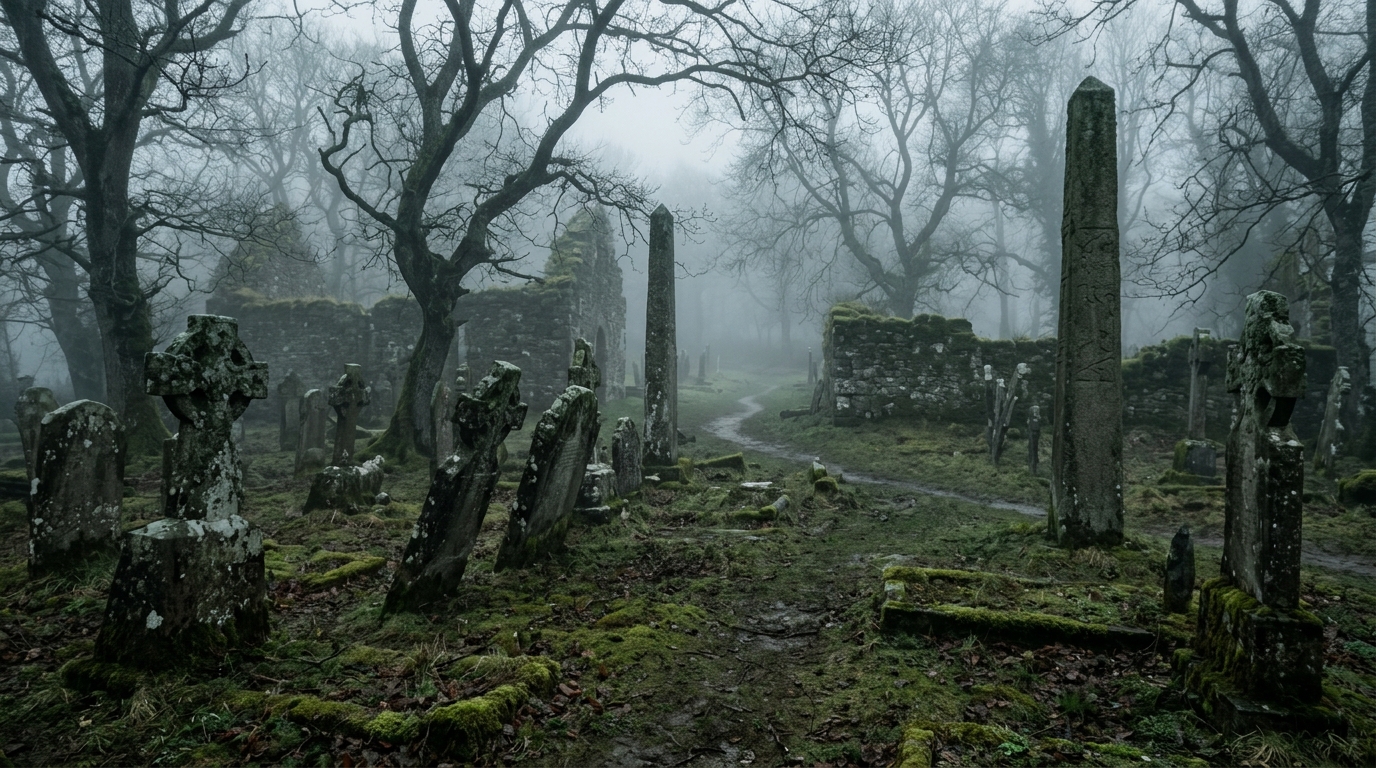
The burial ground sat on a wooded hillside overlooking the village.
At first glance, it seemed ordinary.
Weathered stone markers leaned beneath ancient trees.
The oldest graves had almost disappeared beneath moss.
Only after walking deeper into the cemetery did the physician notice something unusual.
The graves were remarkably narrow.
Far too narrow for a body lying flat.
The Old Caretaker
The cemetery's caretaker was an elderly man who had served there for decades.
When questioned about the unusual graves, he simply smiled.
"We return them to the earth as they entered it," he reportedly said.
He offered no further explanation.
The Discovery
Curiosity eventually overcame caution.
One evening, the physician quietly measured several of the graves.
Each was nearly six feet deep.
But less than two feet wide.
The dimensions made little sense.
There was no practical reason to dig graves in such a shape.
Unless those buried within them were not lying down.
The Village Tradition
Over the following weeks, he observed a funeral from a distance.
The mourners dressed entirely in black.
They spoke very little.
The coffin itself was unlike any he had seen.
It was tall.
Narrow.
Almost like a wooden cabinet.
The villagers lowered it carefully into the grave using ropes.
No prayers were spoken.
When the grave was filled, every person left without looking back.
Questions Without Answers
The physician attempted to ask about the custom once more before leaving the village.
No one answered.
Several people simply walked away.
Others pretended not to hear him.
Only one elderly woman offered a warning.
"Some things should remain standing."
She refused to explain what she meant.
The Return
Years later, another traveler attempted to find the same village.
He carried detailed notes and carefully followed the physician's route.
He never found it.
The road described in the journal no longer existed.
Nearby towns claimed no village had ever stood in that valley.
Even the cemetery had vanished.
The Journal
The physician's account survives today only in fragments copied into later collections of regional folklore.
Historians debate whether the village ever existed.
Some believe the journal exaggerated local customs.
Others suggest the burial tradition was symbolic.
But among collectors of forgotten folklore, another explanation persists.
They believe the graves were narrow because the dead were never laid to rest.
Only buried exactly as they were found.
Standing.
Some traditions disappear for a reason.