The Wendigo: The Insatiable Hunger in the Northern Woods
The Wendigo is hungry.
That is the first thing to understand.
Not hungry in the ordinary sense.
Not the hunger that comes after a missed meal.
Not even the desperate hunger of a person who has gone days without food.
The Wendigo's hunger has no end.
It eats.
And remains hungry.
It consumes a human being.
And remains hungry.
In some traditions, the creature actually grows larger after feeding, meaning that every meal increases the size of the body that must be fed.
The more it consumes, the more it needs.
There is no final meal.
There is no satisfaction.
There is only appetite.
For centuries, stories of a terrifying cannibalistic being have circulated among several Algonquian-speaking peoples of the northern woodlands of North America, including traditions among the Ojibwe, Cree, Saulteaux, Innu, Naskapi, and neighboring communities.
Its name has been written in many ways.
Wendigo.
Windigo.
Wiindigoo.
Weendigo.
Witiko.
Wîhtikow.
The exact traditions vary between communities, languages, places, and storytellers.
There is no single official Wendigo.
But certain themes return with remarkable persistence.
Winter.
Cold.
Starvation.
Cannibalism.
Greed.
Isolation.
Transformation.
And hunger that cannot be satisfied.
Today, however, millions of people know a somewhat different creature.
Search for a Wendigo online and one image appears again and again.
A towering humanoid stalking through a dark forest.
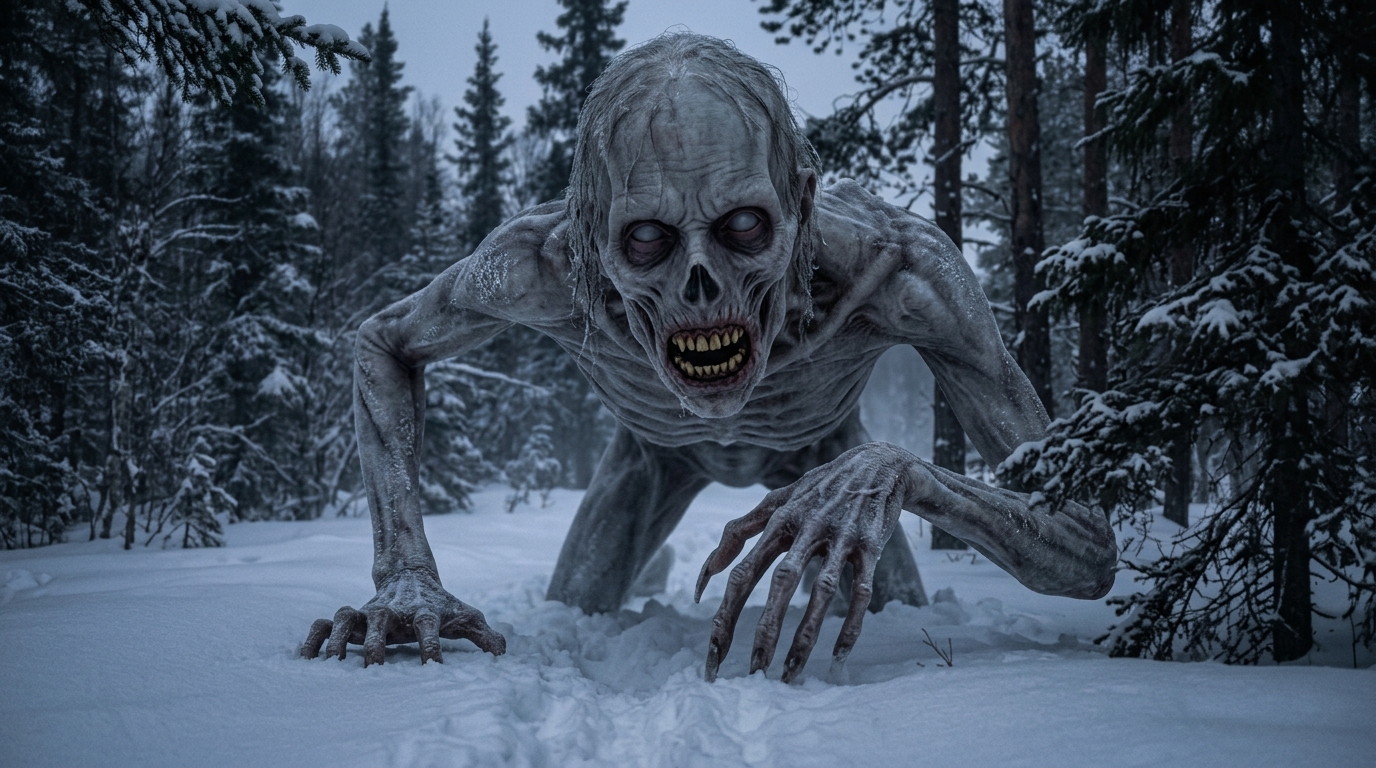
Its body is skeletal.
Its arms are impossibly long.
Its fingers end in claws.
Its ribs protrude through rotting flesh.
Where its head should be is the skull of a deer.
Above that skull rises a magnificent set of antlers.
It is an excellent monster.
It is instantly recognizable.
And the antlers are one of the least traditional things about it.
The older Wendigo was not simply a deer-headed cryptid wandering through the Canadian wilderness.
It was something more complicated.
And arguably more frightening.
Because in many stories, the Wendigo was not born a monster.
It had once been human.
Before the Antlers
Modern horror has given the Wendigo an extraordinarily successful makeover.
The deer skull has become so closely connected with the name that removing it can make a modern depiction seem incorrect.
But older descriptions of the Wendigo do not require antlers.
They do not require a deer skull.
They do not even consistently describe an animal-like creature.
The Ojibwe People's Dictionary maintained by the University of Minnesota gives wiindigoo a strikingly simple definition:
"a winter cannibal monster"
That description contains almost the entire traditional core.
Winter.
Cannibalism.
Monster.
No antlers required.
Historical accounts and oral traditions describe Wendigos in different ways.
Some are gigantic.
Some are emaciated.
Some resemble terrifying human beings.
Some contain ice.
Some possess supernatural strength.
Some are spirits.
Some are people who have transformed.
Some retain the ability to speak and think.
And some stories barely require a detailed physical description at all.
The important question was not necessarily:
What species of monster is this?
The more important question was:
What has this being become?
The World of the Wendigo
The Wendigo belongs to the northern forests.
That geography matters.
Across the Great Lakes and enormous stretches of what are now Canada and the northern United States, winter historically presented dangers difficult to appreciate from the comfort of a heated home stocked with food.
Temperatures could fall brutally low.
Snow could make travel difficult or impossible.
Hunting could fail.
Stored food could run out.
Illness or injury could prevent hunters from providing for their families.
Animals could become scarce.
A group could become isolated.
And hunger could become something considerably more serious than discomfort.
Starvation was possible.
So was death.
In those conditions, survival was not merely an individual problem.
It was communal.
Food had to be shared.
Resources had to be managed.
People depended upon one another.
Someone who hoarded food while others starved did not merely behave rudely.
They could threaten the survival of everyone around them.
Against this background, the Wendigo becomes much easier to understand.
It is not simply a monster associated with hunger.
It is a monster associated with uncontrolled appetite during scarcity.
The difference is enormous.
A hungry person needs food.
A Wendigo needs everything.
The Monster That Could Never Be Full
One of the most memorable elements of Wendigo tradition is the creature's impossible relationship with food.
It eats constantly.
Yet it starves.
In descriptions associated with Ojibwe writer, educator, and storyteller Basil Johnston, the Wendigo is grotesquely emaciated despite its enormous appetite.
Its skin appears stretched over its bones.
Its body resembles starvation itself.
And in some accounts, every person the Wendigo consumes causes it to grow.
That creates a supernatural trap.
Suppose the creature is starving.
It eats a person.
Its body becomes larger.
A larger body requires more food.
So it becomes hungry again.
It eats again.
It grows again.
Its hunger increases again.
The meal does not solve the problem.
The meal makes the problem worse.
Consumption creates the need for greater consumption.
The Wendigo therefore embodies a particularly disturbing form of excess.
It does not accumulate until it possesses enough.
There is no enough.
That is the curse.
Hunger Versus Greed
Modern summaries sometimes describe the Wendigo simply as a cannibal monster.
That is true.
But it is incomplete.
The creature is also strongly associated with greed, selfishness, gluttony, and excessive consumption.
Those ideas are closely related.
Imagine a small winter hunting group with limited food.
One person secretly takes more than their share.
That person may survive longer.
Everyone else now has less.
Individual greed becomes communal danger.
The Wendigo represents that impulse taken to its ultimate conclusion.
First, someone consumes more than they need.
Then more.
Then everything available.
Eventually even other human beings become things to consume.
The boundary between hunger and greed disappears.
The Wendigo is therefore not frightening merely because it eats people.
Plenty of monsters eat people.
The Wendigo is frightening because its appetite has replaced every other obligation.
Family does not matter.
Community does not matter.
Enough does not exist.
There is only consumption.
A Human Can Become One
Perhaps the most unsettling part of Wendigo folklore is that the monster does not always come from somewhere else.
Sometimes it comes from within the community.
A person can become a Wendigo.
The exact causes vary among traditions and later accounts.
Cannibalism is one of the most famous.
A person who consumes human flesh—particularly during starvation—may cross a boundary from which they cannot return.
Other stories connect transformation with greed.
Some involve possession.
Some involve dreams or supernatural influence.
Some describe an individual becoming increasingly obsessed with the idea of human flesh.
The details differ.
The central terror remains.
The Wendigo may begin as a human being.
A neighbor.
A relative.
A hunter.
A spouse.
A parent.
Someone sitting beside the same fire.
That changes the nature of the legend.
A monster outside the camp can be watched for.
A monster inside a person is considerably harder to detect.
Cannibalism and the Final Boundary
Cannibalism has occurred under extreme survival conditions throughout recorded history.
Shipwrecks.
Famines.
Sieges.
Lost expeditions.
Disasters.
People trapped without food have sometimes eaten the dead to survive.
Northern winter conditions could create similarly desperate situations.
But within Wendigo traditions, cannibalism carried consequences beyond the physical act.
Eating human flesh could represent the destruction of the distinction separating human community from monstrous appetite.
A starving person might believe cannibalism could save their body.
The Wendigo story asks what else might be lost in the process.
The horror is not merely:
You ate a person.
It is:
Now you may never stop.
The first act of cannibalism does not satisfy hunger.
It awakens another kind.
The Heart of Ice
Ice appears repeatedly in Wendigo stories.
Some traditions describe the creature as having a heart of ice.
Others portray enormous Wendigos whose bodies contain ice or whose presence is connected with extreme cold.
One Ojibwe story preserved by the Milwaukee Public Museum describes a child who transforms into a Windigo and becomes a terrible ice monster.
After supernatural beings kill it, the Windigo's enormous body is cut apart.
Inside the ice is found the tiny body of the child from which it originated.
Another story recorded by the museum describes a Windigo approaching a village as the temperature becomes bitterly cold.
Trees crack.
The river freezes.
The creature is enormous.
When it is finally defeated and chopped apart, the body again proves to be made of ice.
At its center is a human body.
The imagery is difficult to miss.
The monster surrounds the person.
Ice surrounds humanity.
Something human remains inside.
But it has been swallowed by what the person became.
As Tall as a White Pine
Not every Wendigo is merely human-sized.
Some are giants.
Enormous giants.
Accounts describe creatures many times the height of an ordinary person.
In one story preserved by the Milwaukee Public Museum, an approaching Windigo is described as being as tall as a white pine tree.
That is not a creature that can hide behind a bush.
Some historical descriptions collected by outsiders similarly mention beliefs in cannibal giants twenty or thirty feet tall.
Basil Johnston's influential description presents the Wendigo as towering several times above an ordinary human being.
Yet despite that enormous body, it remains gaunt.
Starving.
Empty.
That contradiction is central to the horror.
Imagine something thirty feet tall emerging through the trees.
Its body is skeletal.
Its skin is stretched tightly against its bones.
It has eaten human beings.
Perhaps many of them.
And it still looks as though it has never eaten at all.
The Wendigo Was Not Necessarily Mindless
Modern monster movies often turn supernatural predators into animals.
They snarl.
They chase.
They kill.
They rarely have much to say about it.
Some Wendigo traditions are considerably more disturbing.
The creature can retain intelligence.
It can speak.
It can threaten people.
It can deceive them.
It may remember aspects of its former humanity.
In some stories, Wendigos use tools.
That means the transformation does not necessarily destroy the mind.
A person may understand what is happening.
They may know who their victims are.
They may possess human intelligence while being consumed by an inhuman appetite.
A monster that cannot understand its actions is dangerous.
A monster that understands perfectly is something else.
The Wendigo as Warning
It is tempting to reduce folklore to a single function.
The Wendigo, according to this interpretation, was invented to discourage cannibalism.
Or to make children behave.
Or to encourage food sharing.
Or to explain mental illness.
Or to personify winter.
Each explanation captures something.
None captures everything.
Folklore survives precisely because stories can do several things simultaneously.
A Wendigo story can be frightening entertainment.
It can reinforce a taboo.
It can teach about greed.
It can warn against isolation.
It can express anxiety about starvation.
It can explain horrifying behavior.
It can preserve spiritual beliefs.
It can provide language for discussing someone who has abandoned communal responsibilities.
And it can simply be a story about a terrifying supernatural being.
The mistake comes when outsiders insist that one interpretation must eliminate all the others.
Did People Believe Wendigos Were Real?
Calling the Wendigo folklore does not mean the people telling Wendigo stories necessarily regarded them as fiction.
That distinction is essential.
Modern readers often divide stories into two categories.
Real.
And made up.
Traditional belief systems do not always fit neatly into that framework.
Historical records show that Wendigo beliefs were sometimes treated with profound seriousness.
People could fear that another person was becoming a Wendigo.
People could fear becoming one themselves.
Individuals believed to be transforming could be watched.
Healers could be consulted.
And in extreme cases, people believed to have become Wendigos were killed.
These were not hypothetical monsters.
Real human beings died.
When Folklore Entered the Historical Record
The historical Wendigo is difficult to study.
Most early written records were created by outsiders.
Missionaries.
Fur traders.
Government officials.
Anthropologists.
Police officers.
Judges.
Journalists.
These observers often misunderstood the languages and cultures they attempted to describe.
Some were openly hostile toward Indigenous spiritual beliefs.
Others sensationalized stories of cannibalism.
Still others tried to force unfamiliar beliefs into European categories involving demons, insanity, superstition, or criminality.
That means written sources must be treated carefully.
They can establish that particular events were reported.
They cannot automatically tell us what everyone involved actually believed.
The historical record is therefore valuable.
But it is not neutral.
The Case of Swift Runner
One of the most frequently cited historical cases connected with Wendigo belief involves a Cree man remembered in English-language records as Swift Runner.
The case occurred in Alberta in the winter of 1878–1879.
Swift Runner had once worked with the North-West Mounted Police and reportedly had a wife and children.
During the winter, his family disappeared.
When Swift Runner later returned alone, questions followed.
His explanation did not hold.
Investigators eventually concluded that members of his family had been killed and eaten.
The case became one of the most notorious cannibalism trials in nineteenth-century Canadian history.
Swift Runner was convicted of murder.
He was executed at Fort Saskatchewan in December 1879.
Over time, the case became closely associated with the concept later called Wendigo psychosis.
But the historical reality is more complicated than the version commonly repeated online.
What Happened to Swift Runner's Family?
Accounts of the case describe Swift Runner and his family spending the winter in an isolated camp.
Food became scarce.
Members of the family died or were killed.
Human remains were consumed.
The most disturbing element was the allegation that cannibalism continued even though a Hudson's Bay Company post was reportedly within reachable distance.
That detail became important to later interpretations.
If Swift Runner had been completely trapped and starving, the case could be understood as survival cannibalism.
If food was accessible elsewhere, something else appeared to be happening.
Later writers interpreted Swift Runner's behavior through Wendigo belief.
Some accounts claim he believed himself possessed.
Others use the case as the classic example of a supposed psychiatric disorder.
But much of what modern readers encounter has passed through generations of retelling.
The murders are historical.
The trial is historical.
The execution is historical.
The precise psychological state of Swift Runner is much harder to reconstruct.
December 20, 1879
Swift Runner was sentenced to death.
The execution itself became part of the story.
He was hanged at Fort Saskatchewan on December 20, 1879.
Later accounts have accumulated dramatic details about his final moments, including stories that he remained calm and joked about the executioner's preparations.
Whether every colorful detail repeated today is reliable is another question.
What is not disputed is the essential fact.
A man associated in later literature with Wendigo belief was executed after killing and consuming members of his family.
The supernatural explanation could not save him in a colonial court.
The law saw murder.
Folklore saw something more complicated.
And later psychiatry would attempt to give that complication a name.
"Wendigo Psychosis"
For much of the twentieth century, books about unusual psychiatric conditions frequently included something called Wendigo psychosis.
The supposed syndrome was usually described as occurring among certain Algonquian-speaking peoples.
A person suffering from it might develop an obsessive fear of becoming a cannibal.
They might believe they were transforming into a Wendigo.
They might crave human flesh.
In extreme accounts, they might kill and consume other people.
The condition became famous as an example of a culture-bound syndrome—a psychological disorder supposedly shaped by a particular cultural environment.
It appeared in psychiatric literature.
Anthropology.
Books about unusual mental disorders.
Paranormal writing.
And eventually thousands of popular articles.
There was one problem.
Scholars began questioning whether "Wendigo psychosis" existed as a distinct psychiatric disorder at all.
Did Wendigo Psychosis Actually Exist?
The debate is substantial.
Some researchers interpreted historical cases as evidence that cultural belief could shape the form taken by severe psychological distress.
A person living in a society where Wendigo transformation was feared might express psychosis through that framework.
That possibility is not inherently implausible.
Culture affects how people understand illness.
It affects the language used to describe distress.
It affects what people fear.
It affects how hallucinations or delusions are interpreted.
But other scholars argued that the evidence for a distinct Wendigo syndrome was weak.
Historical reports were often secondhand.
Cases differed dramatically.
Colonial observers misunderstood Indigenous beliefs.
Cannibalism, starvation, violence, spiritual belief, and mental illness were sometimes combined into a single category simply because outsiders expected them to belong together.
Anthropologist Lou Marano became particularly associated with criticism of the conventional Wendigo-psychosis model.
The problem was not necessarily that nobody ever feared becoming a Wendigo.
Historical evidence indicates such fears existed.
The problem was whether those fears constituted a unique psychiatric disease in the way textbooks sometimes claimed.
That remains much harder to establish.
When a Diagnosis Becomes Part of the Legend
The phrase "Wendigo psychosis" is now so famous that it often appears alongside the folklore as though it were simply another established fact.
But its history demonstrates how outsiders can create a second mythology around an existing tradition.
First there are Wendigo beliefs.
Then outsiders observe those beliefs.
Then those outsiders create a psychiatric category.
Then later writers use the psychiatric category as evidence that the original beliefs were so powerful they caused people to become cannibals.
The argument can become circular.
This does not mean the historical cases were invented.
Nor does it mean psychological distress played no role.
It means the evidence deserves more caution than the phrase Wendigo psychosis often receives.
Sometimes the strangest part of folklore is not the original legend.
It is what later generations decide the legend proves.
Jack Fiddler
If Swift Runner is the most famous alleged Wendigo cannibal, Jack Fiddler is perhaps the most famous historical Wendigo killer.
His story unfolded nearly three decades later.
Jack Fiddler, whose Indigenous name is often rendered Zhauwuno-geezhigo-gaubow, was a powerful leader and spiritual figure among the Sucker people of the Sandy Lake region of northwestern Ontario.
He was known as a healer.
He was also said to have confronted Wendigos.
Many of them.
Later accounts frequently state that Jack Fiddler claimed to have killed fourteen Wendigos during his lifetime.
That sentence sounds like the beginning of a cryptid-hunting television series.
The historical reality was considerably darker.
The "Wendigos" were people.
The Responsibility of a Wendigo Killer
Within the worldview described in accounts of Jack Fiddler's community, someone believed to be transforming into a Wendigo could represent an existential threat.
The transformation might not yet be complete.
The person could be ill.
They might behave strangely.
They might dream of cannibalism.
They might ask to be killed before they became dangerous.
A spiritual specialist might attempt treatment.
But if the transformation could not be stopped, killing the prospective Wendigo could be understood not as murder but as protection.
That distinction would eventually collide violently with Canadian law.
The Death of Wahsakapeequay
In 1907, Jack Fiddler and his brother Joseph Fiddler were arrested following the death of a woman commonly identified in historical accounts as Wahsakapeequay.
She was believed to be becoming a Wendigo.
Accounts differ in details, but Jack and Joseph did not simply deny responsibility.
They believed the killing had been necessary.
From their perspective, they had prevented something worse.
Canadian authorities saw the situation differently.
A woman had been killed.
Whatever spiritual explanation accompanied the death, colonial law treated it as homicide.
The brothers were taken into custody.
For Jack Fiddler, a man already in his eighties, the consequences would be fatal.
Two Systems of Reality Collide
The Fiddler case cannot be understood simply as a murder mystery.
There was little mystery about who was responsible.
Instead, it was a collision between radically different systems for understanding what had happened.
Canadian law asked:
Did these men cause the woman's death?
The answer was essentially yes.
The cultural context asked a different question:
What happens when someone is becoming a supernatural cannibalistic threat and the people responsible for protecting the community believe they must act?
Canadian authorities did not recognize the Wendigo as a legal defense.
From the perspective of the state, the supernatural danger did not exist.
From the perspective represented by the Fiddlers, failing to act could have endangered everyone.
The same act could therefore be interpreted as murder by one system and protection by another.
The state possessed the prisons.
So the state's interpretation prevailed.
Jack Fiddler's Death
Jack Fiddler escaped custody.
He did not remain free for long.
He was recaptured.
Soon afterward, he died by suicide, hanging himself.
Joseph Fiddler was tried.
He was convicted and sentenced to death.
There was eventually substantial concern over the case, and his sentence was commuted.
But clemency arrived too late.
Joseph became ill in prison and died before he could return home.
The Fiddler case has since become one of the most frequently cited historical examples of Wendigo belief.
It is also a warning about turning history into paranormal entertainment.
"Man kills fourteen Wendigos" is a spectacular story.
"Colonial legal authorities prosecuted Indigenous spiritual leaders whose understanding of their actions existed within a worldview the court did not recognize" is less suitable for a monster-of-the-week show.
It is also considerably closer to the real historical problem.
Were There Really Fourteen?
The famous number deserves caution.
Claims that Jack Fiddler had destroyed fourteen Wendigos have circulated widely.
But "fourteen Wendigos" does not mean fourteen giant supernatural creatures were found frozen in the forests of Ontario.
The alleged Wendigos were human beings believed to be undergoing dangerous transformations.
Some may have asked to die.
Some may have been sick.
Some may have been feared by others.
The details of every alleged case are not preserved with equal reliability.
The number survives because it is memorable.
And because once Wendigo folklore entered popular paranormal culture, the sentence became irresistible.
A shaman who killed fourteen Wendigos sounds like evidence that fourteen monsters existed.
It is not.
It is evidence that belief in Wendigo transformation could have very real consequences.
The Wendigo and Colonialism
Over time, Wendigo imagery acquired another meaning.
European colonial expansion brought enormous disruption to Indigenous communities.
Land was taken.
Resources were extracted.
Traditional economies were transformed.
Communities were displaced.
Diseases devastated populations.
Government policy attempted to suppress languages and cultures.
Against this history, the Wendigo's endless appetite became an obvious metaphor.
The creature consumes.
It takes.
It is never satisfied.
No amount of land is enough.
No amount of timber is enough.
No amount of minerals is enough.
No amount of wealth is enough.
The Wendigo could therefore describe not merely individual greed but systems of consumption.
This interpretation has become especially important in Indigenous literature and scholarship.
The ancient monster of hunger proved disturbingly compatible with the modern world.
The Wendigo Leaves the Forest
By the late nineteenth and early twentieth centuries, Indigenous stories had increasingly entered English-language writing.
Sometimes they were translated carefully.
Sometimes they were distorted.
Sometimes they were treated as anthropology.
Sometimes as superstition.
And sometimes as horror.
One writer would have an enormous influence on how non-Indigenous audiences imagined the Wendigo.
His name was Algernon Blackwood.
Algernon Blackwood's The Wendigo
In 1910, British writer Algernon Blackwood published a novella titled The Wendigo.
Blackwood was already becoming one of the most important supernatural writers of his era.
His stories often placed human beings in landscapes that seemed ancient, enormous, and fundamentally indifferent to them.
The Wendigo was an ideal vehicle for that obsession.
The story follows a hunting expedition into the Canadian wilderness.
Something is present in the forest.
Something enormous.
Something associated with wind, distance, terror, and an almost irresistible call into the wilderness.
Blackwood's creature was not simply a faithful transcription of Indigenous oral tradition.
It was a literary Wendigo.
And that distinction matters.
The Wilderness Becomes the Monster
Blackwood's story helped move the Wendigo into the tradition of English-language supernatural horror.
The wilderness itself becomes threatening.
The forest seems limitless.
Human beings become tiny.
Civilization is far away.
The Wendigo becomes connected not merely with cannibalism and starvation but with the terrifying vastness of the northern landscape.
That interpretation would influence later horror.
Once a traditional being enters popular fiction, it begins changing according to the needs of writers who use it.
The Wendigo had begun another transformation.
This one happened on paper.
August Derleth and Ithaqua
The influence spread further through weird fiction.
Writer August Derleth, associated with preserving and expanding the work of H.P. Lovecraft, developed the entity Ithaqua, sometimes called the Wind-Walker.
Ithaqua drew heavily from Blackwood's Wendigo.
Through weird fiction, tabletop gaming, fantasy, and horror, elements associated with the Wendigo became increasingly detached from the specific cultural traditions in which the being originated.
The name was useful.
The northern setting was useful.
The monster was useful.
And popular culture rarely worries much about whether the pieces still fit together.
The Deer Skull Problem
At some point, the Wendigo acquired antlers.
Today they are nearly unavoidable.
Yet researchers discussing traditional representations repeatedly note that the familiar deer-skull image is a modern addition rather than a standard feature of older Anishinaabe and related traditions.
Older descriptions emphasize human or humanoid forms.
Giants.
Emaciation.
Ice.
Cannibalism.
Human transformation.
Not a stag-headed forest god.
So where did the modern image come from?
There is no perfectly clean answer.
Popular visual culture evolves through accumulation.
One depiction influences another.
A film influences an artist.
An artist influences a game designer.
A game influences fan art.
Fan art influences social media.
Eventually everyone is copying everyone else.
The antlers become "traditional" because people have seen them so many times.
Wendigo and Modern Horror Imagery
The 2001 film Wendigo, directed by Larry Fessenden, is frequently mentioned in discussions of the modern antlered image.
Its interpretation of the creature incorporated animalistic and deer-like imagery.
Later horror productions increasingly used antlers, deer skulls, or stag-like characteristics for supernatural beings associated with wilderness.
The design works exceptionally well.
Antlers create a recognizable silhouette.
A skull signals death.
A deer connects the creature to the forest.
Combine them with an emaciated humanoid body and the result looks ancient even when the design itself is modern.
Visual storytelling rewards immediate recognition.
The traditional Wendigo is conceptually complicated.
"Deer skull monster" can be understood in half a second.
The deer skull won.
The Internet Finishes the Transformation
Then came the internet.
Image boards.
DeviantArt.
Tumblr.
Reddit.
Creepypasta.
YouTube.
TikTok.
Pinterest.
Online paranormal communities.
Video-game fandoms.
Thousands of artists began producing their own Wendigos.
Most searched for reference images before starting.
Those searches returned antlers.
So they drew antlers.
Their artwork then appeared in later searches.
Which caused more artists to draw antlers.
A feedback loop formed.
Eventually the modern Wendigo became visually standardized in a way traditional folklore never was.
Tall.
Thin.
Gray.
Long-limbed.
Deer skull.
Antlers.
Forest.
Preferably fog.
The monster had acquired a uniform.
The Wendigo Versus the Skinwalker
Modern paranormal culture also created another problem.
Wendigos and Skinwalkers began getting mixed together.
The two traditions are not the same.
They do not originate from the same peoples.
They do not describe the same type of being.
The Wendigo is associated with Algonquian-speaking traditions of the northern woodlands.
Skinwalker traditions are associated with Navajo culture in the American Southwest.
One is strongly connected with cannibalism, winter, greed, starvation, and transformation.
The other exists within an entirely different cultural and spiritual framework.
Yet online horror increasingly treats both as generic labels for:
weird humanoid thing in the woods.
A pale creature crawls across a road?
Skinwalker.
Something screams outside a cabin?
Wendigo.
A deer behaves strangely?
Either one.
A TikTok video contains two glowing pixels behind a tree?
Apparently we are now negotiating between both possibilities.
The categories have become so blurred that the original traditions can disappear completely.
Is the Wendigo a Cryptid?
Not really.
At least not in the traditional sense of the word.
Cryptozoology generally concerns alleged unknown animals.
Bigfoot is treated as a possible undiscovered primate.
The Loch Ness Monster is treated as an unidentified aquatic creature.
A cryptid is theoretically biological.
A Wendigo is supernatural.
It can involve transformation.
Possession.
Spiritual danger.
Cannibalism.
Moral transgression.
Ice.
Impossible growth.
It belongs much more naturally to folklore and spiritual tradition than zoology.
That has not stopped cryptid culture from adopting it.
Monster lists love the Wendigo.
It has an excellent name.
It lives in the woods.
It eats people.
And modern artists gave it antlers.
From a marketing perspective, the creature never stood a chance.
Modern Wendigo "Sightings"
The internet contains countless alleged Wendigo encounters.
Most follow a recognizable pattern.
Someone is camping.
Usually somewhere remote.
It is late.
The forest becomes strangely quiet.
A scream is heard.
Sometimes the scream sounds almost human.
Then something appears between the trees.
It is too tall.
Too thin.
Its limbs are too long.
It moves incorrectly.
Perhaps it crawls.
Perhaps it watches.
Perhaps it mimics a human voice.
The witness escapes.
Later, someone tells them they encountered a Wendigo.
These stories can be effective horror.
But they bear surprisingly little resemblance to many traditional Wendigo accounts.
The modern "Wendigo encounter" has absorbed characteristics from creepypasta, crawler stories, Skinwalker stories, feral-person legends, Bigfoot encounters, horror films, and internet monsters.
The result is essentially a new folklore tradition wearing an old name.
The Human Voice in the Woods
One particularly common modern motif is mimicry.
A creature in the forest calls someone's name.
It sounds almost like a friend.
But not quite.
Or it repeats a phrase.
Or screams like a person.
The witness is warned:
Do not answer it.
This motif appears constantly in modern supernatural storytelling.
It is extraordinarily effective because humans are highly sensitive to voices.
A voice where no person should be creates immediate unease.
But attaching every story involving vocal mimicry to the Wendigo is another example of modern folklore consolidation.
The internet has effectively created a generic North American forest monster and assigned several traditional names to it.
That monster is fascinating in its own right.
It just should not automatically be mistaken for the older Wendigo.
The Silence Before the Encounter
Another popular detail is sudden silence.
Birds stop calling.
Insects stop buzzing.
The forest becomes unnaturally still.
Then the creature appears.
Again, this is a powerful horror device.
It is also widespread far beyond Wendigo stories.
Predators can cause animals to become quiet.
Weather can alter sound.
Human attention changes dramatically when someone becomes frightened.
And storytellers have understood for centuries that silence creates tension.
Modern encounter narratives combine these ingredients because they work.
The result feels ancient.
That does not necessarily mean it is.
Could an Animal Explain Some Sightings?
A surprising number of supposed supernatural creatures begin with ordinary animals seen under unusual circumstances.
Bears are particularly effective monster generators.
A bear standing upright can appear shockingly human.
A bear suffering from mange can lose much of its fur and develop an appearance almost unrecognizable to someone expecting a healthy animal.
Deer can also behave strangely.
Chronic wasting disease and other illnesses can produce severe emaciation.
Injury can distort movement.
Nighttime destroys visual detail.
Distance makes size difficult to judge.
Fear fills missing information.
None of that explains a thirty-foot cannibal spirit with a heart of ice.
It does explain why modern forests continue producing monster reports.
Starvation Changes People
There is also a grim physical reality beneath the folklore.
Severe starvation affects the mind as well as the body.
People deprived of food can become weak, confused, obsessive, irritable, depressed, and cognitively impaired.
Extreme circumstances can produce desperate behavior.
Combine starvation with isolation, severe winter conditions, cultural expectations, illness, and fear, and the psychological environment surrounding historical Wendigo cases becomes easier to understand without reducing the tradition to "primitive superstition."
People living through famine did not need to invent the terror of hunger.
The terror was already there.
The Wendigo gave it a face.
Or perhaps more accurately, many faces.
None of which necessarily had antlers.
Why the Cannibalism Matters
Modern adaptations sometimes remove cannibalism almost entirely.
The Wendigo becomes a forest demon.
A guardian.
A deer spirit.
A horned predator.
Something vaguely connected with nature.
But cannibalism is not a disposable detail.
It is central to much of the tradition.
Without it, the Wendigo loses the boundary violation that gives the legend much of its power.
A wolf eats humans because humans are prey.
A Wendigo eats humans because the distinction between human and food has collapsed.
And when the Wendigo was once human, the horror becomes even sharper.
It knows what a human being is.
It simply no longer accepts that this knowledge should prevent consumption.
Why Winter Matters
The same is true of winter.
A Wendigo in a tropical jungle would still be frightening.
But something fundamental would be missing.
Winter creates the conditions of the story.
Scarcity.
Isolation.
Darkness.
Cold.
Hunger.
The shrinking supply of food.
The uncertainty of the next hunt.
The possibility that a storm could trap people far from help.
The Wendigo belongs to that environment so completely that removing winter turns it into a different monster.
The frozen landscape is not background decoration.
It is part of the legend's machinery.
The Monster Outside the Firelight
Imagine the older setting.
There are no roads.
No electric lights.
No phone.
No weather forecast.
No rescue helicopter.
No supermarket.
The temperature outside has fallen far below freezing.
Snow covers the forest.
Food is running low.
The hunters have returned with nothing.
Again.
Someone has become sick.
Someone else has begun acting strangely.
And somewhere beyond the firelight is a story everyone knows.
A story about what hunger can turn a person into.
Under those conditions, the Wendigo does not need a deer skull.
It does not need antlers.
It barely needs to appear.
The Wendigo as Possession
Some accounts describe Wendigo transformation in terms that resemble possession.
A dangerous force enters or overtakes a person.
The individual may experience disturbing desires.
They may fear losing control.
Others may recognize signs.
In some historical accounts, people believed to be affected asked to be killed before the transformation progressed.
That creates one of the bleakest possibilities in the tradition.
The person knows what they may become.
They are still human enough to fear it.
And they believe death is preferable.
Whether individual historical reports can always be trusted is another matter.
But the motif itself reveals something important.
The Wendigo is not simply a predator.
It is a loss of self.
Killing a Wendigo
Folklore naturally developed methods for defeating the creature.
These vary widely.
Some stories emphasize courage and supernatural power.
Others involve destroying the Wendigo's frozen heart.
Fire and heat appear naturally as opposites to the creature's icy nature.
In some narratives, powerful individuals confront Wendigos directly.
The Milwaukee Public Museum preserves an Ojibwe story in which a small girl faces an enormous Windigo approaching a village.
As the creature arrives, the cold becomes intense.
The girl grows until she matches the giant's size.
Her sticks become copper.
She kills the monster.
Afterward, she drinks hot tallow and returns to her normal size.
The story is not merely about helpless people being eaten.
Humans can defeat the monster.
That matters too.
Wendigo Stories Are Also Stories of Resistance
Popular summaries often emphasize fear.
But traditional stories can also emphasize intelligence, bravery, cooperation, and the ability to overcome danger.
The Wendigo may be powerful.
It is not necessarily unbeatable.
People trick monsters.
Challenge them.
Fight them.
Recognize them.
Heal those threatened by transformation.
Or destroy them when necessary.
A culture's monster stories are rarely only about monsters.
They are also about the people who survive them.
The Wendigo Ceremony
Historical and ethnographic sources also describe ceremonial responses connected with the Wendigo taboo.
Among some communities, performances associated with famine reportedly used reversal, humor, masks, and behavior that dramatized dangerous forms of appetite.
Such traditions complicate the idea of Wendigo belief as nothing more than terrified superstition.
People can take a spiritual danger seriously while also representing it through satire or ritual.
Fear and humor are not opposites.
Sometimes humor is one of the ways communities control fear.
The Wendigo could be terrifying.
It could also be mocked.
A monster loses some power when people can laugh at it.
The Problem With a Single "Native American Legend"
The phrase Native American legend appears constantly in discussions of the Wendigo.
It is convenient.
It is also dangerously broad.
There is no single Native American culture.
Hundreds of distinct nations possess different languages, histories, spiritual systems, and traditions.
The Wendigo belongs specifically to traditions among certain Algonquian-speaking peoples.
Even within those traditions, descriptions differ.
Treating every Indigenous supernatural tradition as interchangeable creates exactly the confusion that eventually turns Wendigos into Skinwalkers and Skinwalkers into generic forest demons.
Specificity matters.
The Wendigo is more interesting when its actual cultural context is preserved.
Not less.
A Living Tradition, Not an Extinct Myth
Another mistake is speaking about the Wendigo exclusively in the past tense.
As though Indigenous people once believed in Wendigos until modernity arrived.
Anishinaabe, Cree, Innu, and other peoples associated with these traditions are living communities.
The stories continue.
The languages continue.
Writers and artists continue interpreting the Wendigo.
Some use it traditionally.
Some transform it deliberately.
Some use the creature to discuss colonialism, environmental destruction, addiction, capitalism, or modern greed.
Folklore does not become authentic only after everyone who created it is dead.
The Wendigo is not an archaeological artifact.
It continues to change.
The Wendigo in Literature
The creature has become extraordinarily useful to writers.
Margaret Atwood has drawn on Wendigo imagery.
Indigenous authors have reclaimed and reinterpreted it.
Horror writers use it as a monster.
Fantasy writers use it as a supernatural species.
Comics use it as a villain.
Role-playing games turn it into something players can fight.
Each adaptation changes the creature.
Sometimes dramatically.
That raises a difficult question.
At what point does adaptation become replacement?
Marvel's Wendigo
Marvel Comics introduced its own version of the Wendigo in the 1970s.
In Marvel continuity, the creature is connected with a curse involving cannibalism in the Canadian wilderness.
That version preserves an important traditional association.
But it transforms the Wendigo into a large white-furred superhero monster.
It can fight the Hulk.
It can fight Wolverine.
It exists within comic-book rules.
This is obviously not traditional folklore.
But for generations of readers, it became one of their first encounters with the name.
Popular culture does not need to erase a tradition intentionally.
It only needs to become more visible than the tradition itself.
Hannibal and the Antlered Nightmare
The television series Hannibal used antlered imagery extensively in connection with the cannibalistic Hannibal Lecter and Will Graham's psychological experiences.
The show's dark, skeletal, antlered figure was not simply a straightforward traditional Wendigo.
But it reinforced a visual vocabulary already becoming dominant.
Cannibalism.
Antlers.
Dark humanoid form.
Psychological corruption.
The imagery was extraordinarily effective.
And once again, the modern Wendigo became more deer-like.
Until Dawn
The 2015 video game Until Dawn offered one of the more interesting modern adaptations because its Wendigos are not antlered deer monsters.
They are transformed humans.
Cannibalism causes the transformation.
The resulting creatures are thin, pale, elongated, violent, and recognizably human beneath the monstrous changes.
The game takes enormous liberties with the folklore.
But compared with the generic deer-skull version, it preserves one of the older legend's most important ideas:
The monster was once a person.
That is considerably closer to the heart of the tradition than simply attaching antlers to something scary.
Why the Deer Skull Refuses to Die
Once a monster has a great design, accuracy faces an uphill battle.
The antlered Wendigo looks fantastic.
That is the problem.
It is visually distinct.
A traditional emaciated humanoid could be mistaken for a zombie, ghoul, crawler, or generic monster.
Give it a deer skull and antlers and everyone knows what the artist intends.
At least, everyone thinks they know.
The image is now so entrenched that correcting it can sound like pedantry.
But the correction reveals something fascinating.
We can actually watch folklore mutate.
The antlers are evidence.
Folklore About Folklore
The modern Wendigo is therefore almost two legends occupying the same name.
The first is a family of Indigenous traditions concerning winter, cannibalism, greed, spiritual danger, and insatiable appetite.
The second is a modern North American horror monster.
The second creature inherited pieces of the first.
Then it acquired pieces from elsewhere.
Antlers.
Deer skulls.
Mimicry.
Crawler anatomy.
Cryptid behavior.
Internet encounter tropes.
Now the modern monster generates its own stories.
People claim to see it.
Those stories inspire artwork.
The artwork inspires new encounters.
The cycle continues.
Folklore has formed around folklore.
What About the "Wendigo Roar"?
Videos online sometimes claim to contain recordings of Wendigo screams.
The sounds are usually terrifying.
That does not make them supernatural.
Foxes can produce astonishingly human-like screams.
Mountain lions can make sounds resembling a woman screaming.
Owls produce calls that can sound deeply unnatural to unfamiliar listeners.
Elk can make eerie vocalizations.
Coyotes can create chaotic choruses that seem much larger and stranger than the animals producing them.
Sound travels unpredictably through forests.
Darkness removes visual context.
A frightening noise becomes much more frightening when the source cannot be seen.
There is no scientifically established Wendigo vocalization.
There is, however, an enormous collection of North American wildlife capable of ruining a perfectly good night in the woods.
The Wendigo and Bigfoot
Occasionally Wendigo stories overlap with Bigfoot reports.
Large footprints.
Enormous humanoid figures.
Remote forests.
Unexplained screams.
Missing people.
But the two traditions operate very differently.
Bigfoot is usually described as a flesh-and-blood creature.
The Wendigo is supernatural.
Bigfoot is covered in hair.
Traditional Wendigos may be human-like, skeletal, gigantic, icy, or spiritually transformed.
Bigfoot does not usually represent greed.
Bigfoot does not become larger every time it eats.
And Bigfoot has shown remarkably little interest in turning people into cannibals.
The similarity is mostly geographic.
The woods contain enough room for several legends.
Missing People and the Wendigo
Modern paranormal storytelling sometimes connects unexplained disappearances in northern wilderness areas with Wendigos.
There is no reliable evidence supporting that claim.
People disappear in wilderness areas for depressingly ordinary reasons.
Exposure.
Falls.
Drowning.
Injury.
Getting lost.
Animal attacks.
Suicide.
Accidents.
Medical emergencies.
Remote terrain can make bodies extraordinarily difficult to locate.
Adding a Wendigo can make a disappearance more mysterious.
It does not make the explanation more probable.
That distinction is central to Forbidden Lore.
A story can be fascinating without pretending the supernatural explanation has been proven.
Is There Physical Evidence?
No scientifically verified physical evidence establishes the existence of a supernatural Wendigo.
There is no authenticated body.
No skeleton.
No tissue sample.
No DNA.
No specimen.
No unambiguous photograph demonstrating an unknown giant cannibal creature.
No antlered humanoid corpse stored in a museum basement.
Historical records establish belief.
They establish stories.
They establish deaths associated with those beliefs.
They establish alleged transformations and encounters.
That is not the same thing as establishing the literal existence of the monster.
For the Wendigo, the evidence is primarily cultural and historical.
And that evidence is extensive.
The Historical Evidence Is Real
This distinction is worth emphasizing.
Saying there is no physical evidence for a supernatural monster does not mean the Wendigo was invented recently.
The tradition is old.
Historical writings document it.
Indigenous oral traditions preserve it.
Language preserves it.
Recorded stories preserve it.
The Swift Runner case is historical.
The Jack Fiddler case is historical.
The fear of cannibal transformation is historically documented.
The supernatural explanation remains a matter of belief.
The folklore itself does not.
The Wendigo is unquestionably real as a cultural tradition.
Whether a literal Wendigo has ever walked through the northern forest is a different question.
Why the Legend Survived
Many monsters disappear when the conditions that created them disappear.
The Wendigo adapted.
That is because its central idea is not dependent upon winter starvation.
The central idea is insatiability.
A person who wants more than they can ever use is Wendigo-like.
A corporation consuming resources without limit can be described through Wendigo imagery.
A society destroying the environment to sustain endless consumption fits the metaphor disturbingly well.
Addiction can resemble endless hunger.
Power can resemble endless hunger.
Wealth can resemble endless hunger.
The monster survived because humanity never solved the problem it represents.
We simply found more things to consume.
A Monster for the Modern World
Consider the paradox.
The traditional Wendigo emerged from environments where scarcity could kill.
The modern world produces forms of consumption that would have been unimaginable to people living in those environments.
Entire forests disappear.
Mountains are excavated.
Oceans fill with plastic.
Billions of animals are raised for consumption.
Products are manufactured, purchased, discarded, and replaced.
Companies grow and must continue growing.
Fortunes become larger than a person could spend across multiple lifetimes.
And still the demand is:
More.
The Wendigo does not feel particularly ancient under those conditions.
It feels current.
The Monster Is Not Hunger
This may be the most important distinction in the entire legend.
The Wendigo is not a condemnation of being hungry.
Hunger is natural.
Starvation is suffering.
The Wendigo is what happens when appetite becomes detached from limitation and responsibility.
That is why greed fits so naturally beside cannibalism.
The creature does not merely need.
It takes.
And takes.
And takes.
Until everything around it becomes something to consume.
Why the Wendigo Is Scarier Without Antlers
The deer skull is visually terrifying.
But it also makes the Wendigo safer.
A monster with a giant rack of antlers is obviously not human.
You would recognize it immediately.
You would not invite it inside.
You would probably not spend much time debating the situation.
The traditional idea is worse.
The Wendigo can be human.
It can look human.
It can begin human.
The transformation may happen because of choices, desperation, spiritual corruption, or overwhelming appetite.
That means the boundary between person and monster is not anatomical.
It is behavioral.
Remove the antlers and the legend becomes much harder to escape.
The Person Inside the Ice
The old stories in which a Wendigo's icy body is broken open and a human body is discovered inside contain an almost perfect image of the legend.
Outside:
The monster.
Inside:
The person.
The human being has not disappeared completely.
It has been enclosed.
Buried beneath hunger.
Buried beneath ice.
Buried beneath transformation.
The monster is terrifying precisely because humanity remains somewhere within it.
Could Someone Come Back?
Different traditions and accounts provide different answers.
Some people threatened by Wendigo transformation could supposedly be treated.
Spiritual specialists might intervene.
The dangerous process could sometimes be stopped.
Other cases were believed to have progressed too far.
That distinction helps explain the role attributed to people such as Jack Fiddler.
Killing was not necessarily presented as the first response.
It could be the final one.
Again, the surviving historical accounts are filtered through outsiders and should not be treated as a universal rulebook.
There is no Wendigo manual.
Folklore varies.
The Danger of Turning Tradition Into a Monster Manual
Modern fandom encourages classification.
Height.
Weight.
Abilities.
Weaknesses.
Habitat.
Attack pattern.
How to kill it.
That format works wonderfully for games.
It works poorly for folklore.
There is no canonical Wendigo stat sheet.
One story may contradict another.
One community may tell the story differently from another.
A being may be physical in one account and spiritual in another.
That is not a flaw.
That is how folklore works.
The attempt to create one definitive Wendigo often tells us more about modern media than about the older traditions.
What the Wendigo Is Not
It is not simply a deer demon.
It is not interchangeable with a Skinwalker.
It is not merely another name for Bigfoot.
It is not originally a creepypasta.
It is not best understood as an undiscovered animal.
It is not accurately reduced to a psychiatric diagnosis.
It is not one perfectly standardized being shared identically by every Indigenous culture in North America.
And despite countless pieces of artwork suggesting otherwise, antlers are not required.
What the Wendigo Is
At the broadest level, the Wendigo is a supernatural cannibalistic being found in traditions among several Algonquian-speaking peoples.
It is associated with winter.
Starvation.
Cold.
Greed.
Cannibalism.
Excess.
And transformation.
In some traditions it is gigantic.
In some it is icy.
In some it is a spirit.
In some it is a human being who has become monstrous.
Its defining characteristic is not its head.
It is its hunger.
Could the Legend Have Begun With Real Cannibalism?
Possibly.
But proving a single origin for folklore this old is usually impossible.
Episodes of starvation and cannibalism almost certainly contributed to the cultural environment in which Wendigo traditions developed.
Real famine occurred.
Real survival cannibalism occurred in human history.
Real murders occurred.
Real people behaved strangely under extreme conditions.
Those realities could reinforce existing spiritual traditions.
But saying "people sometimes resorted to cannibalism during famine" does not explain the entire Wendigo tradition.
The monster carries moral, social, spiritual, and symbolic meanings far beyond a simple memory of starvation.
There may never have been one original incident.
There probably was not.
Could Mental Illness Explain It?
Mental illness may explain aspects of some historical cases.
It cannot explain the entire tradition.
A person experiencing psychosis can interpret symptoms through culturally familiar ideas.
Someone terrified of Wendigo transformation might understand disturbing thoughts within that framework.
But the existence of psychiatric explanations for individual experiences does not make a centuries-old cultural tradition itself a psychiatric disorder.
That distinction was often lost in older discussions of "Wendigo psychosis."
The folklore came first.
The diagnosis came later.
Could the Wendigo Have Been a Real Unknown Creature?
There is no compelling evidence for that hypothesis.
The traditional Wendigo behaves unlike a biological species.
Humans become Wendigos.
The creature can grow supernaturally.
It may contain ice.
It can embody spiritual corruption.
Its hunger can be metaphysical.
Attempting to turn the Wendigo into an undiscovered North American predator requires removing much of what makes it a Wendigo.
At that point, the hypothesis is not explaining the folklore.
It is replacing it.
The Antlered Creature Could Be Its Own Legend
There is an interesting possibility.
The modern deer-skull Wendigo may eventually deserve to be studied as a separate folkloric creature.
It already possesses a recognizable appearance.
Its own encounter stories.
Its own behaviors.
Its own online traditions.
People tell stories about seeing it.
Artists reproduce it.
Games establish rules for it.
Videos teach audiences what it supposedly sounds like.
The modern creature may not accurately represent the traditional Wendigo.
But after decades of cultural reproduction, it has become folklore itself.
That is how legends grow.
An inaccurate retelling repeated long enough can become a new tradition.
The Name Remains
And yet the older name remains attached.
Wendigo.
That gives the modern creature an aura of antiquity it did not earn on its own.
A deer-skull monster created in modern horror feels older when someone says Indigenous people feared it for centuries.
The statement sounds authoritative.
It is repeated.
Few people check.
The antlers move backward through time.
Eventually people assume they were always there.
This is one of the most fascinating parts of studying folklore in the internet age.
We are not merely preserving legends.
We can watch them mutate in real time.
Why Accuracy Matters
Correcting the antler myth is not about ruining anyone's monster.
The antlered Wendigo is a great horror design.
It can remain a great horror design.
The problem comes when modern invention is presented as ancient Indigenous tradition.
There is a difference between saying:
"Here is a modern artistic interpretation of the Wendigo."
And saying:
"This is what the Wendigo traditionally looked like."
The first is creative adaptation.
The second is history.
History deserves evidence.
The Wendigo Today
The Wendigo now exists simultaneously in several worlds.
It remains part of living Indigenous cultural traditions.
It exists in scholarship.
It exists in historical records.
It exists in literature.
It exists in horror movies.
It exists in games.
It exists in comics.
It exists in paranormal communities.
It exists in alleged eyewitness reports.
And it exists in millions of pieces of artwork depicting a monster with antlers it probably never had.
Each version tells us something.
Sometimes about the original tradition.
Sometimes about the people retelling it.
So Was the Wendigo Real?
That depends entirely upon what the question means.
Was the Wendigo a real and historically documented belief?
Yes.
Are there real historical cases in which people interpreted violence, cannibalism, illness, or dangerous behavior through Wendigo belief?
Yes.
Did real people die because they were believed to be Wendigos or to be transforming into them?
Yes.
Did starvation and cannibalism occur in the environments associated with the tradition?
Yes.
Is there verified physical evidence that gigantic supernatural cannibal beings inhabited the forests of North America?
No.
Is there evidence that the familiar antlered deer-skull creature represents the oldest traditional descriptions?
No.
The history is real.
The folklore is real.
The supernatural creature remains unverified.
That distinction does not make the Wendigo less interesting.
It makes the story better.
The Real Horror of the Wendigo
Strip away everything modern culture has added.
Remove the antlers.
Remove the deer skull.
Remove the glowing eyes.
Remove the creepypasta.
Remove the video-game boss fights.
Remove the night-vision footage.
Remove the TikTok screams coming from behind someone's shed.
What remains?
A person is hungry.
The winter is long.
Food is disappearing.
Other people are depending upon that person.
There are limits everyone must respect if the group is going to survive.
But one person decides those limits no longer apply.
They take more.
Then more.
Eventually there is nothing they will not consume.
Not even another human being.
And after consuming everything, they discover the most terrible part.
They are still hungry.
That is the Wendigo.
Not a monster because it has antlers.
Not a monster because it lives in the forest.
Not even merely a monster because it eats people.
The Wendigo is monstrous because it has lost the ability to understand the word enough.
The Thing Walking Behind You
There is still something uniquely effective about imagining the Wendigo in its traditional landscape.
A northern forest in winter.
Snow beneath the trees.
A frozen lake.
The temperature falling.
The last daylight disappearing.
You are far from the nearest road.
Every sound travels farther in the cold.
Then something moves among the trees.
Perhaps it is enormous.
Perhaps it is thin.
Perhaps it looks almost human.
Perhaps it was human.
You cannot tell.
The modern version gives it antlers so you will know immediately what you are looking at.
The older stories offer no such convenience.
Maybe the Wendigo is outside.
Maybe it is approaching.
Maybe it is already sitting beside you.
Maybe it is the person who has begun hiding food.
Maybe it is the person staring too long at everyone else.
Or perhaps the legend's most uncomfortable possibility is the one that has allowed it to survive for centuries.
The Wendigo was never really about what might be waiting in the woods.
It was about what hunger could reveal in us.
And unlike the deer skull, that part of the story never needed to be invented.
Sources and Further Reading
- Ojibwe People's Dictionary — wiindigoo
- Ojibwe People's Dictionary — wiindigoowi: "s/he is a windigo"
- Milwaukee Public Museum — Ojibwe Oral Tradition: Windigo
- Dictionary of Canadianisms on Historical Principles — Wendigo
- Canada's History — Dangerous Spirits: The Windigo in Myth and History
- Project Gutenberg — Algernon Blackwood, The Wendigo
- Native Languages of the Americas — Windigo / Wendigo Traditions
- Agnieszka Pawłowska-Mainville — Cannibalizing the Wiindigo: The Wiindigog in Anishinaabeg and Oji-Cree Boreal Landscapes and Its Re-presentations in Popular Culture