Case Record
The following record has been compiled from the available account associated with this case.
The Voynich Manuscript: Inside the Mysterious Book No One Can Read
Somewhere in Europe during the early fifteenth century, someone opened a sheet of prepared animal skin and began to write.
The symbols were carefully formed.
Words were separated by spaces.
Lines moved consistently from left to right.
Paragraphs appeared.
Certain symbols repeated.
Certain words returned again and again.
The writer—or writers—continued.
Page after page.
Thousands upon thousands of words.
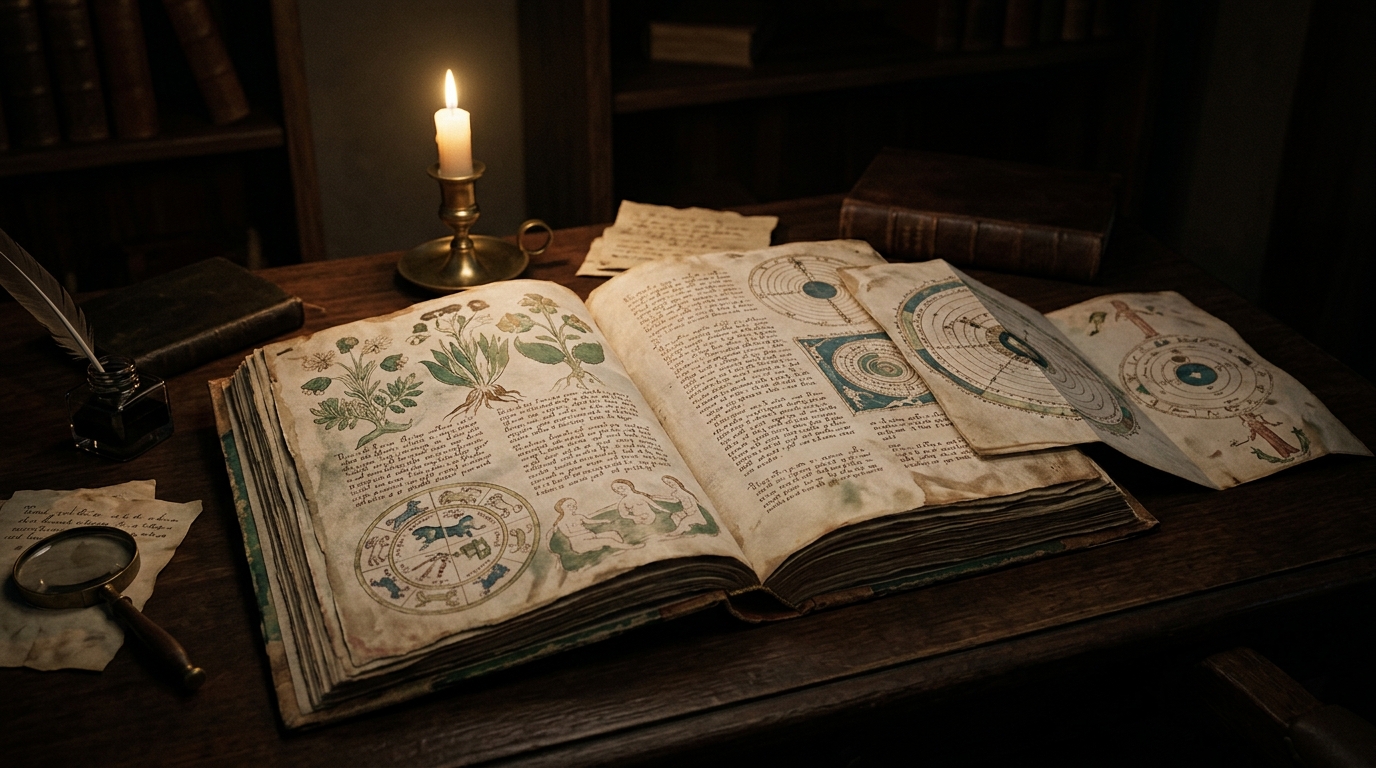
Around the writing appeared drawings.
Plants.
Roots.
Flowers.
Stars.
The Sun.
The Moon.
Circular astronomical diagrams.
Zodiac symbols.
Women standing naked in green pools.
Strange networks of pipes and channels.
Containers resembling pharmaceutical jars.
Foldout diagrams depicting worlds, cities, islands, stars, or perhaps things for which modern readers have no name.
When the work was finished, the manuscript contained hundreds of pages of material.
Someone clearly invested an enormous amount of time in making it.
And then its meaning disappeared.
Today, more than six centuries later, nobody can say with confidence what the book says.
Nobody can identify its author.
Nobody knows exactly where it was made.
Nobody knows with certainty what language—if any—is hidden beneath its script.
Nobody knows why it was created.
The manuscript has survived wars.
Political upheaval.
The collapse of empires.
The birth of modern science.
The invention of computers.
The development of professional cryptography.
Two world wars.
The creation of machines capable of examining language at scales impossible for its original readers to imagine.
And still, nobody has conclusively read it.
The book is now known as the Voynich Manuscript.
At Yale University's Beinecke Rare Book and Manuscript Library, it has a less dramatic designation:
MS 408.
Its existence is not disputed.
The manuscript is real.
Its pages can be examined in extraordinary detail through high-resolution scans.
Its parchment has been scientifically tested.
Its inks and pigments have been studied.
Its historical ownership has been investigated.
Its text has been transcribed into computer-readable form.
Professional cryptographers have attacked it.
Linguists have analyzed it.
Historians have searched archives for clues.
Computer scientists have measured its statistical structure.
Amateur investigators have spent entire careers studying individual symbols.
People have announced solutions repeatedly.
Latin.
Hebrew.
Arabic.
Italian.
German.
Nahuatl.
Proto-Romance.
An invented language.
A cipher.
A shorthand system.
An encoded medical text.
Women's health instructions.
Herbal medicine.
Alchemy.
Astrology.
Religious secrets.
An elaborate fraud.
Nearly every few years, someone claims the mystery has finally been solved.
Then other researchers examine the proposed solution.
And the Voynich Manuscript becomes unreadable again.
For more than a century, this cycle has repeated.
Yet the greatest mystery may not simply be what the manuscript says.
It is this:
How did someone create hundreds of pages of highly structured, apparently systematic writing that has resisted generations of people specifically trained to break secret codes?
And if the writing does not mean anything at all—
why does it behave so much like something that does?
The Book at Yale
The Voynich Manuscript is currently preserved at the Beinecke Rare Book and Manuscript Library at Yale University in New Haven, Connecticut.
Its official catalog designation is:
Beinecke MS 408.
Physically, it does not look like an object that should have generated more than a century of international obsession.
It is not enormous.
It is not bound in gold.
Its pages are not filled with jeweled illumination.
It does not contain an obvious royal seal.
It is, at first glance, simply an old illustrated manuscript.
But opening it changes everything.
Across page after page appears writing in a script found in no clearly identified historical tradition.
The characters look deliberate.
Some resemble familiar Latin letters.
Others resemble numbers.
Some contain loops.
Others rise above the text in tall elaborate forms often called gallows characters.
The overall effect is unnerving because the writing appears almost readable.
Almost.
Your eyes keep searching for something recognizable.
A word.
A phrase.
A pattern.
Anything.
But comprehension never arrives.
Researchers commonly refer to the writing system as Voynichese.
That does not mean Voynichese is a known language.
It is simply a convenient name for the undeciphered text.
And there is a great deal of it.
Modern transcriptions contain tens of thousands of word-like units.
They are separated by visible spaces.
They display recurring patterns.
Certain sequences appear frequently.
Others appear only in particular sections.
Some characters disproportionately appear at beginnings or endings.
It does not look like someone randomly scribbled symbols across parchment.
Something structured is happening.
What that structure represents remains the fundamental question.
How Old Is the Voynich Manuscript?
For decades, proposed dates for the manuscript varied widely.
Some researchers tried to date it through artistic style.
Others examined clothing, architecture, plant illustrations and handwriting.
Then science provided one of the most important breakthroughs in the history of the case.
Samples of the manuscript's parchment were subjected to radiocarbon dating.
The results placed the animal skins used to make the pages in approximately the period between:
1404 and 1438.
That finding dramatically changed the conversation.
The manuscript was not a nineteenth-century fabrication created by the man whose name it now carries.
The physical parchment genuinely came from the early fifteenth century.
That does not necessarily prove every mark was placed on the parchment during exactly those years.
Old blank parchment could theoretically have been stored and used later.
But additional examination of the manuscript's materials has generally been consistent with genuine historical production rather than a modern forgery.
The Voynich Manuscript is old.
Very old.
Whatever its purpose, the mystery did not begin in modern times.
Someone living in medieval or early Renaissance Europe appears to have been responsible for creating it.
Parchment, Not Paper
One important detail is frequently overlooked.
The manuscript's pages are made primarily from vellum, a writing material produced from animal skin.
Creating high-quality parchment was labor intensive.
Animal hides had to be prepared, cleaned, stretched, scraped and dried.
Sheets then had to be arranged and cut.
A manuscript containing this much vellum represented material value before a single character was written.
That creates an immediate challenge for the simplest hoax theory.
If the Voynich Manuscript is meaningless nonsense, somebody devoted significant resources to producing meaningless nonsense.
That is absolutely possible.
History contains elaborate frauds.
Prestige objects were fabricated.
Alchemical scams existed.
Books could be deliberately made mysterious to increase their perceived value.
But the scale matters.
The Voynich Manuscript is not a mysterious paragraph.
It is an entire codex.
If it is a hoax, it is an ambitious one.
Hundreds of Pages
The surviving manuscript contains roughly 240 pages, depending on precisely how leaves, foldouts and missing material are counted.
Evidence suggests some pages are missing.
The book is organized into gatherings or quires like other medieval manuscripts.
Some sheets unfold into much larger diagrams.
These foldouts are among the strangest parts of the object.
There are circles within circles.
Stars.
Structures.
Paths.
Possible landscapes.
Possible cosmological models.
One enormous foldout contains a network of nine circular structures connected by pathways or channels.
Researchers sometimes call it the Rosettes Folio.
What it actually represents is unknown.
A map?
A cosmological diagram?
An allegory?
A medical illustration?
A diagram of some imagined system?
A collection of places?
No interpretation has achieved consensus.
The Plants
The largest and most immediately recognizable portion of the manuscript resembles a medieval herbal.
Nearly every page in this section contains a large drawing of a plant.
Beside and around the illustrations appear blocks of Voynichese text.
This format has encouraged generations of researchers to assume the manuscript contains medical or botanical information.
Medieval herbals were common.
They described plants and their supposed medicinal properties.
Some combined practical medicine with astrology, folklore and inherited classical knowledge.
At first, the Voynich Manuscript seems to fit comfortably into that tradition.
Then you look closely at the plants.
Many are difficult—or impossible—to identify.
A leaf may resemble one known species.
The roots may resemble another.
A flower may appear completely imaginary.
Some plants seem plausible.
Others seem assembled from mismatched biological parts.
Researchers have proposed identifications ranging across Europe, Asia and the Americas.
Few have survived sustained scrutiny.
That creates several possibilities.
The artist may simply have been bad at botanical illustration.
The drawings may have been copied through generations of progressively inaccurate manuscripts.
They may be symbolic rather than literal.
They may depict plants that have changed or disappeared.
They may combine features intentionally.
Or perhaps researchers are looking for precise botanical illustrations where none were intended.
The plants remain one of the manuscript's most tantalizing clues.
They also remain one of its most dangerous traps.
If a researcher begins by deciding that one drawing "must" be a particular species, that assumption can influence everything that follows.
Plants That Shouldn't Exist?
Some claims about the Voynich plants have become especially controversial.
Researchers have periodically identified supposed New World species in the manuscript.
If correct, that would create an extraordinary chronological problem.
The manuscript's parchment predates Columbus's first voyage to the Americas in 1492 by more than half a century.
A convincing depiction of an exclusively American plant could therefore transform the historical interpretation of the manuscript.
Claims have included plants resembling sunflower, cactus and other species associated with the Americas.
None has achieved broad scholarly acceptance.
Plant identification from stylized medieval drawings is notoriously subjective.
A drawing that resembles a sunflower to one observer may look entirely different to another.
The illustrations should therefore be treated as clues.
Not proof.
The Stars
Turn farther through the manuscript and the plants give way to the sky.
Circular diagrams appear.
Stars surround strange central figures.
The Sun and Moon appear with human faces.
Some pages contain zodiac symbols recognizable to modern readers.
Fish.
A bull.
An archer.
Other familiar astrological imagery.
Names—or what appear to be names—are written beside figures.
This section is particularly important because recognizable zodiac imagery provides cultural context.
Astrology was deeply integrated into medieval European medicine.
Physicians considered relationships between celestial bodies and the human body.
Zodiac diagrams frequently appeared in medical manuscripts.
Herbs could be associated with planets.
Treatments could be timed according to astrological beliefs.
The presence of plants, stars, bodies and possible recipes therefore may not represent unrelated subjects.
They could potentially form parts of one medical or natural-philosophical system.
But that remains an interpretation.
Without reading the text, we cannot know.
The Strange Women in the Pools
Then the manuscript becomes stranger.
Dozens of small nude female figures appear across a series of pages.
Researchers often call them nymphs.
The women stand or float inside pools of green or blue liquid.
Some appear inside vessels.
Others are connected through tubes or pipes.
Some hold objects.
Some wear crowns or unusual headpieces.
Their bodies are rendered simply.
Their environment is more difficult to describe.
It looks biological.
Mechanical.
Architectural.
Hydraulic.
All at once.
This portion of the manuscript is commonly described as balneological, referring to bathing and the medicinal use of baths.
Bathing manuals and treatments existed in medieval Europe.
Natural springs could be associated with health.
Medical manuscripts could discuss fertility, reproduction and women's health.
That offers a potentially mundane explanation.
But the Voynich illustrations remain deeply unusual.
Some of the tubes resemble organs.
Some resemble plumbing.
Some pools seem interconnected.
The women's bodies appear integrated into systems whose purpose is not obvious.
This section has therefore inspired some of the manuscript's wildest theories.
Reproductive anatomy.
Gynecology.
Alchemy.
Hydraulic engineering.
Astrology.
The human circulatory system.
Microscopic biology.
Secret rituals.
Even extraterrestrial technology.
Without readable captions, almost anything can be projected onto the drawings.
That is precisely why caution matters.
A Medical Book for Women?
One influential interpretation proposes that much of the Voynich Manuscript concerns women's health.
The bathing figures could relate to fertility.
Pregnancy.
Menstruation.
Childbirth.
Gynecological treatments.
Herbal remedies.
Astrological timing.
The idea has historical plausibility.
Medieval medicine did include specialized knowledge concerning women's bodies and reproduction.
Herbal remedies and bathing therapies could be used in such contexts.
Some visual elements in the manuscript can be interpreted anatomically.
But interpreting them anatomically is not the same as proving that they are anatomy.
Until the text is deciphered, the hypothesis remains compelling but unconfirmed.
The Pharmaceutical Pages
Another section contains drawings of plant parts alongside objects resembling jars or containers.
Roots appear separated from stems and leaves.
The containers sometimes look elaborate.
This has led researchers to label the section pharmaceutical.
Again, the manuscript seems almost willing to explain itself.
Plants.
Medicinal preparations.
Containers.
Recipes.
Baths.
Astrology.
Perhaps this is simply a medical compendium.
Perhaps.
But we cannot read a single recipe.
The Recipe Section
Near the end of the manuscript are pages containing comparatively little illustration.
Instead, blocks of text are arranged into short sections.
Small star-like symbols or floral marks appear beside entries.
The layout resembles a list.
Perhaps recipes.
Perhaps instructions.
Perhaps indexes.
Perhaps prayers.
Perhaps something else entirely.
Researchers refer to this as the recipes section largely because its visual structure resembles recipe or instructional writing.
That label should not be mistaken for a translation.
No one knows whether the entries tell a reader to grind roots in water, calculate the movement of Venus, recite a prayer, mix pigments or do something completely different.
The Language That Nobody Recognizes
If the Voynich Manuscript were written in an obscure but known language, eventually somebody should recognize it.
That has not happened.
Its script does not correspond cleanly to any established medieval alphabet.
There appear to be somewhere around two dozen common characters, depending on how researchers classify variations and compound symbols.
Some characters seem to behave differently depending on where they occur in words.
Certain sequences are extremely common.
Words frequently differ from nearby words by only one symbol.
Repetition occurs in patterns unusual for many familiar European languages.
And yet the text is not obviously random.
That contradiction is the heart of Voynich research.
The text looks organized.
But not organized in a way anyone has convincingly decoded.
Voynichese
Researchers needed a way to discuss the script without constantly reproducing its unusual characters.
Several transcription systems were developed.
The most commonly encountered today is the European Voynich Alphabet, usually abbreviated EVA.
EVA assigns ordinary Latin characters to Voynich symbols.
This does not mean a Voynich symbol represented the corresponding Latin sound.
EVA is simply a transcription system.
A symbol represented as q does not necessarily mean the sound "q."
A sequence written daiin does not mean the manuscript literally contains the Latin letters D-A-I-I-N.
They are labels.
This distinction becomes important when people encounter apparent Voynich words online and mistakenly believe researchers have partly translated the script.
They have not.
We can transcribe Voynichese.
We cannot reliably read it.
The Most Famous Voynich Words
Certain transcription sequences appear frequently enough to have become familiar to researchers.
One famous example is:
daiin
Another is:
ol
Another:
chedy
Patterns involving sequences transcribed as qo, ch, sh, aiin, and others occur repeatedly.
These words have distributions.
Some are more common in certain sections.
Some frequently occur near particular other words.
Some favor specific positions in lines.
If the manuscript is gibberish, its creator constructed remarkably persistent rules for producing that gibberish.
If it is language, the language behaves strangely.
If it is a cipher, the cipher preserves patterns that conventional encryption often destroys.
Every explanation solves one problem and creates another.
Does Voynichese Behave Like Real Language?
This question has become one of the most important areas of modern Voynich research.
Computers allow investigators to ignore meaning temporarily and study structure.
How often does each word appear?
How often do symbols occur?
Which words appear near each other?
Do word frequencies follow patterns found in natural language?
Does vocabulary vary across sections?
Are some words concentrated around certain illustrations?
Multiple statistical studies have found that the manuscript contains non-random organization.
One 2013 information-theoretic study found that word distributions across the manuscript showed patterns comparable in important ways to real human languages.
Another analysis of complex word networks similarly found compatibility with natural-language-like structure.
That sounds enormous.
Perhaps Voynichese is a real language.
But there is a crucial warning.
Structured text does not automatically equal meaningful natural language.
An algorithm can produce statistical patterns.
A sufficiently sophisticated hoax mechanism can produce regularities.
A cipher can preserve structures.
A constructed language can possess structure.
A procedural generation system can create patterns.
Statistics can tell us that something interesting is occurring.
They cannot simply translate the manuscript.
It Isn't Random
This may be the safest conclusion available.
The Voynich text is not easily explained as someone choosing symbols completely at random.
Repeated sequences occur too systematically.
Word-like units have internal structure.
Different sections show different statistical tendencies.
Certain words cluster around certain subjects.
Characters have positional preferences.
Lines exhibit structure.
Something generated these patterns.
The dispute is over what that "something" was.
Language?
Cipher?
Code?
Algorithm?
Mnemonic system?
Artificial language?
Hoax procedure?
The answer remains unknown.
More Than One Voynichese?
Researchers have also identified substantial differences within the manuscript itself.
In the twentieth century, cryptanalyst Prescott Currier noticed that different portions of the manuscript appeared to exhibit distinct statistical characteristics.
These became known as:
Currier A
and
Currier B.
The differences involve character frequencies, word patterns and other features.
Currier also identified differences in handwriting.
That raised an important possibility.
The manuscript may not have been written by one person in one continuous effort.
Multiple scribes may have participated.
Recent paleographic analysis has strengthened the idea that several hands were involved in producing the manuscript.
If true, the mystery becomes more complicated.
A lone eccentric could invent a private script.
But if several people wrote it consistently, they may have shared a system.
That could indicate an actual writing method understood by a group.
Or it could indicate multiple participants in a collaborative production.
Either way, the image of one mysterious genius alone in a tower becomes less convincing.
The First Known Owners
The manuscript's earliest history is frustratingly incomplete.
We do not know who commissioned it.
We do not know who wrote it.
We do not know exactly where it was created.
By the early seventeenth century, however, the trail becomes clearer.
The manuscript became associated with Prague and the extraordinary intellectual world surrounding the court of Holy Roman Emperor Rudolf II.
Rudolf ruled from Prague and famously collected unusual objects.
His court attracted astronomers.
Astrologers.
Alchemists.
Artists.
Mathematicians.
Natural philosophers.
Collectors.
Charlatans.
And seekers of hidden knowledge.
It is difficult to imagine a better environment for the Voynich Manuscript to surface.
Rudolf II
A letter preserved with the manuscript states that the book had once belonged to Emperor Rudolf II.
According to information transmitted in that letter, Rudolf supposedly paid 600 ducats for it.
That would have represented an extraordinary amount of money.
The story also claimed that the manuscript was believed to have been written by the famous medieval scholar Roger Bacon.
Modern evidence does not support Bacon as the author.
The radiocarbon dating alone presents a severe problem.
Roger Bacon died around the end of the thirteenth century.
The parchment dates from more than a century later.
But in Rudolf's time, attribution to an illustrious ancient scholar could dramatically increase the perceived value of an obscure manuscript.
If someone sold Rudolf a mysterious unreadable book while claiming it contained the secret knowledge of Roger Bacon, the emperor may have found the proposition irresistible.
Roger Bacon
Roger Bacon was a thirteenth-century Franciscan friar and scholar associated with mathematics, optics, language study and natural philosophy.
Later generations surrounded him with legends.
He became precisely the kind of historical figure to whom an inexplicable book might be attributed.
Wilfrid Voynich himself became strongly interested in the possibility that Bacon had written the manuscript.
Early twentieth-century attempts to decode it were therefore heavily influenced by the assumption.
But the manuscript's scientific dating has effectively ended the straightforward Roger Bacon authorship theory.
Unless extraordinarily old unused parchment somehow waited more than a century before being written upon—and additional evidence supported that scenario—the dates simply do not fit.
The Roger Bacon connection belongs to the manuscript's history.
Not to its demonstrated authorship.
John Dee and Edward Kelley
Two other famous names became entangled in the mystery:
John Dee and Edward Kelley.
Dee was an English mathematician, astronomer, astrologer and advisor to Queen Elizabeth I.
He possessed one of the largest private libraries in England and became deeply involved in attempts to communicate with angels through Kelley, a controversial scryer and alchemist.
The pair spent time in Central Europe.
They interacted with the intellectual environment surrounding Rudolf II.
This led to an irresistible theory.
Perhaps Dee and Kelley brought the Voynich Manuscript to Rudolf.
Perhaps Kelley created it.
Perhaps they sold an invented book to the emperor by claiming it was written by Roger Bacon.
It makes a wonderful story.
The evidence is much weaker.
Earlier researchers attempted to connect numerical foliation in the Voynich Manuscript to Dee's handwriting.
More recent scholarship has cast serious doubt on the supposed ownership link.
There is no definitive record establishing that Dee possessed the Voynich Manuscript.
There is no definitive document showing Kelley created it.
Possible?
Yes.
Proven?
No.
Jacobus Horčický de Tepenec
A much stronger historical connection comes from a nearly erased signature discovered on the manuscript.
Under ultraviolet examination, researchers identified writing associated with Jacobus Horčický de Tepenec.
He was a pharmacist and court figure connected with Rudolf II.
His presence in the provenance is important because it moves the history away from speculation and toward physical evidence.
At some point, the manuscript appears to have passed through his hands.
After his death, its path again becomes less clear.
Eventually, it reached another Prague scholar.
A man who could not read it.
Georg Baresch
By the seventeenth century, the manuscript belonged to Georg Baresch, also rendered in Latinized forms such as Barschius.
Baresch was an alchemist in Prague.
He was fascinated and frustrated by the strange book.
He apparently spent considerable effort attempting to understand it.
He eventually sought help from one of Europe's most famous scholars.
Athanasius Kircher.
Kircher was a Jesuit polymath based in Rome.
He wrote about languages, religion, geology, magnetism, Egypt, music and countless other subjects.
Most importantly for Baresch, Kircher had developed a reputation for deciphering mysterious scripts.
Kircher believed he could read Egyptian hieroglyphs.
His supposed translations were largely wrong.
But to seventeenth-century Europeans, he appeared to be exactly the man who might unlock a mysterious unknown manuscript.
Baresch sent him samples.
The code remained closed.
"Such Sphinxes"
After Baresch died, the manuscript passed to Johannes Marcus Marci, a physician and scholar in Prague.
Marci eventually sent the entire book to Kircher.
The manuscript still contains the accompanying letter.
It is dated August 19, 1666, though historical discussion has occasionally noted uncertainty surrounding the final digit.
Marci explained that the previous owner had worked tirelessly on the mystery.
His effort had failed.
In an extraordinary phrase, the translated letter describes puzzles like the manuscript as:
"such Sphinxes as these"
Marci encouraged Kircher to:
"burst through its bars"
He also relayed the story that Rudolf II had paid 600 ducats for the book and that Roger Bacon had been suggested as its author.
Then Marci added something remarkably sensible:
"On this point I suspend judgment."
More than three and a half centuries later, that may remain the wisest statement ever made about the Voynich Manuscript.
Into the Jesuit Collections
After Marci sent the manuscript to Kircher, it entered Jesuit collections.
And then, for centuries, it largely vanished from public view.
It survived.
But it ceased to be famous.
The strange book waited inside institutional collections while European history transformed around it.
Then, in the early twentieth century, a rare-book dealer found it.
His name would become permanently attached to the manuscript.
Wilfrid Voynich
Wilfrid Michael Voynich was born in the Russian Empire and became involved in revolutionary politics before eventually establishing himself as an antiquarian bookseller.
In 1912, Voynich acquired a collection of manuscripts from a Jesuit institution near Rome.
Among them was the strange illustrated codex.
Voynich immediately recognized that the manuscript was unusual.
He began investigating its history.
He found the Marci letter.
He became convinced that the manuscript might be an extraordinarily important work.
And he promoted it energetically.
From that point onward, MS 408 became the Voynich Manuscript.
The modern mystery had begun.
William Romaine Newbold
One of the earliest major attempts to solve the Voynich Manuscript came from University of Pennsylvania scholar William Romaine Newbold.
Newbold believed the manuscript was written by Roger Bacon.
He claimed the visible characters concealed microscopic shorthand.
According to his theory, tiny marks within the letters carried the true message.
The decipherment produced astonishing results.
Newbold concluded that Bacon possessed scientific knowledge centuries ahead of his time.
He claimed the manuscript described things seen through microscopes and telescopes before those technologies supposedly existed.
If Newbold were right, history would need rewriting.
He was not.
After Newbold's death, scholars carefully examined his method.
The supposed microscopic marks were largely cracks and irregularities produced naturally by aging ink.
The interpretation depended heavily on subjective choices.
Cryptologist John Manly dismantled the proposed solution.
The first great Voynich decipherment collapsed.
It would not be the last.
The Greatest Codebreakers Took a Turn
The manuscript eventually attracted people who actually knew how to break codes.
Among them was William F. Friedman.
Friedman was not an amateur enthusiast.
He became one of the most important cryptologists in American history.
His work helped establish modern American signals intelligence.
He and his team broke sophisticated cryptographic systems.
Friedman became deeply interested in the Voynich Manuscript.
If it were an ordinary cipher, surely someone like Friedman had a chance.
He never solved it.
That fact has contributed greatly to the manuscript's reputation.
But it should be interpreted carefully.
Failing to solve an unknown text does not prove that the text contains an unimaginably advanced cipher.
A codebreaker normally has context.
Expected languages.
Known alphabets.
Historical clues.
Message origins.
Repeated traffic.
Potential cribs.
The Voynich Manuscript offers almost none of these.
Researchers do not even know whether they are looking at encryption.
Friedman's Theory
Friedman eventually suspected that Voynichese might not represent a traditional cipher at all.
He considered the possibility that it encoded some kind of constructed or synthetic language.
That is enormously important.
If the manuscript uses an artificial language with its own vocabulary and rules, ordinary cryptanalysis may never have had much chance.
Imagine discovering a book written entirely in a language invented by one medieval scholar.
No dictionary survives.
No translation survives.
No bilingual inscription exists.
No speaker remains.
Even if the writing accurately represents language, decoding it could be extraordinarily difficult.
John Tiltman
Another major cryptanalyst to study the manuscript was Brigadier John Tiltman.
Tiltman had extensive professional experience in codebreaking.
He analyzed recurring structures in Voynichese and noted strange regularities within words.
Certain symbols seemed to prefer certain positions.
Words appeared related to one another in systematic ways.
Yet the manuscript did not behave like a straightforward substitution cipher.
Tiltman never produced a definitive solution.
Decades of professional cryptanalytic attention had therefore produced something important:
Not an answer.
A better understanding of why the question was difficult.
Could It Be a Cipher?
The most intuitive theory remains that the Voynich Manuscript contains encrypted text.
Someone wrote a book in Latin, Italian, German or another language.
Then they transformed it using a cipher.
Simple substitution seems unlikely.
In a basic substitution cipher, each plaintext character is replaced by another symbol.
Such systems preserve many statistical properties of the original language.
Frequency analysis can often expose them.
Voynichese does not yield easily to this approach.
More complex systems could be involved.
Homophonic substitution.
Null characters.
Multiple symbols representing the same sound.
Abbreviations.
Syllabic encoding.
Code groups representing entire words.
Polyphonic symbols.
Transposition.
Specialized shorthand.
Multiple simultaneous techniques.
A sufficiently complicated system could frustrate modern analysts.
But complexity creates another question.
Why?
What information was so sensitive that someone needed to encrypt an entire illustrated manuscript with hundreds of pages?
Medieval Ciphers Were Real
Secret writing existed long before modern computers.
Medieval and Renaissance diplomats used codes.
Scholars experimented with cryptography.
Religious and political information could be concealed.
Alchemists used obscure symbolism.
Medical professionals employed abbreviations.
Trade secrets could be protected.
So the basic idea of an encrypted fifteenth-century manuscript is not inherently anachronistic.
The problem is finding a known system that explains Voynichese.
So far, nobody has.
Could It Be a Lost Language?
Another possibility is that Voynichese directly represents a language no longer understood.
Languages disappear.
Scripts disappear.
Entire writing traditions can vanish.
Some historical scripts remained undeciphered for centuries until bilingual texts or other breakthroughs provided keys.
But the Voynich Manuscript presents unusual difficulties.
No clearly related document has been discovered.
There is no obvious Rosetta Stone.
No bilingual version.
No parallel text.
No securely identified proper names.
Even the illustrations are ambiguous.
A single recognizable sentence could transform the entire field.
Six centuries later, none has been identified beyond serious dispute.
Could It Be an Invented Language?
Perhaps no one recognizes Voynichese because nobody was ever supposed to.
The manuscript's creator may have constructed an artificial language.
Today, constructed languages are familiar.
Esperanto.
Klingon.
Quenya.
But language invention is much older.
Philosophers and mystics have repeatedly attempted to design ideal languages.
Systems could classify concepts according to logical categories.
Words could be constructed from meaningful components.
If Voynichese operates in such a system, repeated internal word patterns could make sense.
Related concepts might literally have similar words.
That could help explain some of the strange morphological regularity.
But once again, without the grammar or dictionary, the theory remains unproven.
Could It Be Shorthand?
Another possibility receives less popular attention but deserves consideration.
Voynichese may be a specialized shorthand system.
Medieval scribes used extensive abbreviations.
A highly compressed writing system could appear unfamiliar even if the underlying language were ordinary.
Symbols might represent sounds, syllables or entire common phrases.
This could produce unusual word-frequency patterns.
The difficulty is demonstrating a consistent conversion from Voynichese into a known historical shorthand tradition.
No proposed system has won broad acceptance.
The Hoax Theory
Then there is the possibility that the manuscript says absolutely nothing.
Not encrypted knowledge.
Not lost medicine.
Not an unknown language.
Nothing.
A deliberate fraud.
The theory has obvious appeal.
Rudolf II supposedly paid 600 ducats for the manuscript.
Imagine an ambitious con artist learning that a wealthy emperor collects mysterious works of hidden knowledge.
The fraudster fills expensive parchment with invented symbols.
Adds strange plants.
Draws cosmic diagrams.
Claims the book was written by Roger Bacon.
Then sells it for a fortune.
Case closed.
Except it is not that easy.
How Do You Fake Hundreds of Pages?
Meaningless text is surprisingly hard to produce convincingly over long distances.
Ask someone to invent gibberish for ten pages and unconscious patterns appear.
Vocabulary becomes repetitive.
Randomness becomes obvious.
Structure collapses.
The Voynich Manuscript contains extensive regularity at multiple levels.
Words vary by section.
Symbols behave differently according to position.
Some terms cluster near particular images.
Different textual systems appear across different scribes.
That does not make hoaxing impossible.
But it means the hoax would require a method.
Gordon Rugg and the Cardan Grille Idea
Researcher Gordon Rugg famously demonstrated that a system using tables of syllable-like components and a grille could generate text possessing some Voynich-like properties.
The method did not require the generated words to carry meaning.
A creator could move a template across a table and select combinations.
The result could look systematic without encoding language.
This was significant because it challenged an assumption.
Researchers had often argued:
"The text has structure, therefore it must contain meaningful language."
Rugg demonstrated that structure alone cannot prove meaning.
A procedural hoax can produce structure.
But demonstrating that a method could generate similar text is not the same as proving that the manuscript's creator actually used that method.
The hoax theory remains viable.
It has not been conclusively demonstrated.
Why Make a Hoax This Elaborate?
This remains the strongest psychological objection.
The manuscript contains enormous labor.
Illustrations.
Text.
Foldouts.
Careful organization.
Multiple apparent scribes.
Expensive materials.
If meaningless, why invest so much effort?
Money is one answer.
Prestige another.
Perhaps the manuscript was created specifically to appear like an ancient repository of secret knowledge.
Perhaps it was an artistic experiment.
Perhaps the creators themselves believed in the symbolic system even if it was not conventional language.
Perhaps it was never intended to deceive anyone.
"Hoax" may be too simple a word.
Something can be unreadable without being fraudulent.
The Strange Absence of Corrections
One often-mentioned feature of the manuscript is the apparent scarcity of obvious corrections.
Large stretches seem to have been written fluently.
If the writer were encoding complicated text, one might expect mistakes.
If the text were meaningless, rapid fluent writing becomes easier to explain.
Yet scribes could also have copied from an earlier source.
Corrections may exist in forms not obvious to modern observers.
The absence of visible hesitation is interesting.
It is not decisive.
Are the Words Too Similar?
Voynich words frequently resemble nearby words.
A sequence may repeat with one character altered.
Then another similar form appears.
This behavior has fueled competing theories.
Perhaps words are morphologically related.
Perhaps the language uses extensive prefixes and suffixes.
Perhaps symbols encode grammatical categories.
Perhaps the text was produced algorithmically.
Perhaps the scribe generated each new word by slightly modifying the previous one.
Once more, the same observation supports both meaningful and meaningless explanations.
This is the Voynich problem in miniature.
Every clue seems to face two directions.
The Illustrations Should Have Solved It
Illustrated manuscripts are normally easier to interpret than unillustrated ones.
If a page depicts a rose and the adjacent word repeats across other pages depicting roses, researchers gain a potential foothold.
But the Voynich images are too ambiguous.
The plants are uncertain.
The diagrams are symbolic.
The women are unexplained.
Even recognizable zodiac signs do not produce obvious labels that unlock the script.
The pictures provide context.
They have not provided a key.
The Zodiac Names
One seemingly promising target involves small labels surrounding zodiac figures.
If those labels represent names, perhaps they are personal names.
Perhaps month names.
Star names.
Astrological terms.
Known words should be identifiable through comparison.
Researchers have tried.
No proposed mapping has generated a universally convincing decipherment.
This is especially frustrating because proper names have historically helped crack unknown scripts.
The Voynich Manuscript seems to offer potential cribs everywhere.
Then withdraw them.
Claimed Solutions
A remarkable number of people have announced that they solved the Voynich Manuscript.
Many claims follow the same pattern.
A researcher proposes a language.
Assigns sounds to symbols.
Selects a short passage.
Produces a translation that appears meaningful.
News headlines announce that the world's most mysterious book has finally been decoded.
Specialists examine the method.
Problems emerge.
Symbol values change depending on context without sufficient justification.
Words are rearranged.
Letters are omitted.
Translations depend on obscure vocabulary.
Grammar is inconsistent.
Different passages cannot be translated using the same rules.
The solution collapses.
Then another appears.
The Problem With "Decipherments"
A real decipherment needs to do more than produce one plausible sentence.
Given enough flexibility, almost any unknown sequence can be turned into meaningful language.
A convincing solution should provide consistent rules.
Those rules should work across material not used to construct them.
Independent researchers should be able to reproduce the translation.
Illustrations should make sense alongside the resulting text.
Grammar should remain coherent.
Unexpected passages should translate without changing the system whenever necessary.
Most Voynich solutions fail one or more of these tests.
That is why headlines claiming VOYNICH MANUSCRIPT FINALLY SOLVED should be treated skeptically.
The manuscript has been "finally solved" many times.
It remains unread.
Hebrew?
One computer-assisted study attracted widespread attention by suggesting Voynichese may encode Hebrew.
Algorithms identified possible relationships to Hebrew vocabulary.
A proposed opening phrase was translated in a way that generated headlines.
But the analysis required substantial interpretation and rearrangement.
Hebrew specialists did not accept it as a demonstrated translation of the manuscript.
The episode illustrated an important lesson about artificial intelligence and machine learning.
Computers are extraordinarily good at finding patterns.
A pattern is not automatically a solution.
Proto-Romance?
Another widely publicized claim proposed that the manuscript was written in a lost Proto-Romance language.
The theory generated dramatic media coverage.
Specialists quickly challenged it.
"Proto-Romance" ordinarily refers to reconstructed linguistic stages ancestral to Romance languages, not a mysterious medieval language conveniently matching an undeciphered manuscript.
Critics argued that the proposed translations were inconsistent and selected meanings too freely.
The supposed breakthrough did not become accepted.
Again, the Voynich Manuscript survived.
Arabic?
Researchers have also proposed Arabic or Arabic-derived solutions.
Others have found supposed connections to Turkish.
Romani.
Latin.
Italian dialects.
German.
Greek.
Slavic languages.
East Asian languages.
Mesoamerican languages.
Almost every linguistic family that can be plausibly connected to some visual or statistical feature has received attention.
The sheer number of proposed languages is itself revealing.
If radically different systems can each produce isolated convincing-looking translations, then isolated translations are not strong evidence.
Artificial Intelligence Will Solve It—Right?
Modern AI has revived hopes that computers may finally crack the manuscript.
Language models can compare enormous corpora.
Machine learning can identify statistical similarities.
Pattern-recognition systems can classify handwriting.
Algorithms can model unknown language structures.
Perhaps one day those methods will contribute to a real breakthrough.
But AI faces the same fundamental problem as humans.
There may be no training data.
No known translation.
No established alphabet.
No identified language.
No guarantee that the text represents natural language at all.
A machine can find patterns in Voynichese.
Researchers have already done that.
What it cannot automatically obtain is ground truth.
Without some external anchor, the system can generate plausible interpretations that are impossible to verify.
AI can increase the number of theories.
That is not necessarily the same as increasing the number of answers.
Why Radiocarbon Dating Changed Everything
Before the parchment was dated, one popular skeptical possibility remained open.
Perhaps Wilfrid Voynich himself created the manuscript.
He was a rare-book dealer.
He knew the market.
A sensational undeciphered manuscript attributed to Roger Bacon could become enormously valuable.
If Voynich forged it, many mysteries would disappear at once.
Radiocarbon testing made that scenario far less plausible.
The parchment is genuinely medieval.
A modern forger could theoretically obtain hundreds of sheets of unused fifteenth-century vellum.
But doing so without leaving other obvious traces would be extraordinarily difficult.
The manuscript's material history is broadly consistent with an authentic old object.
Voynich discovered the mystery.
He almost certainly did not manufacture the physical book from scratch.
Could a Medieval Forger Have Made It?
Yes.
This remains much more plausible.
An early fifteenth-century creator could have intentionally produced a false book of ancient wisdom.
Or a later sixteenth-century fraudster could theoretically have used older parchment.
Rudolf's court was filled with people interested in alchemy, astrology and secret knowledge.
An unreadable "ancient" manuscript could command attention.
But proving medieval or Renaissance fraud requires more than observing that fraud was possible.
Who made it?
How?
When?
Why?
Using what generation system?
How were the illustrations planned?
Why do sections differ statistically?
Why do several hands appear?
The hoax theory answers the question of meaning by generating a new mystery of production.
The Manuscript May Have Been Useful to Its Creator
There is another possibility.
Perhaps the manuscript was never intended to be read conventionally.
Maybe it functioned as a mnemonic tool.
A private notebook.
A symbolic medical guide.
A collection of visual prompts.
A teaching aid.
An esoteric ritual object.
A compressed reference system.
If the original owner knew how to interpret the diagrams and abbreviations, the writing might not correspond directly to spoken language.
Modern researchers may be trying to translate something that was never meant to function like ordinary prose.
That could explain why natural-language approaches repeatedly fail.
A Book of Secrets
The medieval and Renaissance worlds were full of secret knowledge.
Alchemy deliberately obscured instructions.
Astrological traditions relied on specialized symbolism.
Medical texts inherited terminology through Latin, Greek and Arabic traditions.
Mystical writings could encode knowledge accessible only to initiates.
A mysterious script could have practical value simply because it restricted access.
Perhaps the Voynich Manuscript was designed to be understood by a small circle.
Then that circle disappeared.
The key disappeared with them.
Why Has No Second Book Been Found?
This question is devastating to several theories.
If Voynichese represented a normal regional language, where are the other documents?
If it represented a widely used cipher system, where are examples?
If it represented a scholarly constructed language, did nobody else copy it?
If multiple scribes understood the system, why did no related manuscript survive?
It is possible related material simply disappeared.
Most medieval documents did not survive.
Libraries burned.
Books were recycled.
Bindings were dismantled.
Parchment was reused.
Yet after more than a century of intense investigation, no unquestionably related manuscript has emerged.
MS 408 appears alone.
A Unique Survival?
Its uniqueness does not necessarily imply extraordinary origins.
Historical survival is uneven.
One manuscript can remain when an entire tradition vanishes.
Rare scripts have survived in tiny corpora.
Private notebooks can be unique.
The Voynich Manuscript may be the sole survivor of something once completely understandable.
If so, the greatest tragedy is not that its creator concealed the meaning too effectively.
It may simply be that every other key was lost.
The Rosettes Folio
Of all the Voynich images, perhaps none inspires more speculation than the enormous foldout commonly called the Rosettes Folio.
Nine circular structures occupy the page.
They are linked.
Inside them are intricate shapes.
Structures resembling towers appear.
Paths connect regions.
Stars or floral forms repeat.
One section contains what looks strikingly like a castle wall with swallowtail battlements.
Researchers have interpreted the folio as:
A map.
A cosmology.
A diagram of the human body.
An alchemical process.
A journey.
A network of cities.
A volcanic landscape.
A spiritual universe.
A representation of baths.
A medical system.
Perhaps none is correct.
The page feels as though it should be the manuscript's centerpiece.
Whatever the book was trying to communicate, the author devoted extraordinary effort to this diagram.
If the text is ever read, the Rosettes Folio may become one of the most important pages.
Until then, it remains a map without a legend.
The Castle Battlements
The architectural features in the manuscript have also been used to argue for geographic origins.
A wall on the Rosettes Folio appears to contain a type of swallowtail, or Ghibelline, battlement associated particularly with northern Italy.
Researchers have used this and other artistic features to argue for an Italian or Central European context.
Such clues are valuable.
But artistic motifs travel.
Scribes copy earlier manuscripts.
Illustrators imitate unfamiliar architecture.
No single tower can establish a birthplace.
At best, the drawings narrow possibilities.
They do not identify the workshop.
How Many People Made It?
For years, popular retellings often imagined one unknown author.
Recent handwriting research has suggested several scribes may have contributed.
That matters enormously.
A manuscript produced by several hands implies coordination.
The scribes presumably knew what symbols to use.
They understood where words ended.
They followed shared conventions.
They could produce long stretches of text.
If Voynichese were meaningless, several people may have participated in generating consistent meaningless material.
If meaningful, several people may have been literate in a writing system now completely lost.
Either possibility is remarkable.
Does the Text Follow the Illustrations?
Statistical studies indicate that vocabulary varies between sections.
Words appearing frequently around botanical material may occur less frequently elsewhere.
Other terms cluster in different portions of the manuscript.
This is exactly what we might expect from meaningful writing about different subjects.
A botanical chapter uses botanical vocabulary.
An astronomical chapter uses astronomical vocabulary.
A medical section uses medical vocabulary.
That is one of the stronger arguments against completely unconstrained gibberish.
But an organized hoaxer could deliberately generate different vocabularies for different sections.
Once again:
Evidence for structure.
Not definitive evidence for meaning.
Why the Voynich Manuscript Is So Difficult
The manuscript combines nearly every problem a decipherer could encounter.
Unknown author.
Unknown location.
Unknown language.
Unknown script.
Unknown purpose.
Unknown encoding method.
Unknown genre.
No bilingual text.
No confirmed proper names.
Ambiguous images.
Missing pages.
Several possible scribes.
No known related manuscript.
No surviving key.
No historical explanation from the creators.
It is almost a perfect cryptographic nightmare.
Even a perfectly meaningful book could remain unread indefinitely under those conditions.
What We Actually Know
After stripping away centuries of theories, a surprisingly solid factual core remains.
The Voynich Manuscript is a genuine historical object.
Its parchment dates to the early fifteenth century.
It contains hundreds of pages of systematic writing in an unidentified script.
It contains illustrations relating broadly to plants, astronomy or astrology, bathing or biological imagery, pharmaceutical material and recipe-like entries.
Its text shows significant internal structure.
Different portions of the manuscript have different statistical characteristics.
Several writers may have participated.
By the seventeenth century, it was circulating among scholars in Prague who already could not read it.
It eventually reached Athanasius Kircher in Rome.
Wilfrid Voynich purchased it in 1912.
Professional cryptographers studied it.
No decipherment has achieved scholarly consensus.
Those facts are enough.
The Voynich Manuscript does not need aliens.
It does not need time travelers.
It does not need supernatural explanations.
The documented mystery is already extraordinary.
What We Do Not Know
We do not know who wrote it.
We do not know precisely when the text was written.
We do not know exactly where it was produced.
We do not know whether Voynichese represents language.
We do not know whether it is encrypted.
We do not know whether the illustrations are literal.
We do not know the manuscript's intended audience.
We do not know whether it was useful.
We do not know whether it was deceptive.
We do not know whether anyone after its creators ever successfully read it.
And most importantly:
We do not know what it says.
The Possibility That There Is Nothing to Solve
This possibility must remain open.
Perhaps the greatest unsolved cipher in history is not a cipher.
Perhaps thousands of brilliant hours have been spent searching for meaning that was never there.
That would not make the manuscript less fascinating.
It might make it more fascinating.
A fifteenth-century creator who produced hundreds of pages of convincing pseudo-language anticipated techniques that still deceive modern pattern recognition.
The hoax itself would become the historical achievement.
But before declaring the text meaningless, one uncomfortable fact remains.
Nobody has proved that either.
The Possibility That Everything Is There
The opposite possibility is even more tantalizing.
Maybe every page is readable.
Maybe each strange plant has a name.
Maybe every woman in every pool illustrates a treatment.
Maybe the zodiac labels refer to dates.
Maybe the pharmaceutical containers hold specific preparations.
Maybe the Rosettes Folio represents an actual place.
Maybe the final pages contain recipes.
Maybe the entire book has been sitting in front of us for six hundred years saying something perfectly coherent.
We simply do not possess the key.
That possibility keeps researchers returning.
A Message Across Six Centuries
Think about the human reality behind the manuscript.
Someone sat at a table.
They sharpened a quill.
They dipped it into ink.
They wrote the first symbol.
Then another.
Then another.
Their hand moved across the page.
They knew what they were doing.
At least, presumably they did.
They turned the sheet.
Continued.
Other hands may have joined them.
Someone drew roots.
Someone painted pools green.
Someone constructed circles representing the heavens.
Someone folded enormous pieces of vellum to preserve diagrams.
Someone arranged the quires.
Someone bound the book.
Perhaps people read it.
Perhaps they studied it.
Perhaps they used it.
Then, somewhere between that world and ours, understanding vanished.
The physical object survived.
The meaning did not.
The Ultimate Historical Cold Case
Most mysteries involve something missing.
A person.
A murderer.
A ship.
A treasure.
The Voynich Manuscript is different.
The evidence is sitting in a climate-controlled library.
We have the object.
We have the words.
We have the illustrations.
We have the pages.
We can zoom close enough to examine individual strokes of ink.
Nothing is hidden from us physically.
And yet almost everything is hidden intellectually.
It is the rare mystery where the evidence itself is the mystery.
Case Assessment
Documented: The Voynich Manuscript is a genuine illustrated manuscript preserved at Yale University's Beinecke Rare Book and Manuscript Library as MS 408.
Documented: Radiocarbon analysis dates its parchment to approximately 1404–1438.
Documented: The manuscript contains hundreds of pages written in an unidentified script commonly called Voynichese.
Documented: Its illustrations include plants, astronomical and astrological diagrams, bathing figures, cosmological imagery, pharmaceutical-looking material and recipe-like entries.
Documented: A seventeenth-century letter from Johannes Marcus Marci accompanied the manuscript when it was sent to Athanasius Kircher.
Documented: The manuscript was associated with Rudolf II and later owners in Prague, although parts of its earliest provenance remain uncertain.
Documented: Wilfrid Voynich purchased the manuscript from a Jesuit collection in 1912.
Documented: Professional cryptographers including William F. Friedman and John Tiltman studied the manuscript without producing an accepted decipherment.
Documented: Statistical studies have found significant organization within the Voynich text and similarities to some properties of natural language.
Documented: Different portions of the manuscript display different textual characteristics.
Unresolved: What language, if any, is represented by Voynichese.
Unresolved: Whether the text is encrypted.
Unresolved: Whether the manuscript contains meaningful linguistic content.
Unresolved: Who created it.
Unresolved: Why it was created.
Unresolved: Precisely where it was created.
Unverified: Claims that individual plants have been conclusively identified.
Unverified: Claims connecting the manuscript definitively to John Dee, Edward Kelley, Roger Bacon or other famous historical figures.
Unverified: Every announced "complete decipherment" that has failed to gain reproducible scholarly acceptance.
Possible: A natural language written in an unknown or heavily abbreviated script.
Possible: An encrypted text.
Possible: An artificial language.
Possible: A specialized mnemonic or reference system.
Possible: Meaningless text generated according to systematic rules.
Final Analysis
The Voynich Manuscript has survived because it occupies a rare place between knowledge and ignorance.
We know enough to understand that it is extraordinary.
But not enough to understand why.
The parchment is real.
The ink is real.
The handwriting is real.
The drawings are real.
The history is partly recoverable.
There is no need to imagine that the book fell from another planet or appeared through some supernatural event.
Its documented history is more interesting than that.
Somewhere in fifteenth-century Europe, human beings made this object.
They spent money.
They spent time.
They prepared parchment.
They created illustrations.
They filled page after page with tens of thousands of carefully separated word-like forms.
And whatever system they understood has disappeared.
Generations later, Georg Baresch struggled with the manuscript.
He could not read it.
Johannes Marcus Marci inherited it.
He could not read it.
He sent it to Athanasius Kircher.
Kircher did not solve it.
Centuries passed.
Wilfrid Voynich rediscovered it.
William Romaine Newbold announced a solution.
His solution collapsed.
Professional codebreakers arrived.
William Friedman studied it.
John Tiltman studied it.
They found patterns.
They did not find the answer.
Computers arrived.
The manuscript became data.
Researchers counted characters.
Mapped words.
Measured entropy.
Built networks.
Compared distributions.
Machine learning arrived.
Artificial intelligence arrived.
The characters remained silent.
That is what makes MS 408 different from so many historical mysteries.
We are not waiting for the object to be discovered.
It has already been discovered.
We are not waiting for the evidence to emerge.
The evidence has been photographed at extraordinary resolution and placed online for anyone in the world to examine.
We are not even necessarily waiting for some hidden page to surface.
The answer may already be sitting openly on every page.
We simply cannot see it.
Perhaps Voynichese represents a language whose final speaker died centuries ago.
Perhaps it is a cipher whose key was destroyed.
Perhaps it records medical knowledge in a private shorthand.
Perhaps it represents an artificial language understood only by a tiny group.
Perhaps it is an elaborate fifteenth-century deception.
Perhaps its creator would find the entire modern obsession hilarious.
Or perhaps there is still a method waiting to be discovered.
One observation.
One parallel manuscript.
One overlooked historical letter.
One recognizable name.
One repeated phrase.
One key.
That is all it might take.
For now, the Voynich Manuscript remains what Johannes Marcus Marci recognized centuries ago:
A sphinx.
A physical object asking a question.
Six hundred years of scholars have answered with theories.
The manuscript has answered with silence.
Case Status
Unresolved
The classification above describes the current status of this entry within the Forbidden Lore archive. A documented report does not necessarily establish the explanation offered for it as fact.